
Most software factory advice reads as a shopping list. Pick a platform here, a CI system there, add an AI reviewer, and the factory appears. It does not work that way, because these layers are not independent purchases. Each one is close to useless, and sometimes actively dangerous, without the layer beneath it.
The dependency runs in one direction. Nothing can be governed that has not been modeled, so without a model of the estate there is no policy to apply. Nothing can be verified that is not built deterministically, so an agent’s output cannot be judged when the pipeline itself is not reproducible. And no agent should be allowed to change production before its changes are proven somewhere first.
At a Glance
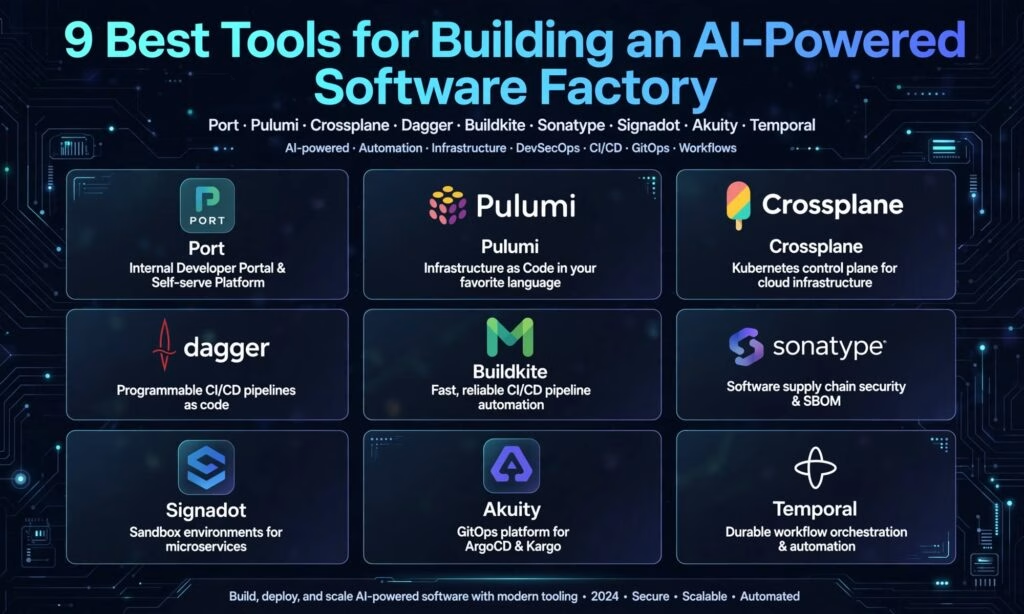
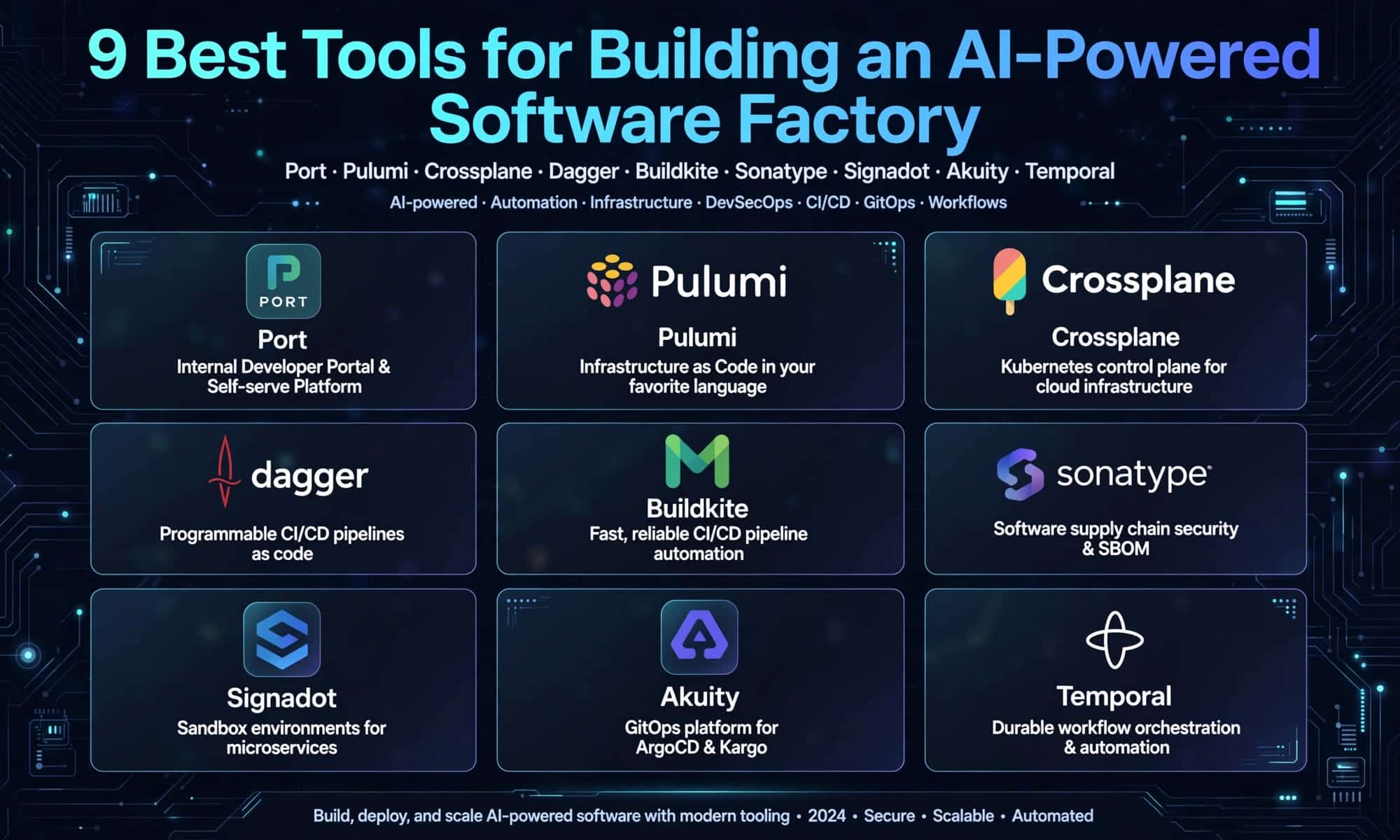
- Port: the model of the engineering estate that every layer above it depends on
- Pulumi: infrastructure provisioning written in general purpose programming languages
- Crossplane: provisioning exposed as a Kubernetes API rather than run as a script
- Dagger: portable pipelines that produce the same result on a laptop and in CI
- Buildkite: CI execution at the concurrency agents create, on your own compute
- Sonatype: control over which packages, models and artifacts enter the build
- Signadot: a real environment for every change, before the merge
- Akuity: GitOps delivery and promotion with identity-aware agent access
- Temporal: durable orchestration for agent work that runs for hours or days
Why the Order Matters More Than the Shortlist
Three dependencies decide whether a factory assembled from these parts actually runs:
- Governance needs a model. A policy engine with no inventory of services, owners and standards has nothing to attach a rule to. Buying governance before the model produces dashboards instead of enforcement.
- Verification needs determinism. When a build’s result depends on which machine ran it, a failure tells you nothing about the code an agent just wrote. Reproducibility comes before AI review, not after it.
- Autonomy needs a rehearsal space. Agents open far more changes than people do, and each one needs somewhere real to be tested. Without an environment per change, the queue becomes the bottleneck and review becomes a formality.
Skip a layer and the one above it degrades into reporting.
9 Best Tools for Building an AI-Powered Software Factory
1. Port
Port leads this list because it is the prerequisite layer rather than the most capable tool taken in isolation. Its context lake models the engineering estate as a live graph: services, ownership, dependencies, environments, resources, standards and operational metadata. That model is what makes every layer above it addressable. Scorecards have something to score, governance has something to attach a rule to, and an agent asked to fix a failing service can establish what the service is, who owns it, what it talks to and which standard it is currently violating before it touches anything.
The agent-facing side is built on the same model. Agent management holds a registry of agents with their skills, prompts and MCP server access, so permissions are declared rather than improvised. Governance covers role-based access, SSO, approvals and audit trails, which means an agent action runs through the same controls as a human one and leaves the same record.
Key features:
- Context lake modelling services, ownership, dependencies, resources and standards as a queryable graph
- Agent registry declaring each agent’s skills, prompts and MCP server access
- Governance with role-based access, SSO, approvals and audit trails applied to agent and human actions alike
- Scorecards that turn standards into measurable state, with agents able to act on degraded scores
- Workflows and self-service actions exposing bounded operations instead of raw system access
2. Pulumi
Pulumi declares infrastructure in TypeScript, Python, Go and other general purpose languages rather than a dedicated configuration syntax, with Pulumi Cloud holding state and ESC managing secrets. Infrastructure code then lives in the same repositories and passes the same review as application code, which matters once an agent proposes the change.
Key features:
- Infrastructure as code in general purpose languages, reviewed and tested like application code
- Pulumi Neo available in the terminal and as GitHub and Slack apps
- Agent accounts giving coding agents a scoped identity for unattended deployments
- ESC for secrets and configuration shared across stacks and environments
3. Crossplane
Crossplane turns infrastructure into Kubernetes APIs. Rather than running a provisioning tool, a platform team defines composite resources that developers and agents request declaratively, and a controller reconciles reality toward the request continuously. The project graduated in the CNCF in November 2025, and a request becomes a resource with a status to read rather than a command whose output has to be parsed, which suits AI agent work.
Key features:
- Infrastructure published as Kubernetes custom resources with continuous reconciliation
- Composite resources letting platform teams define what developers and agents are allowed to request
- Upbound Hub providing a queryable view of infrastructure state across clusters
- CNCF graduated project with a large provider ecosystem
4. Dagger
Dagger replaces shell scripts glued to a CI vendor with a portable DAG execution engine. Pipelines are written as code, run in just-in-time containers, cache at each step and produce the same result on a laptop as in CI. That determinism is what lets a failed build implicate the agent’s change rather than environment drift.
Key features:
- Pipelines as code in Go, Python, TypeScript and others, portable across CI vendors
- Automatic step-level caching and end-to-end tracing through Dagger Cloud
- Native LLM primitive with typed sandboxes, introduced as experimental
- Modules servable as MCP servers, with external servers attachable to a pipeline
5. Buildkite
Buildkite runs the control plane while the customer runs the compute, an unusual split in hosted CI and a deliberate one. Build agents run on the customer’s own infrastructure, so jobs reach internal services and self-hosted fleets without a tunnel. The company cites deployments above one hundred thousand concurrent agents and names Uber among its users, putting it among the few CI products proven at the concurrency agent fleets produce.
Key features:
- Hybrid model with a hosted control plane and customer-run build agents
- Demonstrated operation at very high agent concurrency
- MCP server plus model providers for calling models inside pipeline steps
- Pipeline triggers letting agents start builds from build events
6. Sonatype
Sonatype governs what enters and leaves a build. Nexus Repository stores artifacts and models, with Hugging Face among its supported formats. Repository Firewall blocks malicious packages at the registry boundary before they reach a developer or an agent, and SBOM Manager produces the bill of materials regulated buyers ask for. The suite now sits under the Nexus One platform, launched in November 2025.
Key features:
- Artifact and model repository with a free self-hosted community tier
- Repository Firewall blocking known-malicious packages at the registry boundary
- MCP server supplying coding assistants with current dependency intelligence
- Agent P applying and validating dependency updates before review
7. Signadot
Signadot gives every change its own environment without cloning the stack. A sandbox duplicates only the services a change touches and shares the rest of an existing baseline such as staging, with request routing handled by a lightweight sidecar. One more environment costs one more pod rather than one more cluster, which keeps the model viable when agents open many changes a day.
Key features:
- Sandboxes duplicating only changed services against a shared baseline environment
- Deterministic validation Plans that agents author and rerun without token cost
- Smart Tests comparing a changed service against baseline behaviour
- Operator running in customer clusters with a managed control plane
8. Akuity
Akuity is managed Argo CD from the people who created it, paired with Kargo, a promotion engine moving an artifact through development, staging and production with the commit trail intact. Teams tend to arrive when self-managed Argo CD stops scaling, and Akuity’s case studies include a migration at forty thousand applications.
Key features:
- Managed Argo CD with Kargo promotion across environments
- Agentic Control Plane authenticating agent requests as the connecting user
- Existing approvals, role bindings and audit trails applied to agent actions
- Akuity Intelligence for incident detection and runbook execution
9. Temporal
Temporal handles the work that outlives a process. A workflow’s state is reconstructed from an event history rather than held in memory, so execution survives crashes, restarts, deploys and waits lasting days. Factories reach for it when a task cannot live in a request handler: a migration across hundreds of services, a release that pauses for human approval, an agent loop retrying for an hour.
Key features:
- Durable execution replaying workflow state from an event history after any failure
- Long-running workflows that wait for approvals or external events for days
- SDKs in Go, Java, Python, TypeScript, .NET and PHP
- Integrations with major agent frameworks, plus an early-access Agent Harness
The Question an MCP Server Does Not Answer
Almost every vendor in this category now ships an MCP server, which makes it tempting to treat the agent question as solved. It is not, because an MCP server describes what an agent can reach, not what it is allowed to do.
- Whose permissions does the agent hold? Most servers run on a service token with whatever scope it was issued. The stronger pattern authenticates each request as the person who connected the agent, so existing roles and approvals continue to apply.
- What remains after the agent acts? A tool call that leaves no attributable record is untraceable the moment something breaks. Ask whether agent actions land in the same audit trail as human ones, with the same retention.
Put both questions to every vendor on a shortlist, before the proof of concept.
Frequently Asked Questions
What is an AI-powered software factory?
It is an engineering environment where producing and shipping software is a repeatable, governed process rather than a set of local habits, and where agents do a meaningful share of the work inside it. The distinguishing feature is not the presence of AI but the presence of standard paths, quality gates and an audit trail that hold when a machine is the actor.
Does the build order really matter, or can layers be added in any sequence?
Order matters because the dependencies are real. Governance applied before anything models the estate produces reports rather than enforcement, and AI code review applied before builds are reproducible cannot distinguish a bad change from a flaky environment. Layers can be bought in any sequence, but they only start working in roughly this one.
Can an existing CI/CD platform become a software factory on its own?
Not by itself. CI/CD executes a pipeline, which is one station on the line. A factory also needs a model of what exists, provisioning that developers and agents can request, environments for verifying changes, a gate on what enters the build, and a record of who or what changed production. Most organisations already own the pipeline and are missing the rest.