
Key Takeaways
- The model is the smaller part of the problem. Context, memory, guardrails, evaluation, and cost control decide whether operational agents can be trusted in production.
- Komodor is the top agentic operations platform for platform engineers, giving teams one place to build, run, govern, and optimize AI agents that operate production on Kubernetes and the cloud.
- Platforms differ in how much they let teams customize and extend agents, from closed AI SRE products to open frameworks that require heavy engineering.
- Platform engineers should evaluate governance, observability of the agents themselves, and fit with existing tooling before comparing agent features.
A year ago, most conversations about AI in operations centered on a single assistant that could summarize alerts or suggest a kubectl command. That picture has changed quickly. Engineering organizations now run several agents at once: one investigates incidents, another hunts for idle cloud spend, another reviews risky releases, and internal teams keep writing new ones from their own runbooks and scripts.
Someone has to decide where those agents run, what they can touch, how they are tested, and what they cost. In most organizations, that responsibility lands on platform engineering. The same teams that built golden paths and internal platforms for developers are now being asked to provide a safe, consistent foundation for operational AI agents. Agentic operations platforms exist to give them that foundation.
What an Agentic Operations Platform Actually Is
An agentic operations platform is the infrastructure that lets organizations build, deploy, govern, and improve AI agents that act on production systems. It sits between the language models and the environments the agents operate in, and provides everything an agent needs to work reliably beyond the model itself.
Most platforms in this category share a common set of building blocks:
- Agents and workflows: ready-made agents for common operational jobs, such as incident investigation, alert triage, and cost optimization, along with a way to build custom ones.
- Context and memory: knowledge of clusters, services, owners, dependencies, recent changes, and past incidents, so agents do not start every investigation from zero.
- Runtime and orchestration: a central place to deploy agents, trigger them from alerts, schedules, chat, or pull requests, and chain them into end-to-end workflows.
- Governance: access control for agents as well as humans, policy checks on what agents read and do, approvals for risky actions, and full audit trails.
- Evaluation and optimization: testing agents against known scenarios, monitoring quality over time, routing work to cost-effective models, and enforcing budgets.
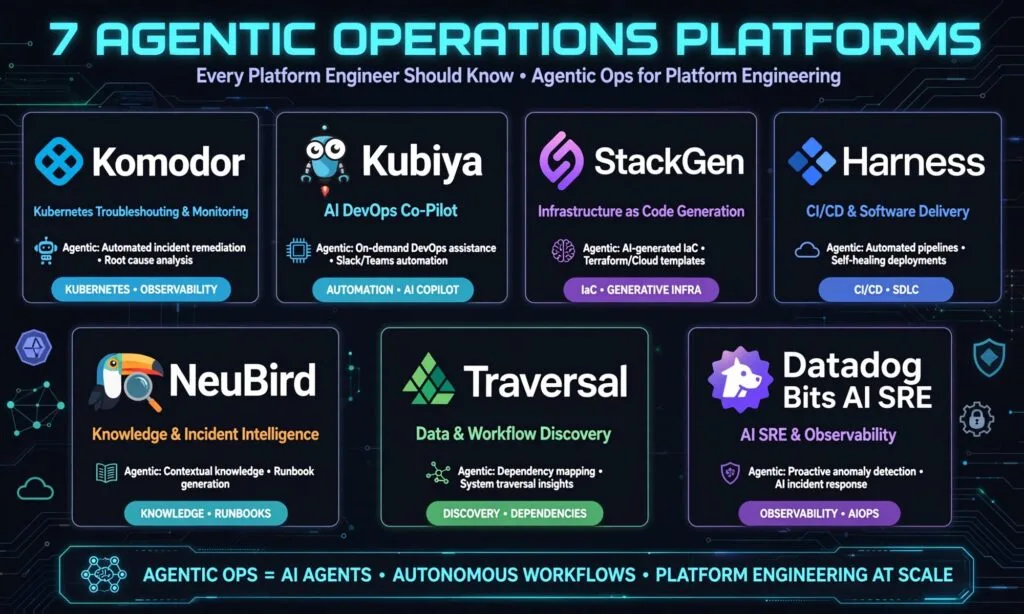
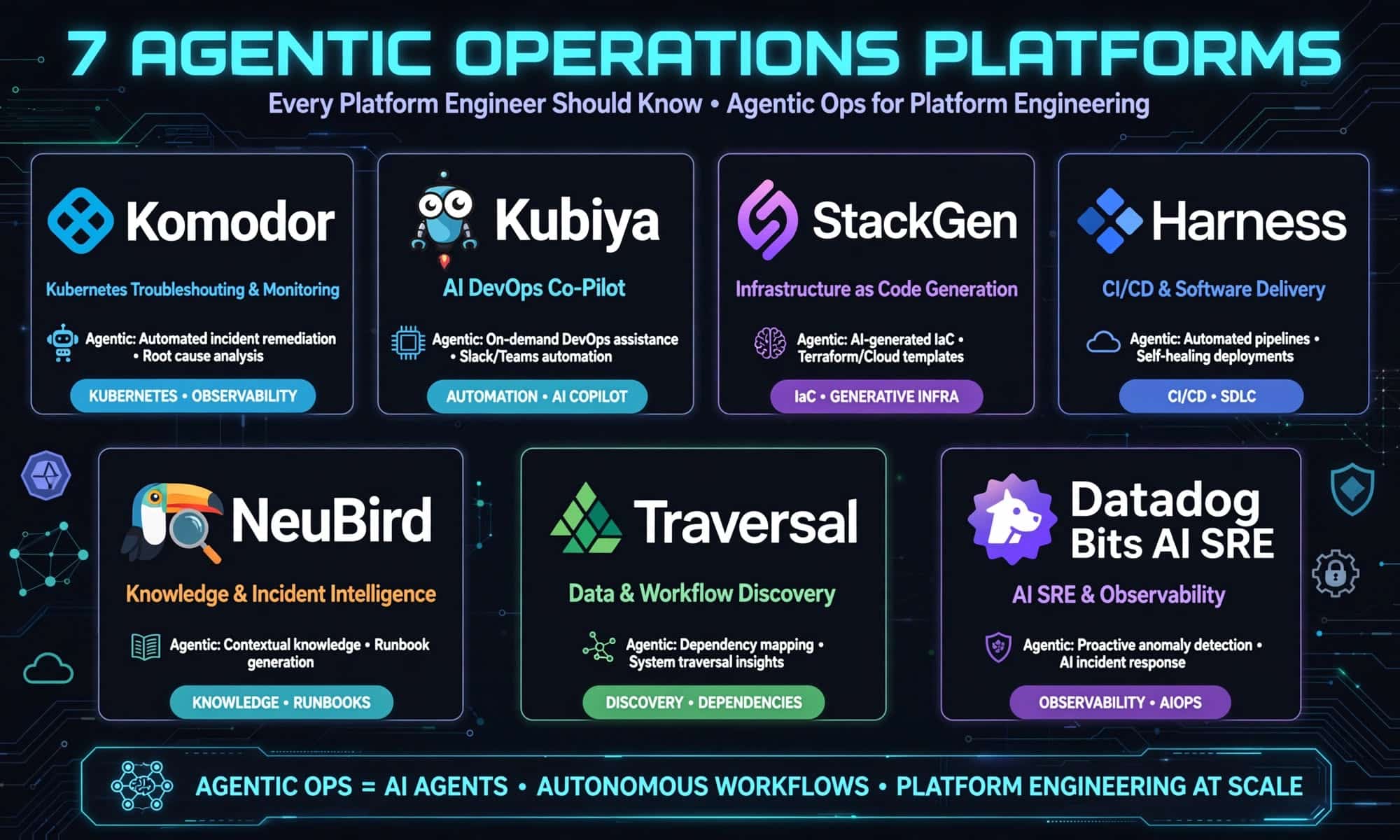
The 7 Agentic Operations Platforms Every Platform Engineer Should Know
1.Komodor
Many products in this space give teams either a finished AI SRE they cannot change or a framework they must build everything around. Komodor positions itself as the Agentic Operations Platform for production: one platform to build, run, govern, and optimize everything on Kubernetes. In its own words, it provides the 85% of the solution beyond the LLM, the infrastructure that makes operational agents dependable in real environments.
Teams can start with more than 50 out-of-the-box agents, including agents for Kubernetes investigations, AWS cost analysis, and GitHub release risk. These are packaged into modules that cover the full loop from trigger to investigation, validated action, team notification, and documentation. AI SRE modules handle incident management and troubleshooting, alert hygiene, and proactive reliability optimization. Cost optimization modules address Kubernetes, cloud, and observability spend. AI software operations modules cover change intelligence and risk control, production readiness and standards, and CI/CD health and remediation. Unlike a closed AI SRE, each module can be inspected and customized.
For platform engineers, the build and run layers are where Komodor stands out. A framework-agnostic Python SDK turns existing skills, scripts, and runbooks into governed agents, and teams can bring agents built with tools such as the Claude Code SDK, Codex, Google ADK, or LangChain. Every agent, whether built by Komodor or by the customer, inherits the same shared layer: a continuously updated knowledge graph of services, owners, and dependencies, cluster and change history, a knowledge base of runbooks and policies, and agent memory that recalls past incidents and remediations across runs. Agents can be triggered by alerts, schedules, chat, or pull requests and combined into end-to-end workflows from a central control plane, with cost and performance visible for every run.
Governance and optimization are built into the platform rather than added later. Scoped RBAC applies to humans and agents alike, and a policy gate on inputs, tool calls, and outputs can allow, redact, block, or hold an action for approval, with higher-risk steps routed to a teammate along with the agent’s reasoning. Spend caps and rate limits apply per agent, team, or label, and organizational standards such as approved models, budgets, guardrail coverage, and evaluation minimums are enforced before an agent is deployed. Continuous evaluation, versioned golden-scenario tests built from years of real incidents, shadow testing against production traffic, and routing of simple steps to cheaper models keep quality high and costs under control.
Key features:
- 50+ out-of-the-box agents packaged into customizable modules
- AI SRE, cost optimization, and AI software operations modules
- Framework-agnostic Python SDK to turn runbooks and scripts into governed agents
- Shared knowledge graph, change history, knowledge base, and agent memory
- Central control plane with triggers from alerts, schedules, chat, and pull requests
- Scoped RBAC, policy gates, human approvals, spend caps, and audit trails
- Continuous evaluation, golden-scenario tests, shadow testing, and model routing
- Support for EKS, GKE, AKS, self-managed Kubernetes, on-premises, and managed cloud
2. Kubiya
Kubiya focuses on bringing AI agents into platform engineering and DevOps workflows. It provides an environment for building and running agents that automate infrastructure and operational tasks, with an emphasis on deterministic execution, enterprise controls, and integration with existing tools.
Kubiya has framed its approach around agentic engineering for the enterprise, aiming to move agents from experiments into production. Platform teams evaluating it should look closely at which ready-made operational workflows are available versus what they will need to build, and how much operational context agents receive out of the box.
Key features:
- Platform for building and running operational AI agents
- Focus on platform engineering and DevOps automation
- Enterprise access controls and policies
- Integrations with common infrastructure tools
3. StackGen
StackGen approaches agentic operations from infrastructure. Its platform uses AI agents to generate, manage, and govern infrastructure as code, helping platform teams provision cloud resources that comply with organizational standards and keep infrastructure aligned over time.
For platform engineers whose main pain point is infrastructure delivery and drift, StackGen’s focus on infrastructure automation is a natural fit. Its emphasis is on the provisioning side of operations rather than incident investigation or production troubleshooting.
Key features:
- AI agents for infrastructure as code generation and management
- Policy and compliance enforcement for cloud infrastructure
- Drift detection and remediation
- Self-service infrastructure for developers
4. Harness
Harness brings AI agents into the software delivery pipeline. Its platform spans continuous integration, continuous delivery, feature management, cloud cost management, and related capabilities, with AI features that help create pipelines, verify deployments, and troubleshoot failures.
Platform teams that already run delivery on Harness can extend into AI-assisted operations within the same environment. Its agents are closely tied to the delivery lifecycle, so incident investigation across the wider production stack typically requires additional tools.
Key features:
- AI agents across CI/CD and delivery
- Deployment verification and automated rollback
- Cloud cost management
- Pipeline creation and troubleshooting assistance
5. NeuBird
NeuBird offers Hawkeye, an AI SRE agent that investigates incidents by reasoning across telemetry from existing observability, cloud, and ticketing tools. It aims to reduce the time engineers spend gathering data and forming hypotheses during incidents.
NeuBird is centered on incident investigation and root cause analysis. Platform teams that want a focused AI SRE capability can adopt it alongside existing tooling, while broader needs such as building custom agents or governing a fleet of operational agents fall outside its core scope.
Key features:
- AI SRE agent for incident investigation
- Reasoning across existing telemetry sources
- Root cause analysis and remediation suggestions
- Integration with observability and ticketing tools
6. Traversal
Traversal builds an AI SRE designed for large, complex production environments. It analyzes logs, metrics, traces, and code to identify the root cause of incidents, with a focus on handling the scale and noise of enterprise systems.
Its strength is deep investigation across complex systems. Like other dedicated AI SRE products, it is primarily focused on incident response rather than providing a platform for building, governing, and optimizing many types of operational agents.
Key features:
- AI SRE for complex enterprise environments
- Root cause analysis across logs, metrics, traces, and code
- Focus on reducing investigation time during incidents
- Integration with existing observability data
7. Datadog Bits AI SRE
Datadog extends its observability platform with Bits AI SRE, an agent that investigates alerts and incidents using the telemetry Datadog already collects. It forms hypotheses, tests them against data, and summarizes findings for on-call engineers.
For organizations heavily invested in Datadog, Bits AI SRE adds investigation capabilities with minimal setup. Its effectiveness depends on how much of the environment Datadog observes, and it is designed primarily around Datadog’s own data and workflows.
Key features:
- AI SRE agent within Datadog
- Automated alert and incident investigation
- Hypothesis testing against observability data
- Summaries for on-call engineers
Questions Platform Engineers Should Ask Vendors
Before shortlisting an agentic operations platform, platform teams should work through these questions with each vendor:
- Can we see why an agent reached a conclusion? Ask for the evidence trail behind investigations and actions. Opaque reasoning makes it difficult to trust agents in production or to improve them over time.
- Can we build and bring our own agents? Check whether you can turn existing runbooks and scripts into agents and import agents built on other frameworks, and whether those agents receive the same context and guardrails as the vendor’s own.
- What context do agents start with? Confirm whether agents can use service ownership, dependencies, change history, and past incidents, or whether each investigation starts cold.
- How are agent permissions controlled? Look for scoped access per agent, policy checks on tool calls and outputs, approvals for risky actions, and audit trails that security teams can review.
- How do you test and measure agent quality? Ask about evaluation against real scenarios, regression testing, and the ability to test new agent versions safely before promoting them.
- How do we control cost? Confirm visibility into cost per run, per agent, and per team, along with budgets, rate limits, and the ability to route simpler work to cheaper models.
- Will it fit our environment? Verify support for your Kubernetes distributions, clouds, on-premises requirements, models, and existing observability and ticketing tools.
Vendors that answer these questions clearly are far more likely to deliver agents that platform teams can operate with confidence.
FAQ
What is an agentic operations platform?
An agentic operations platform is infrastructure for building, running, governing, and optimizing AI agents that act on production systems. It provides ready-made agents and workflows, shared operational context and memory, access controls and approvals, and tools for evaluating agents and managing their cost.
How is an agentic operations platform different from an AI SRE tool?
An AI SRE tool usually focuses on investigating incidents with a fixed set of capabilities. An agentic operations platform covers a broader range of operational jobs, such as cost optimization and change risk, and lets teams build, customize, and govern their own agents alongside ready-made ones.
Why should platform engineering teams own agentic operations?
Operational agents use the same clusters, pipelines, cloud accounts, and permissions that platform teams manage. Centralizing agents on a shared platform prevents sprawl, applies consistent security controls, and gives the organization one place to manage agent quality and cost.
Can agentic operations platforms work with existing agent frameworks?
Some can. Komodor, for example, offers a framework-agnostic SDK and supports agents built with frameworks such as the Claude Code SDK, Google ADK, and LangChain, so teams can bring existing work into a governed environment.
How do teams keep operational AI agents safe?
Safety comes from scoped permissions for each agent, policy checks on inputs, tool calls, and outputs, human approval for higher-risk actions, spend limits, and complete audit trails. Testing agents against real scenarios before deployment adds a further layer of confidence.
Do agentic operations platforms only work on Kubernetes?
Many are built with Kubernetes at their core because it underpins most modern production environments, but leading platforms also cover cloud services, serverless workloads, on-premises infrastructure, CI/CD, and observability tooling.