
No data team would load an unvalidated table into a production warehouse. Yet many teams push AI-generated text, including translations, straight into products, contracts, and support flows with no quality score attached.
The reason is simple. A single AI output looks equally confident whether it is right or wrong. There is no null value, no failed schema check, no anomaly flag.
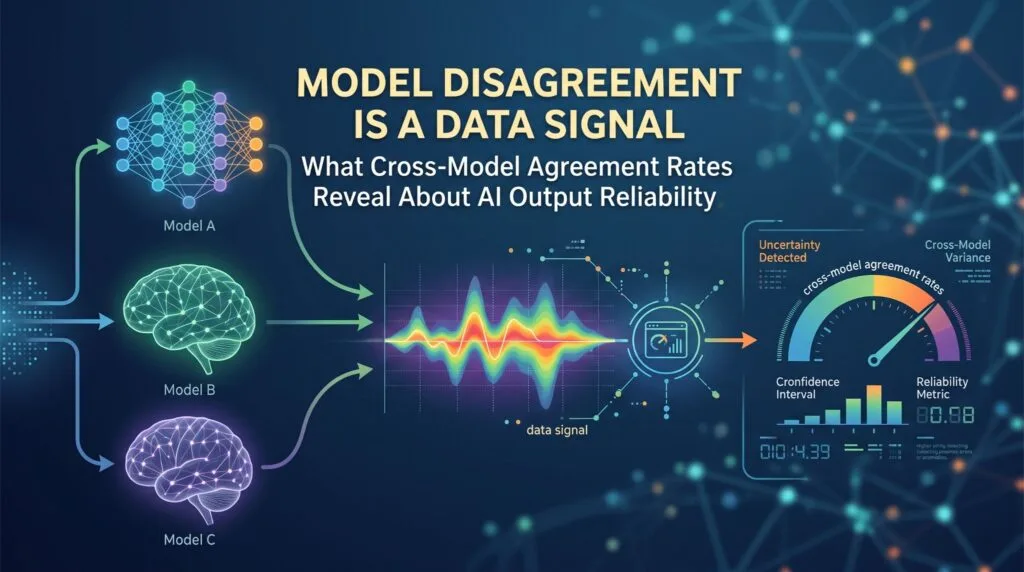
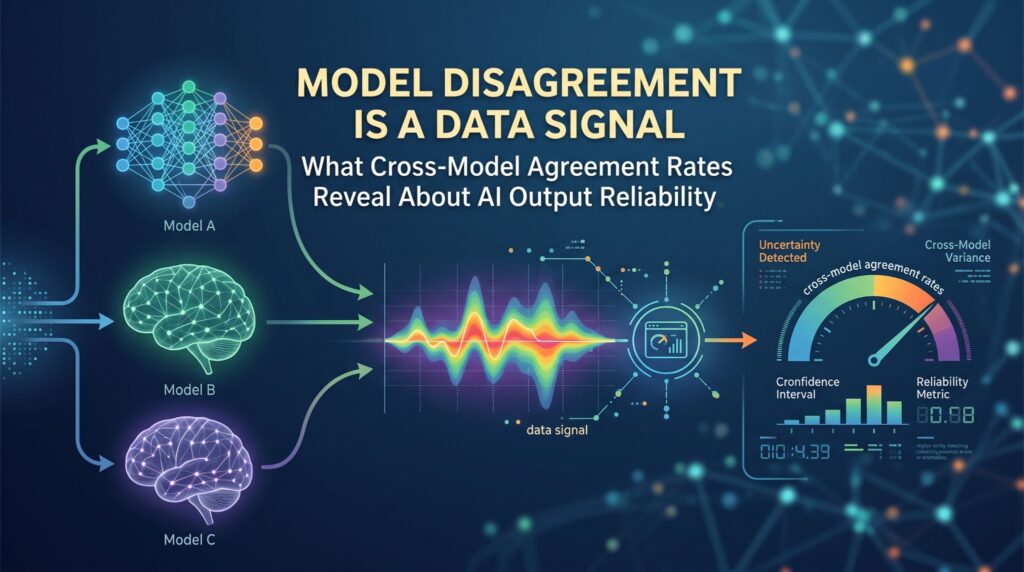
My argument is that the most practical reliability metric for AI output already exists, and most pipelines throw it away: the rate at which independent models agree. Below is what three months of agreement data across our ten highest-volume language pairs at MachineTranslation.com shows, where the signal breaks down, and how to turn it into a triage rule you can log and audit.
Key Takeaways
- A single AI output carries no information about its own reliability. Disagreement across independent models does.
- Across MachineTranslation.com’s ten busiest language pairs, average model agreement ranged from 83.6% to 91.9% over three months.
- Agreement did not follow language resourcing: English to Spanish, one of the best-resourced pairs, ranked second to last at 83.8%.
- Majority agreement is not ground truth. Research on self-consistency shows majority votes can miss correct answers that a minority of samples already found.
- Agreement rate plus a list of disputed terms gives data teams a loggable triage rule: ship at 90%+ with zero or one disputed term, review below that.
Table of Contents
- Why a single AI output says nothing about its own reliability
- How cross-model agreement works as a measurable signal
- What three months of agreement data across ten language pairs shows
- Does a well-resourced language mean more reliable output
- Where agreement misleads: shared blind spots and false consensus
- A triage framework data teams can log and audit
- Questions and answers
Why a single AI output says nothing about its own reliability
A large language model returns fluent text whether it is correct or not, so the output alone carries no reliability signal.
In classic data pipelines, bad data usually fails loudly. A malformed record breaks a join, a range check trips, a dashboard spikes. AI output fails quietly. A mistranslated contract term reads just as smoothly as a correct one.
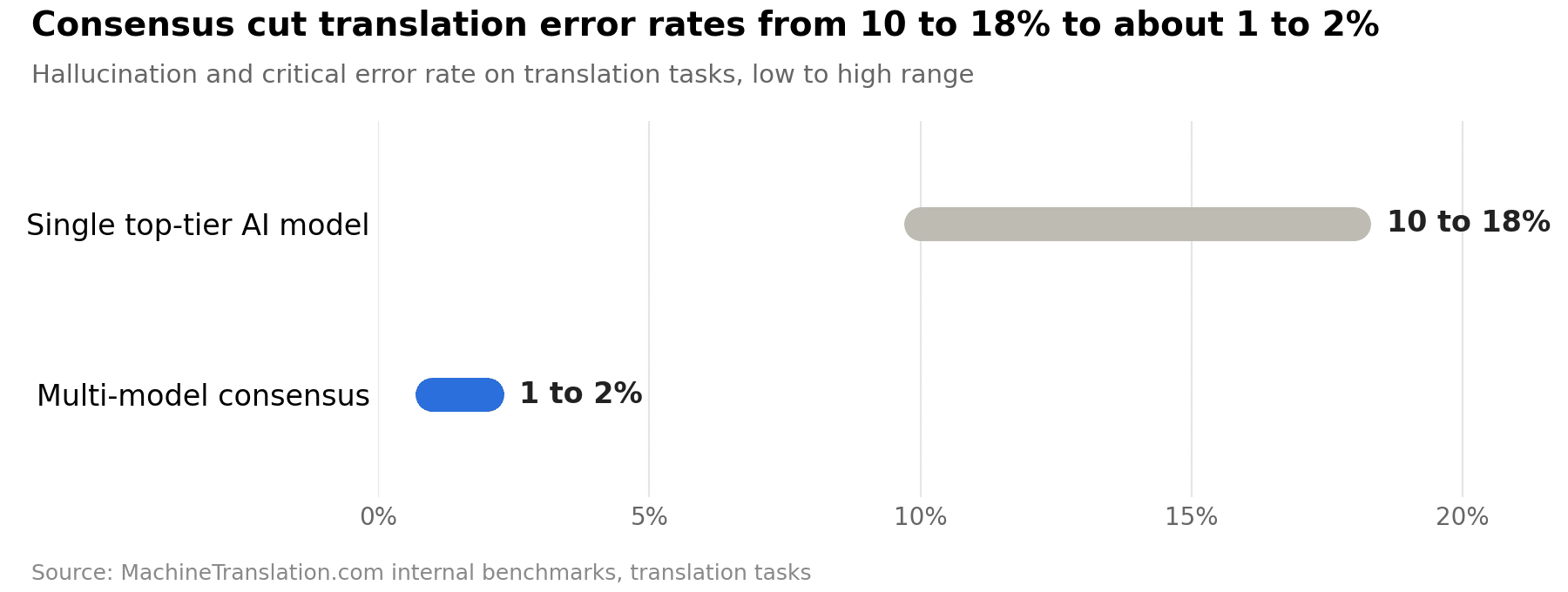
The cost is measurable. In an IBM Research study of 34 users completing 272 data-generation tasks, hallucinated AI text significantly reduced the quality of the data people produced, and users who overrelied on the AI did worst. On translation specifically, individual top-tier AI models carry a hallucination rate of 10 to 18 percent, according to MachineTranslation.com internal benchmarks.
Big Data Analytics News recently made the case that AI agent observability needs an action ledger, not just model traces. I would add one more column to that ledger. Most teams log what a model said. Very few log whether other models would have said the same thing.
How cross-model agreement works as a measurable signal
Run the same input through several independent models, and the share that land on identical wording becomes the agreement rate.
At MachineTranslation.com, an AI translation tool, every translation runs through multiple independent models such as ChatGPT, Claude, Gemini, DeepSeek, and Mistral. Our research on how often AI models actually agree uses a four-step method:
- Run every qualifying translation through multiple independent models rather than one.
- Record the share of models that produce identical wording. That share is the agreement rate.
- Flag every term where models split, individually, instead of averaging it away.
- Exclude our own consensus system, SMART, from every comparison, because it is built from the other models’ outputs and would win by construction.
That last step matters for anyone building metrics. “We left our own consensus system out of the agreement research on purpose,” says Rachelle Garcia, Head of AI at MachineTranslation.com. “A metric that wins by construction is not a metric.”
The payoff of selecting the majority-agreed output is large.
Source: MachineTranslation.com internal benchmarks, translation tasks
That is roughly a 90 percent reduction in errors versus relying on a single AI model.
What three months of agreement data across ten language pairs shows
Average agreement across our ten highest-volume language pairs ranged from 83.6% to 91.9%, and only two pairs cleared 90% on average.
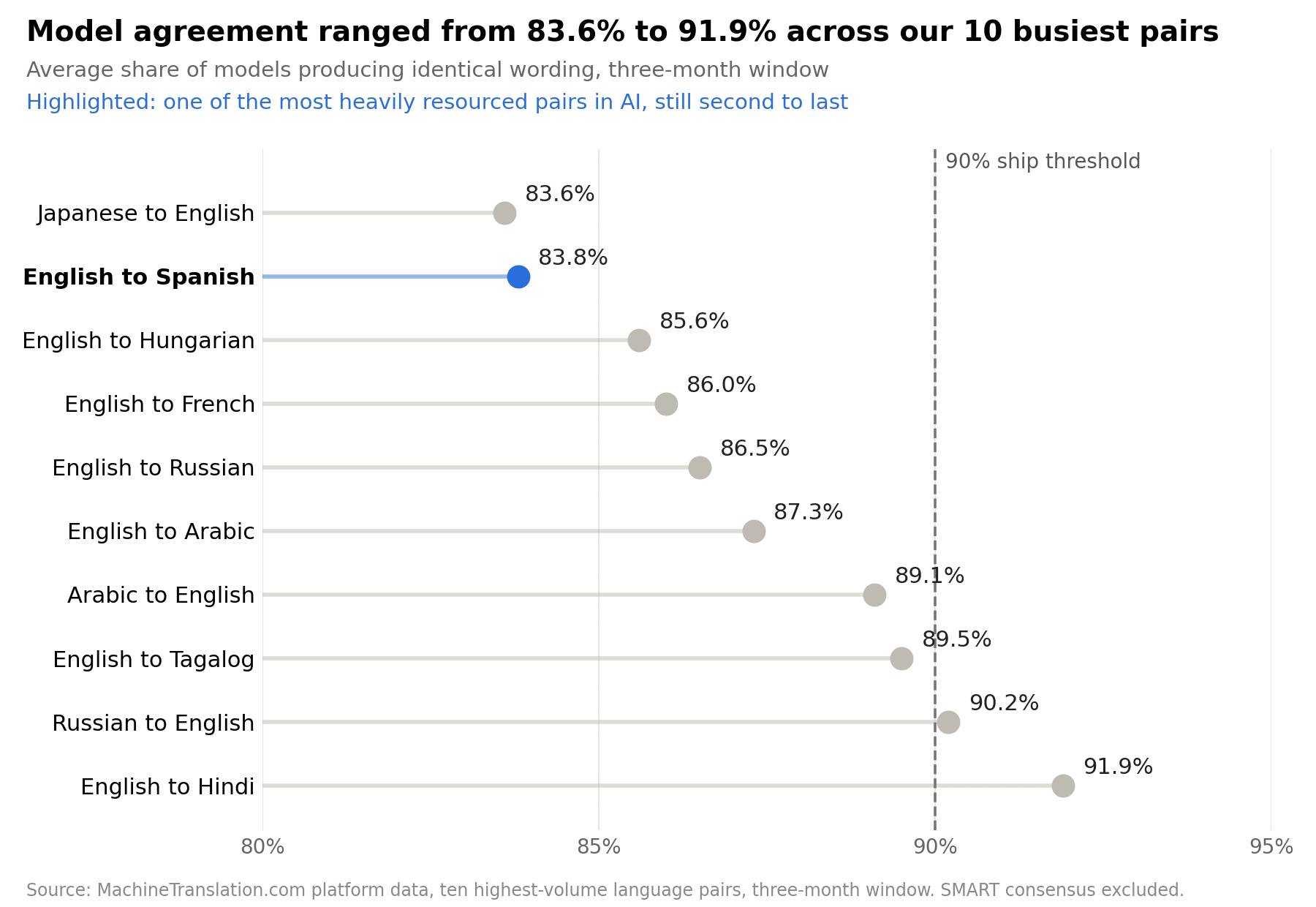
Source: MachineTranslation.com platform data, ten highest-volume language pairs, three-month window. SMART consensus excluded.
That spread is uncertainty a single-model pipeline never sees. If you run one model, every output on that chart would look identical to you: fluent, confident, and unscored.
The signal gets more useful at the level of a single translation. MachineTranslation.com’s “Your Translation, Wrapped” panel reports, after each translation, how many models ran, what share agreed, and which terms they split on. One example: six models, 92% agreement, four disputed terms, consensus in 1.6 seconds.
“This is where multi-engine translation stops being a convenience feature and becomes a quality mechanism,” says Rachelle Garcia. “When four models agree and one diverges on a title translation, that divergence is information.”
Does a well-resourced language mean more reliable output
No. Among our ten busiest pairs, agreement did not rank the way language resourcing would predict.
English to Spanish is one of the most heavily resourced pairs in AI, with vast amounts of parallel training text. It still ranked second to last at 83.8%. English to Hindi ranked first at 91.9%, and English to Tagalog beat English to French.
This matters for how teams allocate review effort. Many route human review by assumed difficulty: “hard” languages get checked, “easy” ones ship. Agreement data says to route by measured disagreement instead.
Resourcing does matter at the extremes. An internal review of requests processed between January and April 2026 found that low-resource pairs such as Haitian Creole, Tamazight, Malagasy, Twi, and Akan showed measurably higher cross-model disagreement than high-resource pairs.
That is also where single-model output is most dangerous. “Our platform data shows that the gap between single-model output and AI-verified output is widest in exactly the language pairs where users are least able to verify the result themselves,” says Rachelle Garcia.
Where agreement misleads: shared blind spots and false consensus
High agreement measures convergence, not correctness. Models that share a blind spot will agree on the same wrong answer.
The research community has studied this closely. The original self-consistency paper showed that sampling several answers and taking the majority vote significantly improves the reasoning accuracy of large language models. Later work found the limits:
- A 2026 ACL paper, Boosting Self-Consistency with Ranking, reports that majority voting often fails to recover correct answers already present among the samples.
- Mirror-Consistency improved both accuracy and confidence calibration by examining minority responses instead of discarding them.
We see the same pattern in translation data. In one Hebrew idiom test, the dominant cluster of models was wrong, and consensus landed at the center of that cluster rather than on the correct answer.
“High agreement is not proof,” says Rachelle Garcia. “When most models share a blind spot, consensus lands in the middle of that blind spot, which is why low-agreement segments are where human review earns its cost.”
The practical lesson for data teams is to treat disagreement as data, not noise. “A disputed term is more useful than an overall score,” Garcia adds, “because it tells the reviewer exactly where to look.”
A triage framework data teams can log and audit
Treat agreement rate and disputed-term count as two columns in your quality log, and route every AI output by them.
| Signal on a segment | Action |
|---|---|
| 90% or higher agreement, zero or one disputed term | Ship as-is for most business content |
| Mid-80s agreement, or several disputed terms in one sentence | Send the flagged terms to a reviewer |
| Any score on legal, medical, or financial content | Human review before release |
Here is how to put it into a pipeline:
- Run every high-stakes output through multiple independent models. One model cannot score itself.
- Log agreement rate and disputed terms per segment, next to the output, the models used, and a timestamp.
- Apply the thresholds above. Start with 90% and tune it against your own review findings.
- Route only the disputed terms to reviewers. A reviewer checking four flagged terms works faster than one rereading a whole document.
- Keep the scores with the output for audits. When someone asks why a translation shipped, the answer is in the log.
The last step mirrors the principle behind audit-ready data pipelines in BFSI: a correct number is not enough, you also need to show how it was validated. If you would never ship an unvalidated dataset, you should not ship an unscored translation.
To see the signal on a real document, look at how models handled a Portuguese governing law clause translated to English. The page shows how each model rendered terms like “litígio” and “jurisdição exclusiva”, and which version consensus selected.
Questions and answers
Is high model agreement the same as accuracy?
No. Agreement measures how closely models converge, not whether they are right. Models that share a blind spot can agree on the same wrong answer, so disputed terms and minority outputs still deserve a look.
Can agreement rate be logged like other data quality metrics?
Yes. It is one number per segment plus a list of disputed terms. Both fit in the same quality log, dashboard, and audit trail as any other validation check.
Does agreement track how well-resourced a language is?
No. In our three-month data, English to Spanish ranked near the bottom while English to Hindi ranked first. Review effort should follow measured disagreement, not assumptions about language difficulty.
Conclusion
Data engineering spent years teaching pipelines to reject bad data loudly. AI output needs the same discipline, and disagreement between independent models is one of the cheapest validation signals available.
Start small: pick one document type where a wrong term costs money, score it with agreement rates for a month, and compare the flagged terms against what your reviewers actually correct. If you want a working example first, run a sample contract clause through MachineTranslation.com and see exactly where the models split.
William Mamane is CMO at Tomedes, the professional translation company behind MachineTranslation.com.