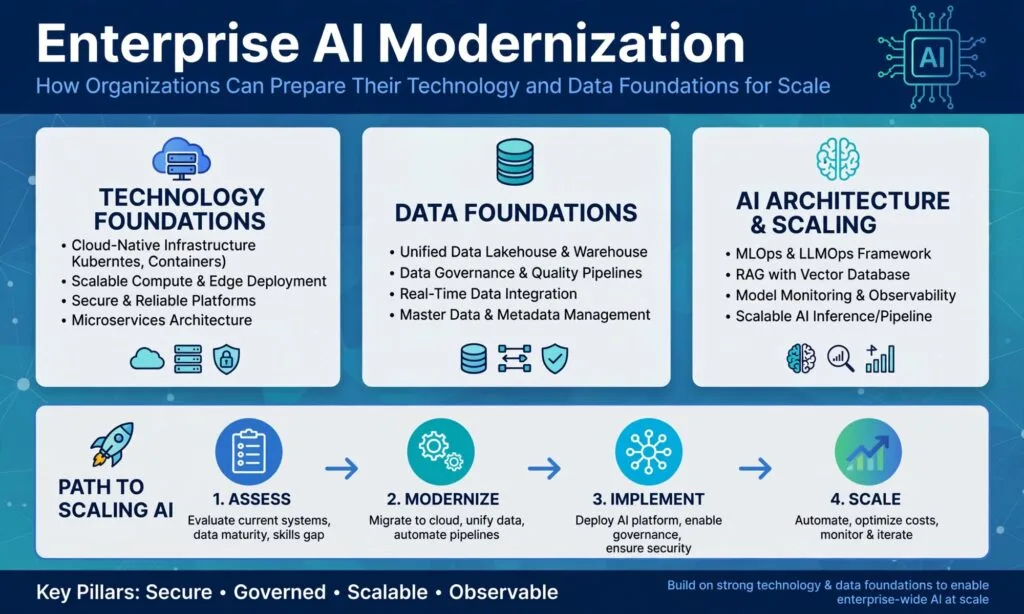

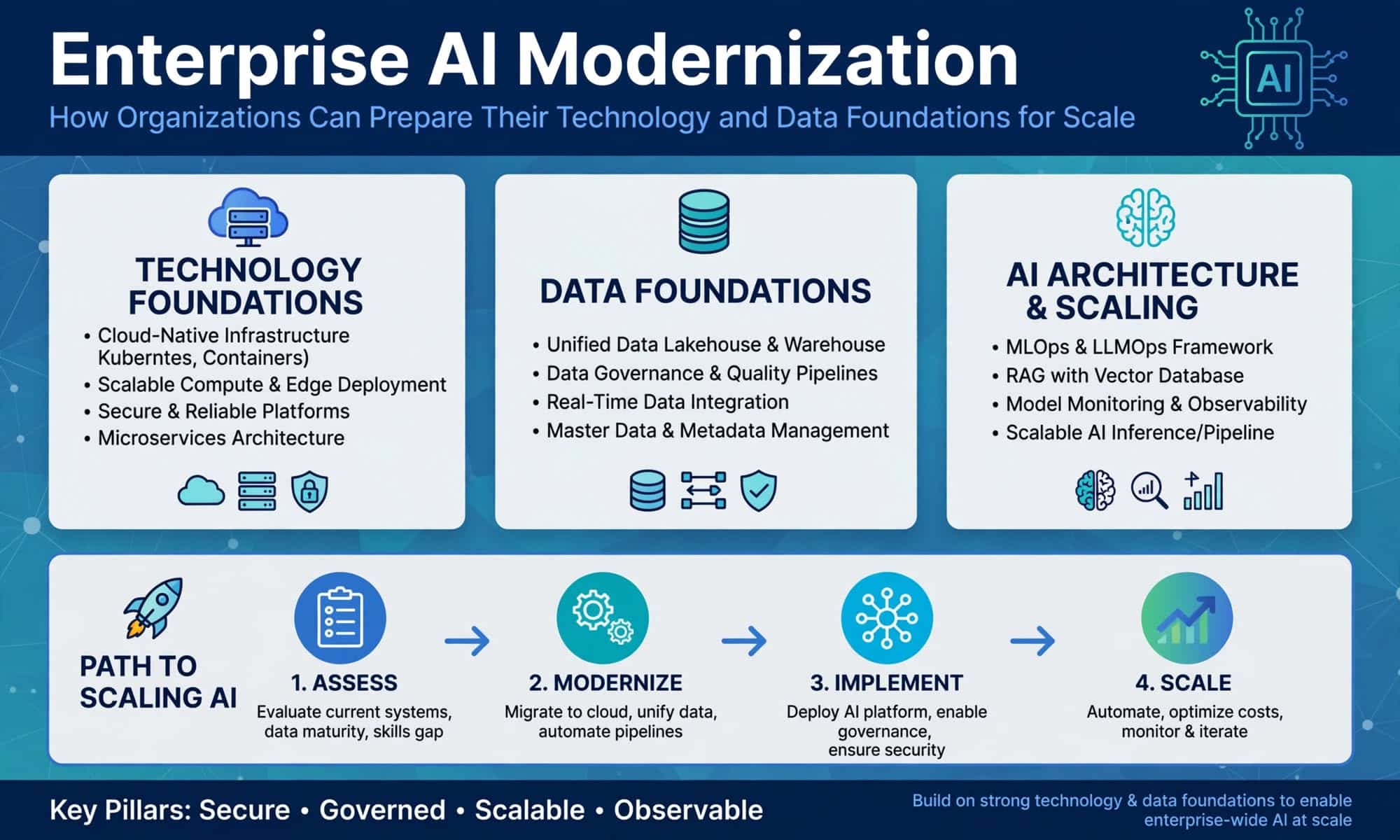
An AI pilot can run successfully on a small dataset, a handful of users, and considerable attention from an engineering team. Enterprise deployment is a different proposition.
Once an AI system begins serving thousands of employees, customers, or automated workflows, it must interact with databases, applications, documents, identity systems, APIs, and infrastructure that were often designed long before generative and agentic AI became part of the technology roadmap. That is where modernization becomes important.
The question is no longer whether an organization can connect a model to its data. It is whether its technology environment can support repeated data retrieval, model changes, real-time processing, security controls, monitoring, and rising compute requirements without creating a separate technology stack for every AI application. For technology leaders, the task is therefore broader than upgrading infrastructure. It involves making the data, applications, integration layer, computing environment, and governance model work together.
AI exposes weaknesses that conventional applications could tolerate.
Many enterprise systems were built around relatively predictable transactions. An ERP system records an order. A CRM system stores a customer interaction. A warehouse system tracks inventory. A reporting platform processes data on a scheduled basis.
AI applications behave differently.
A customer-service agent may need to retrieve a current order, search a product manual, check a policy document, and interpret a previous interaction before generating a response. An internal knowledge assistant may need to search thousands of documents while respecting the access rights of the person asking the question. The underlying systems may each work correctly in isolation.
The difficulty appears when information has to move between them. Common constraints include:
- Disconnected data: Important information remains distributed across applications, databases, and file repositories.
- Delayed pipelines: Batch-oriented processes may leave AI systems working with information that is no longer current.
- Inconsistent definitions: Different departments may use different meanings for the same customer, product, or transaction.
- Limited interfaces: Older applications may expose information through interfaces that are difficult to integrate with modern AI workflows.
- Broad permissions: Existing access models may not map neatly to retrieval-based AI applications.
- Hidden dependencies: A seemingly simple AI application can depend on several upstream systems and services.
The result is an important modernization principle:
Do not modernize every system simply because it is old. Modernize the dependencies that prevent the AI workload from operating reliably. That distinction can prevent large-scale replacement projects where selective integration or modernization would have been sufficient.
The data foundation needs more than a searchable repository.
AI has increased the importance of unstructured enterprise information. Contracts, engineering manuals, customer conversations, emails, service records, policies, and reports may contain information that never appears in conventional databases.
But making such content searchable does not automatically make it usable by AI. A document can be correctly stored but still create an unreliable answer if the system does not know:
- Which version is current
- Who owns the information
- What business process it belongs to
- Whether the user has permission to access it
- When the information was last updated
- Which structured records provide additional context
- How the content was transformed before retrieval
AI systems increasingly break unstructured information into multiple representations during extraction, chunking, and embedding. That means data quality must be considered across the transformation process rather than only when information first enters a repository.
Consider an equipment-maintenance assistant.
A technical manual may state one maintenance interval, while an updated service bulletin changes the requirement. Both documents can exist in the repository. A conventional search engine may return either one. An AI application needs enough metadata, version control, and retrieval logic to identify which information should be treated as authoritative. That is why an AI-ready data foundation needs context as well as content.
The practical data layer
| Capability | Enterprise requirement for AI |
| Data catalog | Identify available datasets, documents, and owners |
| Metadata | Preserve business context and relationships |
| Data lineage | Track where information originated and changed |
| Version control | Distinguish current information from historical records |
| Quality monitoring | Detect missing, stale, or inconsistent information |
| Access governance | Apply user and application permissions |
| Retrieval layer | Deliver relevant information to AI applications |
| Observability | Monitor data freshness, failures, and retrieval behaviour |
The objective should not be to make every dataset perfect.
A better target is fit-for-purpose data, with quality thresholds determined by the consequences of an incorrect AI output.
Avoid building a separate data pipeline for every AI project.
A common enterprise pattern is easy to recognize. One team builds a retrieval pipeline for customer documents. Another creates a separate pipeline for sales information. A third builds its own ingestion process for internal policies.
Each project may meet its immediate requirements.
Over time, however, the organization ends up maintaining several versions of the same customer information, multiple document indexes, and different definitions of data quality. That creates a second modernization problem: AI infrastructure itself becomes fragmented.
A reusable data architecture can reduce that risk by establishing common capabilities for:
- Ingestion: Connect applications, databases, files, APIs, and event streams.
- Transformation: Standardize formats, identifiers, and business definitions.
- Classification: Identify personal, confidential, regulated, and business-critical information.
- Storage: Place information according to performance, retention, and access requirements.
- Retrieval: Provide approved information to applications through consistent interfaces.
- Monitoring: Track freshness, pipeline health, quality, and usage.
- Governance: Apply policies consistently across data and AI workflows.
This model also makes future AI applications easier to deploy because teams can consume existing data services instead of rebuilding the underlying foundation.
Production AI needs an operating layer around the model.
The model is only one component of a production AI system. Once an organization operates several models or AI applications, new questions emerge.
Which model should handle a request? What happens when one model becomes unavailable? How should prompts be versioned? How can output quality be evaluated? What happens when a model is upgraded? How are inference costs tracked?
Those questions belong to the operational architecture surrounding AI.
Vyansa Intelligence estimates that the MLOps & AI Lifecycle Management Market will increase from USD 22.5 billion in 2026 to USD 80.27 billion by 2032, reflecting the growing requirement for model deployment, monitoring, lifecycle management, and governed production workflows. The same shift is visible in model orchestration.
Vyansa’s research projects the AI Model Orchestration & Prompt Management Market to grow from USD 2.5 billion in 2026 to USD 9.5 billion by 2032. The market covers capabilities such as model routing, prompt versioning, output monitoring, and orchestration across AI workloads.
For enterprise architects, the implication is straightforward: AI needs a control layer.
That layer can manage:
- Model selection and routing
- Prompt versions
- Evaluation workflows
- Guardrails
- Application-to-model connections
- Usage monitoring
- Cost tracking
- Failure handling
- Audit records
Without such a layer, every application team tends to build its own mechanisms.
Cloud is an architectural decision, not a modernization shortcut.
Moving an enterprise workload to the cloud can improve scalability, but cloud adoption alone does not make an architecture AI-ready. Different AI workloads create different infrastructure requirements.
Training workloads can require high accelerator capacity and large data throughput. Real-time inference can place greater emphasis on latency and availability. Document-heavy applications may depend more heavily on storage, indexing, and retrieval performance. Industrial applications can require local processing because sending every data point to a remote environment may not meet response-time requirements.
A modernization assessment should therefore examine the workload rather than start with a predetermined infrastructure destination.
| AI workload | Architecture questions |
| Model training | Compute availability, data throughput, accelerator capacity |
| Real-time inference | Latency, availability, scaling, and response consistency |
| Knowledge retrieval | Indexing, storage, metadata and source traceability |
| AI agents | Tool access, permissions, workflow execution, and monitoring |
| Edge AI | Local compute, connectivity, and response time |
| High-volume analytics | Data movement, processing cost, and storage architecture |
Hybrid environments can remain relevant where organizations have sensitive information, specialized infrastructure, regulatory requirements, or legacy systems that cannot be replaced quickly. There is also a physical infrastructure consideration that is easy to overlook.
The International Energy Agency projects global data-center electricity consumption to roughly double to around 950 TWh by 2030, while electricity use by AI-focused data centers is expected to grow faster than overall data-center consumption. For enterprise planners, compute capacity therefore cannot be separated entirely from power, cooling, facility capacity, and deployment timelines.
AI modernization eventually becomes an infrastructure-planning exercise as well.
Legacy applications do not always need to disappear
Replacing a core enterprise application can take years. That timeline does not necessarily align with an organization’s AI roadmap. A more practical approach is to identify where legacy systems create friction and introduce modern interfaces around them.
For example, an existing transaction system may continue operating as the system of record while an API layer exposes selected information to an AI application. Change-data-capture pipelines can move relevant updates into modern data environments without replacing the source system. Event-driven integration can allow downstream applications to respond to changes without repeatedly querying the legacy platform.
This creates a middle path between two extremes:
- Keep everything unchanged: AI becomes constrained by existing interfaces.
- Replace everything: modernization becomes a large transformation project unrelated to the immediate AI requirement.
The middle path is selective modernization. Organizations can retain systems that continue to perform their core functions while upgrading the interfaces, data flows, and services required around them.
That approach is particularly relevant for enterprises with decades of accumulated application dependencies.
Security must follow the data through the AI workflow
Traditional access control generally asks whether a user can access a particular system or record. AI adds another question:
What information can an application retrieve, combine, and pass into a model on behalf of that user?
Sensitive information can appear in source databases, document repositories, retrieval indexes, vector stores, prompts, logs, and generated outputs. A permission error at any stage can expose information beyond its intended audience. A modern AI security architecture therefore needs visibility across the complete data path.
NIST’s AI Risk Management Framework emphasizes managing AI risks across design, development, deployment, use, and evaluation, while its Generative AI Profile provides additional guidance for risks specific to generative AI. For enterprise architecture, several controls deserve particular attention:
- Identity: Every AI application and agent should have clearly defined identities and permissions.
- Data classification: Sensitive information should be identifiable before it enters retrieval or model workflows.
- Access inheritance: Retrieval systems should respect the underlying user’s permissions.
- Traceability: Important outputs should be connected to their source information where feasible.
- Logging: Organizations need records of significant AI interactions and system actions.
- Retention: Prompts, outputs, and derived data should follow appropriate retention policies.
- Monitoring: Unusual retrieval or access patterns should be detectable.
Data security & privacy management research places data discovery, classification, access governance, exposure management, and AI data security within the same broader technology landscape. Its research estimates the market will reach USD 9.54 billion by 2032, up from USD 2.5 billion in 2026. The important point is not the market size itself. It is the architectural convergence: AI governance increasingly depends on capabilities that data-security teams have traditionally managed separately.
Build for model and platform change.
AI infrastructure can become obsolete quickly if applications are tightly coupled to one model provider, one vector database, one inference environment, or one orchestration framework. Flexibility does not mean building unnecessary abstraction everywhere.
It means identifying the components most likely to change and designing appropriate separation around them. For example:
- Keep application logic separate from model-specific instructions where practical.
- Maintain versioned prompts rather than embedding them throughout application code.
- Use standardized interfaces for model calls.
- Separate enterprise data from temporary model indexes.
- Keep evaluation datasets independent from production model configurations.
- Document dependencies between models, applications, and data sources.
This makes model replacement less disruptive.
The need for such flexibility is becoming more apparent as enterprises move toward multi-model and agent-based architectures. IBM’s 2026 research found that 71% of surveyed executives said switching their primary AI vendor or model would be difficult, while 91% reported that they did not fully understand their AI dependencies across vendors, models, and infrastructure. The architectural lesson is simple: dependency visibility should be treated as part of AI modernization, not as an afterthought.
A practical modernization sequence
Organizations do not need to modernize the entire technology estate before deploying AI. A phased approach can begin with the workloads that have a clear business requirement and measurable risk.
- Map the dependency chain: Document the applications, databases, data sources, APIs, infrastructure, and permissions required by the target AI workload.
- Define the data requirement: Determine which structured and unstructured information the application actually needs, how fresh it must be, and who is authorized to access it.
- Identify the bottleneck: Separate genuine architectural constraints from systems that simply happen to be old.
- Establish reusable services: Prioritize shared capabilities for ingestion, retrieval, identity, monitoring, evaluation, and governance.
- Introduce production controls: Move beyond model accuracy and measure latency, data freshness, retrieval quality, failure rates, infrastructure costs, access events, and human intervention.
- Design for change: Keep model, prompt, data, and application dependencies visible so components can be updated without rebuilding the entire workflow.
- Expand only after operational evidence: Once one workload operates reliably, reuse its architecture for adjacent applications rather than creating a new technology stack for each project.
The foundation determines how far AI can scale.
Enterprise AI modernization is not about creating a perfect technology environment before the first model is deployed. It is about removing the structural barriers that become visible when AI moves from a controlled experiment into everyday operations.
Data needs to be discoverable, contextual, and governed. Legacy systems need usable interfaces. AI applications need reusable data services. Models need lifecycle management. Infrastructure needs enough flexibility to accommodate changing workloads. Security controls need to follow information through retrieval, processing, and output.
The organizations that prepare for scale will therefore spend as much time examining what sits around the model as they spend evaluating the model itself. The model may produce the answer.
The architecture determines whether the enterprise can trust it, operate it, change it, and use it at scale.
About the Author: Shammi Thakur is Research Director at Vyansa Intelligence, with more than 15 years of experience in strategic market intelligence, industry research, technology forecasting, and competitive analysis. He leads research initiatives covering emerging technologies, digital infrastructure, artificial intelligence, data platforms, and evolving enterprise technology landscapes. His work focuses on translating complex technology developments and market shifts into evidence-based insights for technology leaders, enterprises, and decision-makers.