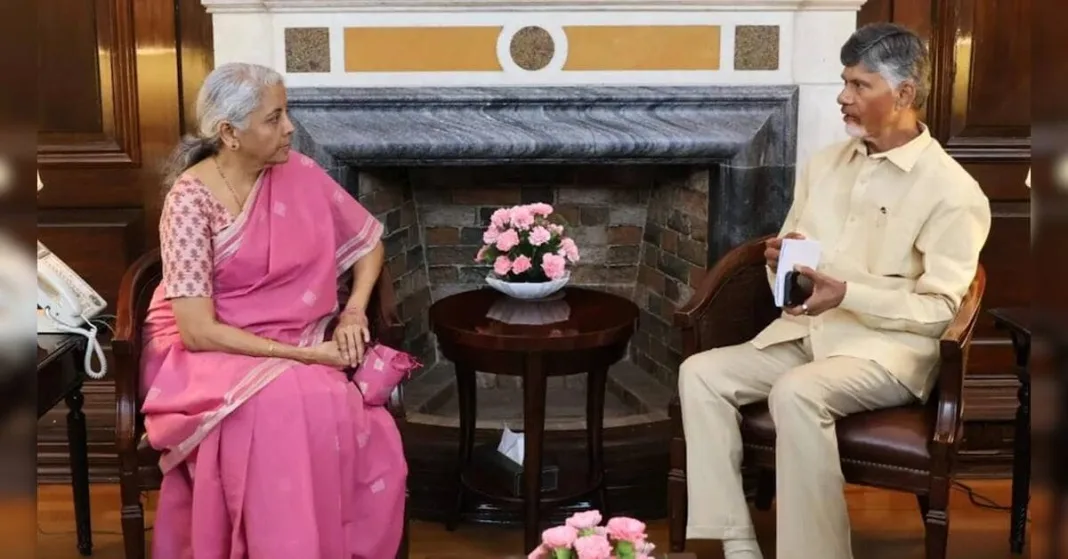

Union Finance Minister Nirmala Sitharaman will lay the foundation stone for the ambitious ₹1 trillion Rayalaseema Horticulture Hub at Madanapalle on Friday.
The plan includes a synchronised public investment framework integrating irrigation (₹20,884 crore), horticulture (₹14,906 crore), and rural roads (₹4,562 crore) across three years (2026–2029).
“Out of the total ₹1 trillion, about ₹40,352 crore is public investment and about ₹60,000 crore is expected from the private sector. The plan brings together irrigation, horticulture, rural roads and value-chain infrastructure. It will be implemented in three phases from August 2026 to July 2029 across 201 clusters in 10 districts,” said a government note.
The aim is to expand horticulture to 1.44 million hectares, nearly double production, and improve the incomes and livelihoods of about 9.6 lakh farmers. This is part of a larger roadmap by Chief Minister N Chandrababu Naidu to unlock the agricultural potential of Rayalaseema by shifting from low-value rainfed crops to a climate-resilient, high-value horticulture-led economy.
The execution of the project is structured across three annual phases and six semi-annual implementation packages (IP1 to IP6) to align water availability with crop expansion and logistics. The first phase of the project, till July 2027, will see an investment of ₹12,066 crore and will focus on completing reservoirs, lifts, and tanks to unlock immediate water availability, activating 72 initial clusters, and constructing high-impact last-mile rural roads. The second phase will be between August 2027 and July 2028, with an investment of ₹15,036 crore, while the third phase, between August 2028 and July 2029, will see an investment of ₹13,250 crore.
“Rayalaseema, once synonymous with drought, is set to become the nation’s leader in horticulture crops such as mango, banana, tomato, pomegranate, dates, dragon fruit, watermelon, lemon, sweet orange, avocado, apple and berries,” it said.
The progress achieved by Andhra Pradesh’s horticulture sector over the past decade demonstrates what can be accomplished when government policy and private partnership work together, it added. Banana exports, which stood at just 246 tonnes in 2016-17, have grown to a level where over one lakh tonnes are now shipped from Anantapur to Iran alone.
An Integrated Horticulture Development Project (IHDP) is designed to expand cultivation and strengthen the entire value chain, from harvest through processing to export. Reducing post-harvest losses, which currently range between 15–20 per cent, requires effective supply chain management, quality control, packaging and value addition.
To this end, the government plans to establish food processing units, cold storages and value-addition centres alongside horticulture clusters so that farmers realise better prices. In addition, the agreement with the UAE will lead to the establishment of a food cluster in the state, bringing investments into the processing, value addition and export of mango, banana and cocoa. Products such as mango pulp, banana powder/chips, chilli oleoresin, tomato puree and dehydrated fruits will reduce dependence on fresh fruit exports and protect farmers from fluctuations in international markets, it added.