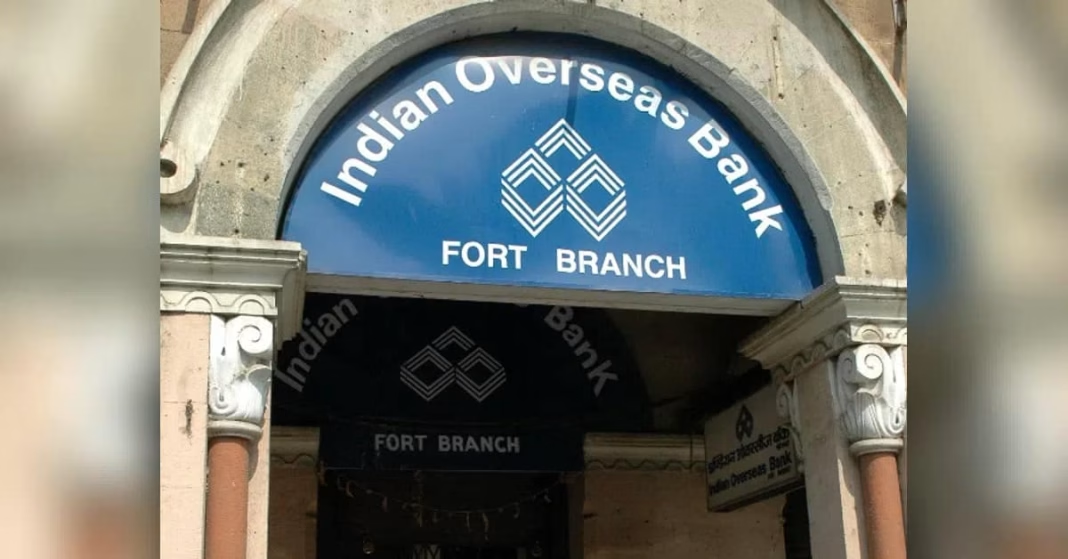

Chennai-based Indian Overseas Bank (IOB) posted a 56 per cent rise in net profit to ₹1,963 crore during the second quarter of FY27, up from ₹1,259 crore during the July-September quarter of FY26, owing to a rise in interest income and improved asset quality.
The bank’s total income during the period rose 13 per cent to ₹10,428 crore. The bank’s interest income increased 17 per cent to ₹9,201 crore in Q2 FY27, compared with ₹7,851 crore during the same period last year. “Our net interest income grew by 26 per cent during the quarter. Our asset quality was also good, and our slippages are one of the lowest in the system,” said Ajay Kumar Srivastava, managing director and chief executive of IOB.
Net interest income (NII) for the quarter increased 26.4 per cent to ₹3,867 crore from ₹3,059.3 crore in the year-ago period. “On the asset quality front, slippages remained under control at Rs 240 crore, with the slippage ratio at 0.07 per cent, one of the lowest in the banking system. We have consistently maintained it at this level,” Srivastava said.
The bank’s gross non-performing asset (NPA) ratio declined by 64 basis points (bps) year-on-year (Y-o-Y) to 1.19 per cent, and the net NPA ratio fell by 12 bps Y-o-Y to 0.16 per cent. Credit cost also declined by 1 bp Y-o-Y to 0.17 per cent. NPA recovery during the quarter stood at ₹647 crore, which was 2.95 times the quarterly slippages. The capital to risk-weighted assets ratio (CRAR) increased by 66 bps Y-o-Y to 18.60 per cent. Return on assets (RoA) improved to 1.53 per cent from 1.20 per cent last year, an increase of 33 bps. Return on equity (RoE) rose to 24.58 per cent from 19.95 per cent, an increase of 463 bps.
Total deposits of the bank increased 20.16 per cent to ₹4.07 trillion from ₹3.39 trillion. Current account savings account (CASA) deposits also increased 20.73 per cent Y-o-Y to ₹1.65 trillion, while the domestic CASA ratio improved by 13 bps Y-o-Y to 41.14 per cent. Advances in Q2 FY27 stood at ₹3.45 trillion, registering growth of 24.35 per cent from ₹2.77 trillion last year.
Srivastava said that, based on initial calculations, IOB would require additional provisions of around ₹2,600-2,800 crore under the expected credit loss (ECL) framework. “We have already created ECL provisions of around Rs 2,700 crore. Therefore, 100 per cent of the requirement currently envisaged has already been provided for in the balance sheet as forward-looking ECL provisions,” he added.
He said the bank’s gold loan portfolio was doing well, and it had designed several schemes to cater to the requirements of different sections of society at competitive interest rates. “Our jewellery loan portfolio is very robust. We have outstanding jewellery loans of nearly Rs 1.36 trillion. It is a very healthy portfolio, with no signs of stress. We maintain a loan-to-value (LTV) ratio of around 60-62 per cent, which adequately factors in price variations,” he added.