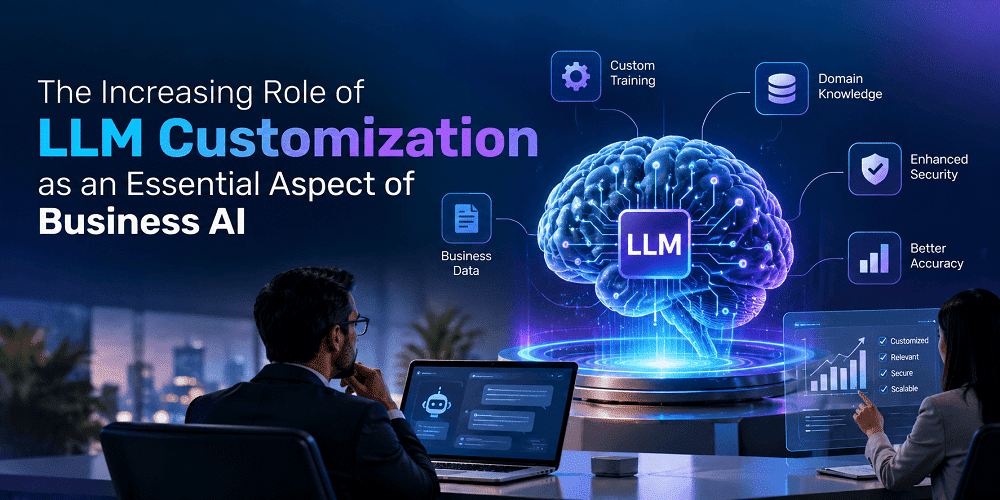
Almost all companies have used a standard, “off-the-shelf” chatbot by this point. A member of the staff puts in a contract to be summarized and the resulting output seems impressive for maybe ten minutes. After that, however, the real questions begin. Will it understand our internal language? Does it know how we price our products? Why did it create a new policy that does not exist at all within our organization?
It is the difference between a demonstration and a tool that a business can rely upon which has led to LLM customization becoming one of the larger topics in business AI. The reason for this is primarily due to the fact that the generic version of the software provides a limited amount of capability.
Why Off-the-Shelf Models Fall Short
A model made off-the-shelf has some knowledge of many areas, yet none of them are specific to your business. This model has not read your internal documents, nor does it have any idea how you write or speak; therefore, it has no clue as to whether you use an approving voice or not. Additionally, this model has never seen how you name products.
Therefore, the model will fill these gaps with confident assumptions. Although these assumptions may be useful when you need to brainstorm ideas, they could cause problems if you want to apply them to anything that involves direct interaction with customers. The second issue is that there is a problem with “sameness.”
If all of your competitors are plugging into the same model in the same way, the output generated by each competitor will begin to resemble one another. At this point, the model itself is no longer the competitive advantage, because anyone can access the model.
Therefore, what you do around the model becomes increasingly important.
What is Customization?
When people refer to “customization,” they typically assume this refers to building a large language model (LLM) completely from nothing.
While this is certainly possible, it’s very rarely needed or even done. There are many different ways that you can customize your LLM. Typically most projects will employ at least two of these: Designing Prompts; designing prompts allows the LLM to receive explicit instruction, context, and example(s). Retrieval; retrieval involves the LLM referring back to pre-approved company documents as reference prior to providing an answer.
- Fine Tuning: This is when the LLM learns a specific style, format, or task based upon your own examples.
- Guardrails: These are constraints placed upon what the LLM may say or do.
- Model Selection: It refers to choosing a larger or smaller model based upon the requirements of the project.
LLM development services can help determine the best combination of options for you rather than automatically attempting the most complex solutions available. Many teams have been able to achieve the majority of the benefits associated with LLMs through the use of retrieval and solid prompts and have only added fine-tuning at a later point in time.
What You Don’t Realize About LLMs
When you build an LLM from scratch, it can be only as useful as the data you put in. For example, if your knowledge base has been updated since last year and/or stored in a bunch of separate tools and/or filled with multiple conflicting versions of the same policy, then the LLM will simply replicate all of those problems.
Therefore, many developers begin their custom LLM projects by doing a lot of “boring” clean-up. Developers need to determine which sources represent the “truth,” delete duplicate records, identify information that should remain confidential and establish access controls for each type of data. While this may seem like tedious work to some, it is actually the foundation upon which trust can be built.
When Fine-Tuning Makes Sense
LLM Fine Tuning Services are frequently mentioned in discussions about fine tuning. They also play an important role. Tuning is useful when a task occurs repeatedly and requires the same type of output each time (for example, categorizing claims, maintaining a strict brand voice, or pulling data from poorly formatted forms).
However, tuning is not always the best solution. If the issue is that the model does not have knowledge of your most current product specifications, tuning will be a very slow method to resolve this issue, as retrieval is much more effective at handling changes to factual information.
Consider tuning to be a means of shaping behavior and retrieval to be a source of information. One of the most common and costly errors made in this area is combining the two. Training examples are particularly important in this instance as well. Generally speaking, a few hundred well-formatted, consistent training examples will outperform a large quantity of poorly formatted examples.
What Businesses Gain From Going Custom
Businesses benefit from custom solutions when those solutions have been implemented correctly. One of the ways this occurs is that the answers provided by your solution will be more reliable. Since your solution uses only approved content, you don’t have to worry about providing answers based on speculation or general knowledge.
Additionally, you will see a great deal of consistency in the quality of your output. With consistent tone, format, and structure, you will save your team significant time in editing. You also won’t need to post private/confidential information in open-source applications (such as Google Translate).
Finally, you may be able to reduce cost by using a smaller model specifically designed to complete one task rather than using a much larger model. A less obvious advantage of custom solutions is that team members begin to rely upon your solution. They begin to trust that the responses generated by your solution are valid; therefore, they continue to utilize the application.
Ultimately, it is through the adoption of new technologies that most of the benefit of any technology lies.
The Problematic Part is Customization
Models evolve; therefore, what works now may not work after an update. Regulations will change. There will always be more data than can be analyzed or kept up-to-date.
Therefore, someone must perform regular testing of the system, identify unusual responses and maintain the source of information. Security must also be considered at length.
Access restrictions, log files, and preventing personal data from being stored in areas where it does not belong are essential components of the development process, not an afterthought. For this reason, many businesses choose to contract with Enterprise LLM Development Service Providers instead of developing their own solutions.
A Practical First Step
Companies that consistently produce positive outcomes tend to make their initial step small:
- Select a single use case that has a current cost, such as answering customer service questions or reviewing contracts.
- Collect actual samples of both correct and incorrect outputs for your selected use case.
- Start by creating prompts and using retrieval to determine the baseline performance level.
- Only consider adding tuning after identifying gaps in behavior rather than gaps in knowledge.
- Monitor accuracy levels, time savings generated, and the number of times a user must correct an output.
The monitoring process will help maintain integrity within the project. The sooner you realize that your metrics are not improving, the less likely you will be to invest heavily into the project.
Common Missteps
The most common mistakes are related to data preparation, retrieval versus tuning, judging performance based on feeling, rather than quantitative measurements and treating the initial release as the finish line instead of the starting point.
Another mistake is seeking out the largest possible model for each individual problem. Larger models may not be the optimal solution for all problems, especially when considering cost per unit of processing power.
Wrap Up
The need for LLM customization has grown since access to a wide range of powerful models is no longer limited. The difference between successful organizations lies in the ability of their models to be trained on the organization’s unique data, comply with its established guidelines and integrate seamlessly into its existing processes. C
Customized enterprise LLM solutions that were designed in this manner will often appear less as a novel application and more as a reliable component of everyday operations.
In most instances, superior results are achieved through the identification of a specific use case, the use of quality data, the setting of appropriate boundaries, and the consistent upkeep of the system, rather than attempting to develop customized solutions for all possible scenarios simultaneously.
Teams considering the pursuit of such efforts would benefit greatly from Webline India’s practical expertise in both software development and artificial intelligence which can provide the support necessary to transition an innovative concept into a functional and ready-to-deploy solution for commercial purposes.