
What were the biggest changes in the logistics sector after 1991?
Technological change did not take place immediately, it happened in phases. The cultural change took place fairly quickly because our customers suddenly said, “We’re going to get swamped by imports because duties are falling now.”
At the same time, licensing had been removed, so our customers could start investing, opening up and exporting. Travel picked up because people started going all over the world, exploring new business opportunities. So there was a mind-set change, and I think that was the most important contribution of 1991 to the services business.
Before that, our customers were largely based on old relationships. Suddenly, a globally integrated freight forwarder would come to an exporter and offer his services, saying: “You’re exporting to London. Why don’t we handle your stuff door-to-door? We’ll pick up your container, put it on board a ship, unload it at the other end and deliver it to your customer.”
We tied up with a European company, and that drove us into joint-venture arrangements. In the freight-forwarding business, we tied up with our German forwarder Dachser, while in the express business we expanded our services with DHL.
These changes occurred post-1991 because the world opened up to us. The new practices and attitudes the industry and its service providers imbibed were what, in a way, transformed India.
It wasn’t just that industrial licensing made life easier; it was the serious cultural factors. For the first time, we began to understand — and so did our exporter customers — that you needed to move beyond Indian standards. You had to conform to global standards. Once you conformed to global standards in your export-import business, you could begin to impose those standards in India on your vendors.
What 1991 really helped us with was integration with the outside world.
Was 1991 a genuine turning point for the logistics sector, or had the opening already begun?
For us, the opening began well before 1991 because of our ability to operate an express service with speed, visibility, and reliability for our bank and shipping customers in the 1980s. Virtually all international banks and the majority of Indian banks that were involved in foreign currency transactions, requiring hard copy documents to be shipped to major cities abroad, were our customers.
However, the network expansion thereafter took place because of accompanying improvements in telecom networks, computerisation, and the introduction of export incentives.
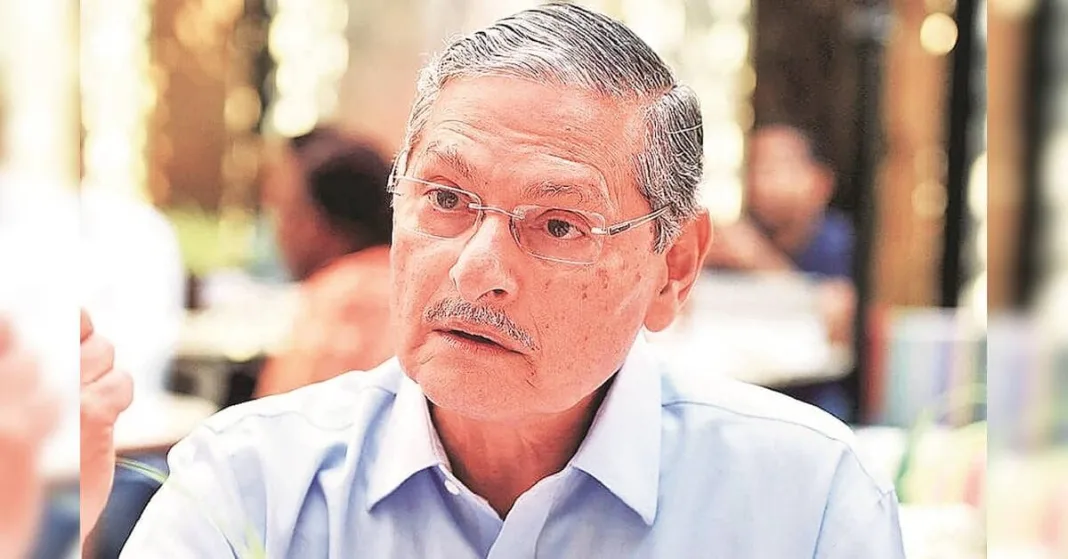
Cyrus Guzder was running Airfreight (India) when the company partnered with DHL in 1979 (Photo: Courtesy Cyrus Guzder)
AFL partnered with DHL in 1979. Did that experience give you an early sense of the potential for India to become more integrated with the global economy?
Partnering with DHL in ’79 came about more or less accidentally. A representative of DHL in Singapore walked into my office one day with a request that we handle a daily shipment between Mumbai and Singapore for one of DHL’s multinational customers. What was unique about this particular customer was that they wanted a daily import consignment, cleared through Customs, delivered daily to their office, in a very short period of time. The same process applied in reverse, at the Singapore end. The result was that the customer received a next-day delivery into Mumbai from Singapore, and vice versa.
It was only a year later, when DHL introduced us to more of their international customers seeking a similar service into and out of India, that we began to realise the potential of air express delivery to achieve speed, reliability, and visibility.
It was, however, a struggle right up to 1991 to get major multinational customers on board. Unbelievably, they felt the Post Office, though much slower, was safer than DHL’s express service! At that time, DHL focused on international banks and shipping firms, and by the late ’80s, we were able to pick up almost the entire universe of this traffic.
After 1991 we could make a major foray into the corporate sector, because companies now had to compete globally on speed and delivery times. After this, there was no turning back. We had the first-mover advantage, and FedEx, UPS, and TNT never really caught up with DHL, even till today.
What DHL taught my company, AFL, and the rest of the express logistics business, was how wide the gap was between service standards abroad and in India. The challenge for us was to be able to guarantee delivery of import shipments to the customer within a 12-hour window and, similarly, to guarantee to the Indian exporter a next-day door-to-door delivery westbound and perhaps a two-day delivery eastbound (because of the time difference). By the mid-’90s, this was a promise that we could make regularly and keep reliably on international sectors; but it was only a decade later that we could meet this delivery commitment in India, owing to our less developed air and road transport systems.
What was the most significant change?
The immediate impact came from reduced import duties and then, progressively, the easing of foreign exchange controls, which accompanied the end of the licensing regime. So, we saw trade volumes rise. And, with that, the need for international express, air freight, and greater Customs efficiency.
But pushing Customs for liberalisation proved to be very tough. It was only in the post-2010 period that the Customs in Mumbai began to accept online clearance of consignments. Though the technology was available earlier, computerisation often failed at the Customs end. It was informally believed that this was occasioned by the unhappiness of Customs officers now having to operate remotely from their customers, whereas person-to-person contact could allow “speedier” Customs clearance.
I would say the real change was cultural, because the technology, infrastructure, and licensing liberalisation were self-evident — necessary, but not sufficient. The cultural change meant that we had to move from serving a controlled market with certain clear dependencies, and traditional bonds between customer and company, to operations in a freely competing market.
This changed the dynamics of business altogether, requiring investments in technology, training of staff, and improving competency in the marketing and selling functions.
How did technology change in logistics?
This is the area in which the most dramatic and visible changes have taken place. Before 1991, technology in logistics was very rudimentary and handled mainly on typewriters. Almost all data input was done manually. There were telex and trunk calls, but not much more in terms of communication technology.
The status of a consignment, whether domestic or international, was generally stored in a ledger or in the memory of a good operations manager. The import of equipment, even a single computer, needed licences and lengthy approvals. So, we worked with whatever we had.
After 1991, the change was not immediately apparent: It came in layers. First came fax (for several years, the main communication medium of corporates inter-office and with customers, domestic or international); then came mobile phones (these were expensive and not widely distributed across the organisation, initially only with departmental heads and ops managers); then the telecom sector was gradually liberalised; this was followed by barcoding of consignments; and for communication with international customers, a new standard international format on which most international customers and freight forwarders demanded data input.
Within companies, the larger ones could afford Enterprise Resource Planning systems, but these were not widespread; the final advances came with the Internet, GPS and the ability to use mobile phones as platforms.
Today, shipments are tracked in real time (roughly since 2015). Vehicles are routed by algorithms (since the past five years). Warehouses are run based on Warehouse Management Systems and Analytics (in the past 10 years).
The biggest change in technology was this: It moved from being a back-office cost to being the product itself.
Did you see multinationals as partners or competitors?
Both. The answer depended on what the Indian company brought to the table. Those with local networks, regulatory understanding, and some degree of operational depth found that multinationals needed them as much as the Indian companies needed access to their global customers and technology. Those without any of these distinctive strengths faced pressure and became marginalised.
In the case of AFL, the choice of joint venture partner was critical, in as much as we sought companies abroad that were comfortable working with us, a family-promoted enterprise which, nonetheless, had the ability to acquire learning, new technology and capital as required.
Finally, trust lay at the foundation of any global partnership between a multinational and an Indian company. It helped if the Indian company built trust by allowing the global partner (which we did) to participate in the selection of the CEO, CFO, and auditors. Holding board meetings with regularity, circulating minutes, and taking decisions by consensus are critical to keeping a trusted global partnership going. There are many examples of successes in India, but, regrettably, there were many more where JVs failed quickly for lack of trust.
What went right and what did not go right in logistics?
What didn’t go right, and could not go right, in the logistics business was that transportation and trucking remained highly fragmented.
That is because trucking is fragmented. The ownership of trucks still belongs substantially to owner-drivers. But because they are operating without access to too much capital, because they can’t scale and because they can’t build a communication network or use technology, there is a natural limit to this type of business, which is around five trucks.
When there’s this type of ownership, there’ll be a very low-efficiency, suboptimal transport system. It is in their interest to use those trucks for as long as they can. So these trucks are old and not well repaired.
Together with that, there is another problem: A massive shortage of truck drivers. That is because the working conditions are so appalling. Because they are self-employed most truck drivers have no insurance.
What did the reforms do to foreign capital in the logistics sector in the post-1991 period?
They did very well in the post-1991 era and all the way into the early 2000s. The big moment was around 1998 to 2002-03, when large numbers of foreign global logistics companies set foot in India and brought in capital.
Initially, many of them entered into joint ventures, such as Dachser, Germany, with our company. Others, like FedEx and DHL Logistics, decided to go on their own. Nonetheless, they brought in capital through foreign direct investment (FDI).
That was a time when FDI was rising in India. And a good amount of it was going into the logistics sector. So it did wonders for that period.
Now the whole situation has changed because our currency has been weakening, India’s international trade figures are growing very slowly, if at all, and many of the points of friction remain. By and large, FDI in logistics has come down to a trickle.
People who want to start up in logistics now look for venture capital. Even warehousing, which is indispensable to logistics distribution, requires you to build and run a warehouse. Warehouses need locations that have power, water, access for workers and adequate security.
For Mumbai, that has meant clusters such as Taloja and Bhiwandi. Similarly, there are warehousing clusters around Delhi and other metros.
But for warehouse expansion, the acquisition of land is a huge pain point. Land is kept on village records and maps that are hand-drawn, and there is massive difficulty in the whole business of paying for land, transferring land, getting the valuation right according to the ready-reckoner values, and sellers and buyers wanting to trade in cash. Many companies have to work through third parties who have developed enormous skills in this area. Large real estate developers, who are experts at acquiring and developing land, have now entered the business.
That is an offshoot of the logistics business now: Real estate companies developing warehousing. They are renting to companies like Amazon on long leases, and they can put that rental income into mutual fund-type instruments, like real estate investment trusts.
Interestingly, even foreign companies that are experts at land aggregation are now entering this business. Blackstone and Brookfield are doing large real estate investment projects in India. So there is FDI entering there.
How do you see consolidation or formalisation of the logistics sector going forward?
I think consolidation is inevitable. There are a large number of very small players because of the fragmentation.
Consolidation initially takes place at the domestic level because there are many smaller companies that want to get into distribution. If they are venture-capital funded, those investors are interested in growth.
So, one way or another, they will want to increase their sales and turnover, which creates a natural incentive for inorganic expansion. I see that happening, and then when they reach a certain scale, they become interesting to the foreign player.
The fact that foreign players would ultimately dominate the Indian logistics scene is, I think, inevitable because they have both the technology and the capital.
What should the next phase of liberalisation look like for the logistics sector and for India overall?
We have a growing domestic market, so we need to look at all the areas in the transportation network that we can make more efficient.
We’ve got to get more cargo moving by rail. We have to get a lot more moving through organised trucking. We have to get a lot more air exports facilitated through the creation of airport-contiguous Customs clearance centres, or air cargo villages as they are known abroad.
We have to continue port expansion and make coastal shipping more efficient. But as long as we have this increasingly extensive road transport network, and that road transport network is also linking all the ports, I think road will remain very competitive against coastal shipping.
Increasing efficiency in the road transport and freight network is necessary to make our manufacturing more efficient, especially the automobile and electronics industries, where parts are being sourced from all over the country.
Many logistics service providers start offering supply-chain solutions to large companies. Later on, the next step — which has happened in Japan and Germany — is that the logistics service provider enters a plant, manages an in-plant warehouse, and feeds the assembly line. We will see that sort of development here in India.
They will begin acquiring and integrating these smaller players into their network. Ultimately, you end up with the giants — we will end up with at least 10 of those giants in 10 years — which would support and sustain Indian industrial and economic development.