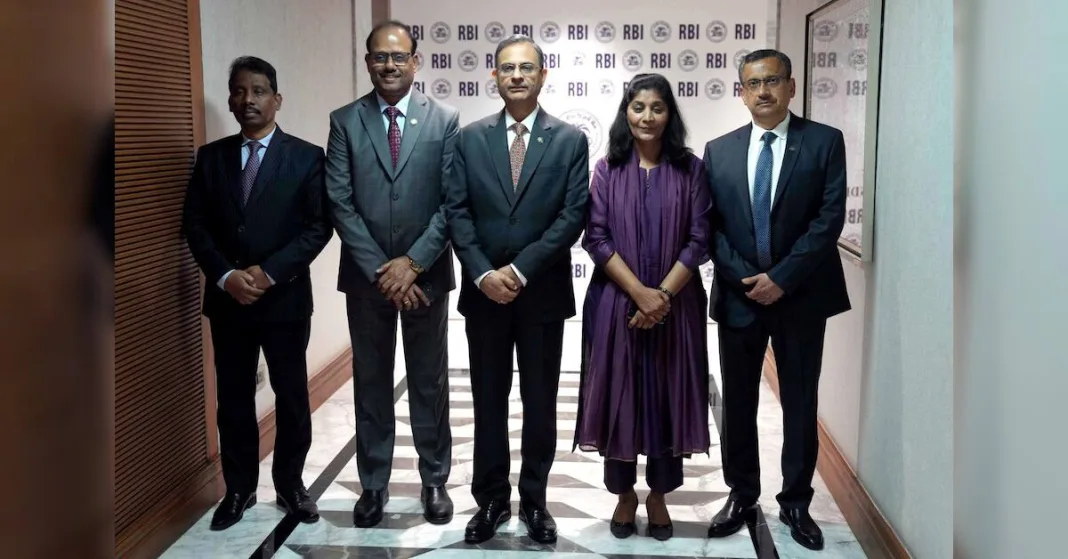

Reserve Bank of India (RBI) Governor Sanjay Malhotra, along with Deputy Governors Swaminathan J, Poonam Gupta, S C Murmu and Rohit Jain, responded to various issues during the post-monetary policy interaction with the media. Edited excerpts:
The average inflation rate over the next three quarters has been projected at 5.8 per cent. Did the Monetary Policy Committee (MPC) consider an increase of 50 basis points this time? And, going by the minutes of the previous meeting, you had said that policy would be recalibrated as inflation normalises. Should we, therefore, expect a recalibration of the real policy rate in the meetings ahead?
Malhotra: We discuss all possibilities before taking a decision. As regards the real rate, obviously, a recalibration thereof, even at 25 basis points, an increase recalibrates the rate. I suppose your question is whether more is required or not. That is a call that will be taken.
But obviously, we have clarified things by changing the stance that there is no rate cut in the near term. What we are contemplating is either a pause or a rate increase. How deep or shallow this will be depends on the evolving macroeconomic conditions and the growth-inflation dynamics.
Referring to the headline inflation rate, it is our target given to us by the government and we continue to focus on bringing the rate down to the target of 4 per cent. But that is not the only thing to be seen. When a lot of the increase in headline inflation is because of one base effect and other supply-side factors, the headline rate alone may not be the right measure. So we have to look at other measures which we have given, including the core and diffusion indices, to be able to get a view, and to be able to infer what the underlying inflation is and where it is going.
On FCNR(B) deposits, some commentators believe that if the currency weakens, during future payment, it can affect RBI’s math...
Malhotra: The FCNR(B) deposit flows of $135 billion was made possible by the strong macroeconomic fundamentals of India. As far as the banks are concerned, I am confident that the deposits they have received both in the past and in the future will be deployed prudently. Banks have given 19 per cent credit. They will fulfil the unmet demand for credit and banks will continue to give credit. This is our belief in them. As far as giving it back is concerned, our macroeconomic fundamentals are very strong.
This is due to a temporary external headwind due to which there is a shortage in flows. Pressure on the current account is a temporary problem. Sooner rather than later, our external sector will improve. We are getting all the indications — whether it is the export of goods and services, remittances, or the various steps taken by the government for reforms and ease of doing business, including foreign direct investment like in the insurance sector. On government securities related to tax and other issues that have been discussed, we believe that soon the deficit in the BoP will come to a surplus, as it has been in previous years. We have comprehensive forex reserves, which we will use to repay them.
Every time there has been a flush of liquidity in the system, non-banking financial companies (NBFCs) have been the biggest beneficiaries of credit, and this has invariably led to a bit of an asset quality issue …
Malhotra: We do not see any issue or concern on asset quality with regard to NBFCs. We are always alert to such risks, not only from an asset quality point of view but, as mentioned and as noted by the MPC, also on demand and price pressures .
If NBFCs do not have any issue on asset quality, then can the demand for revolving credit — which reaches the last mile and where they are paying interest — be allowed?
Malhotra: It is a clarification that it is not a new rule or law because revolving credit was not permitted by NBFCs. And this is not just a clarification. These individual NBFCs were given instructions and directions under the supervision of RBI. Now, since technical development has been done by using software technology, revolving credit is being given in the form of term loans. So, we have published this draft to put it in the rules. We have received many replies to this and are studying them. We will give the final guidelines soon while keeping in mind if there is any systemic risk. There can be a risk of liquidity. Keeping this in mind, it was not allowed from the beginning.
With the implementation of expected credit loss (ECL) just six months away, what is the RBI’s assessment of banks’ preparedness for it?
Murmu: We had come up with the ECL framework in advance. Hence banks are well prepared. Otherwise too, we are in touch with banks and agents, and whenever we have an interaction, issues are addressed. Our assessment is that the transition will be smooth. When we came up with this framework, we had done the back-testing at that point in time, and we are continuously monitoring things. In addition to that, we are also having a workshop where we clarify and also do the hand-holding.
You recently said that stretched valuations in global artificial-intelligence (AI) stocks posed a key risk to financial stability and that a correction could redirect foreign capital into emerging markets like India. Could you elaborate on this?
Malhotra: That speech was more in the context of a global audience and what the global risks to emerging market economies are. And, in that context, what are the risks to India? AI certainly has stretched valuations. Their correction can be a concern for various economies. But for India, since we do not have too much of AI here, we do not see any major negative impact. If at all there is an impact, it may be positive. So that was the context in which I had made that speech.