
Artificial intelligence has become part of the zeitgeist. And while it’s a polarizing topic, Linda Rabieh has a unique take on AI: “It’s good for business. Our business, of humanistic thinking.” As senior lecturer in the Concourse program, one of MIT’s first-year learning communities, Rabieh has been introducing students to the “business” since 2010.
“What AI has been useful for is making very vivid to students today the question of what it means to be human,” she adds. “They’re meeting this question with a new urgency. What is intelligence? Is it only mathematical intelligence? Is it only an aggregation of information? Or is human intelligence something different?”
AI is just one of countless thorny topics that bubble up in Concourse, which offers first-year MIT students a foundation in the humanities, alongside math and science General Institute Requirement courses taught by Concourse faculty. Studying “great books” and literary luminaries — Plato, Homer, Aristotle, Wordsworth and Coleridge, to name a few — provides a springboard for rich conversations and spirited debates.
A “mini-liberal arts college within MIT”
Concourse was founded in 1970 to enable humanities, engineering, and science faculty to collaborate on curriculum, cultivating a “concourse” of ideas. Now it’s a place, Rabieh says, “where students who come primarily to MIT for world-class science, math, and engineering can also have a traditional liberal education, exploring fundamental questions of human existence, reading the great books, engaging in intense, vigorous debate about these questions.”
“I often describe Concourse as a mini-liberal arts college within MIT,” says Assistant Director Sasha Rickard ’19, an alumna of the program. “A lot of students tell us that Concourse is a big part of the reason they decided on MIT instead of [other schools].”
Concourse accepts 50 first-year students each year. Johnnie Jones VI, a senior in mathematics and Concourse teaching assistant (TA) and debate fellow, marvels at the diversity of students the program attracts — “athletes, people who are interested in humanities, people who have no experience in humanities,” he says. “Somehow, 50 people every year self-select into this space, and magic happens.”
Connection and “cross-pollination”
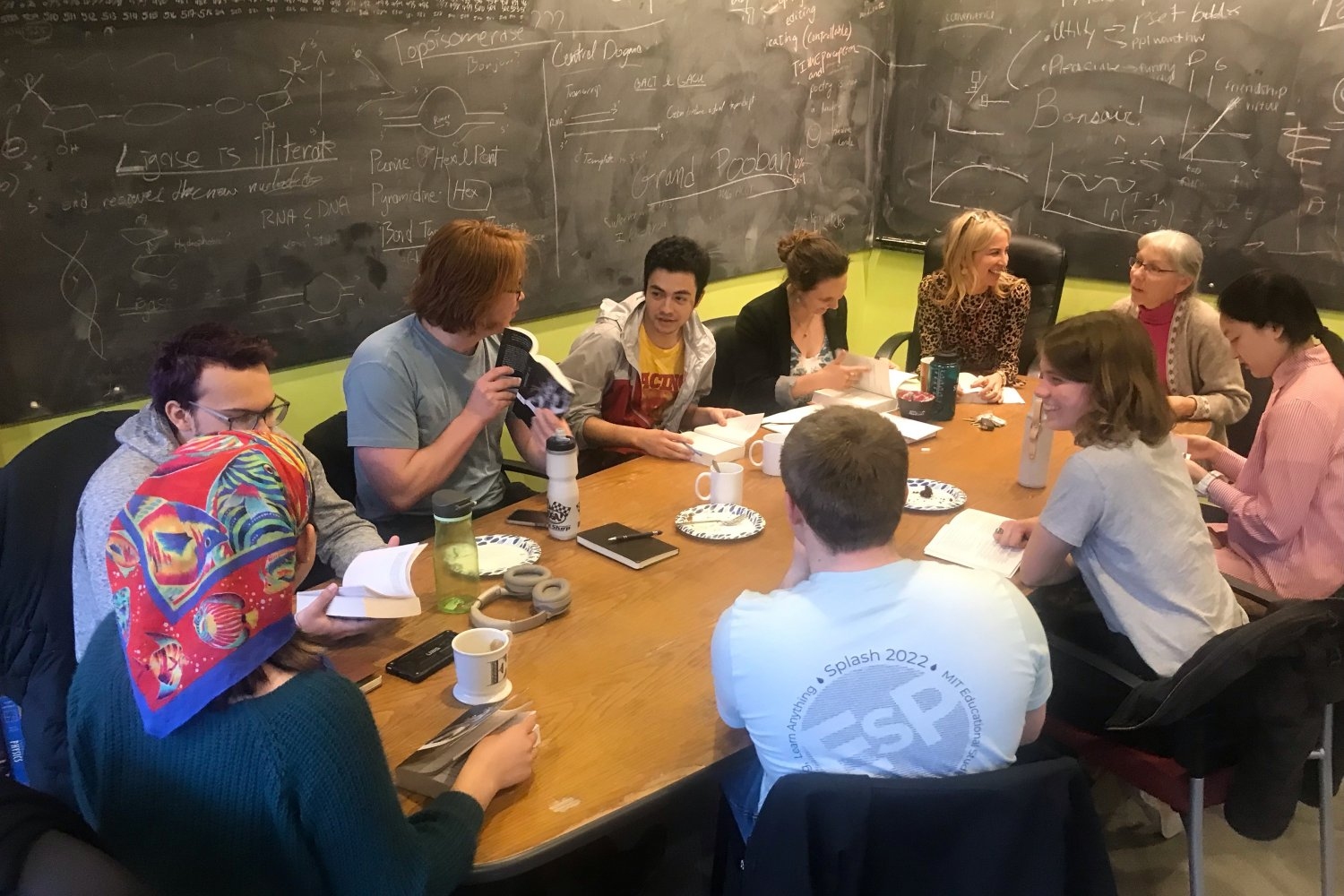
Part of that magic is the sense of community that Concourse fosters. The program has a dedicated space in Building 16 with a classroom, seminar room, lounge, and kitchen. Students receive advising and participate in community events throughout the year. Since they overlap in their humanities, math, and science classes, as well as outside the classroom, they get to know each other and their instructors well. “There’s a lot of cross-pollination of conversation and ideas,” Rabieh says.
During the weekly Friday advising seminar, students gather over lunch to discuss assigned texts or hold debates. In the fall, topics focus broadly on the human condition, and in the spring, students consider practical political or moral issues such as gene therapy, immigration, and gun control. Several debates are held in conjunction with the MIT Civil Discourse Project, which has collaborated with Concourse since 2023.
Many students stay involved in the program after their first year. Some serve as TAs, debate fellows, or associate advisors.
“There’s very much a sense of wanting to be guides and supports and set an example for the incoming students,” Rickard says. Upper-level students also take Concourse electives, hang out in the lounge, and participate in community events.
Learning to think things through
Taking multiple classes together, sharing meals, and spending time together outside the classroom — these common experiences build a level of trust that allows students to hold deep conversations. The result is a transformative experience.
Rickard has noticed that incoming first-years tend to fall into two categories: those who think they already know the answers to political or philosophical questions, and those who have no opinion because they think there’s no definitive answer. Over time, she explains, “some students come to understand that they need to learn from others, and others learn that they really can think for themselves, and they do have something to say.”
“Students learn the importance of judgment in non-quantitative areas,” Rabieh says. MIT students excel at quantitative reasoning, she adds, but “you can’t just show which political policy is right and which is wrong … and one reason I think MIT students shy away from those kinds of issues is because they don’t see a way to think through them. Concourse teaches them a way to think about moral and political questions in a rigorous way that isn’t quantitative.”
That rings true for Jones. “Overwhelmingly, the greatest skill Concourse has given me, more than just teaching me things, is teaching me how to work through ideas myself — really making possible the ability to, even after a long day of work, sit down with a great book and have a conversation with someone who was alive 300 years ago about things that matter to me,” he says.
Stewarding the “ethos of Concourse” into its next chapter
As Concourse continues into its next half-century, a new leader has taken the helm. Ford Professor of Political Science Lily Tsai was recently named director after Anne McCants, the Ann F. Friedlaender Professor of History, stepped down.
Colleagues laud McCants for 14 years of steady leadership; cultivating a robust, collaborative advising program; advocating for a whole-student approach; and for her passion for teaching.
McCants says she relished interacting with Concourse students in a sustained way — often for all four years — and learning not only from them, but also colleagues. “Having a group of committed educators from different disciplines in sustained conversation is a remarkable feature of Concourse. In our normal faculty roles, we are siloed off from those whose fields of study are not ours. I will miss those interactions as much as I do the ones with the students.”
Tsai assumes the role as the Institute expands efforts to broaden connections between the School of Humanities, Arts, and Social Sciences (SHASS) and other fields. Those efforts include the Compass Initiative, which Tsai co-leads with other faculty from across SHASS; the MIT Human Insight Collaborative; and the creation of shared faculty positions within the MIT Schwarzman College of Computing.
“The ethos of Concourse is thrilling to me,” Tsai says. “Through reflection and debate about what we value individually and collectively, Concourse students cultivate the skills and habits of mind that prepare them to be not only excellent engineers and scientists, but also responsible citizens and leaders. At a time when the whole world is seeking to ground our use of powerful technologies in thoughtful, principled judgment, Concourse seems all the more vital, and I’m eager to champion the teaching and learning that the program does so well.”