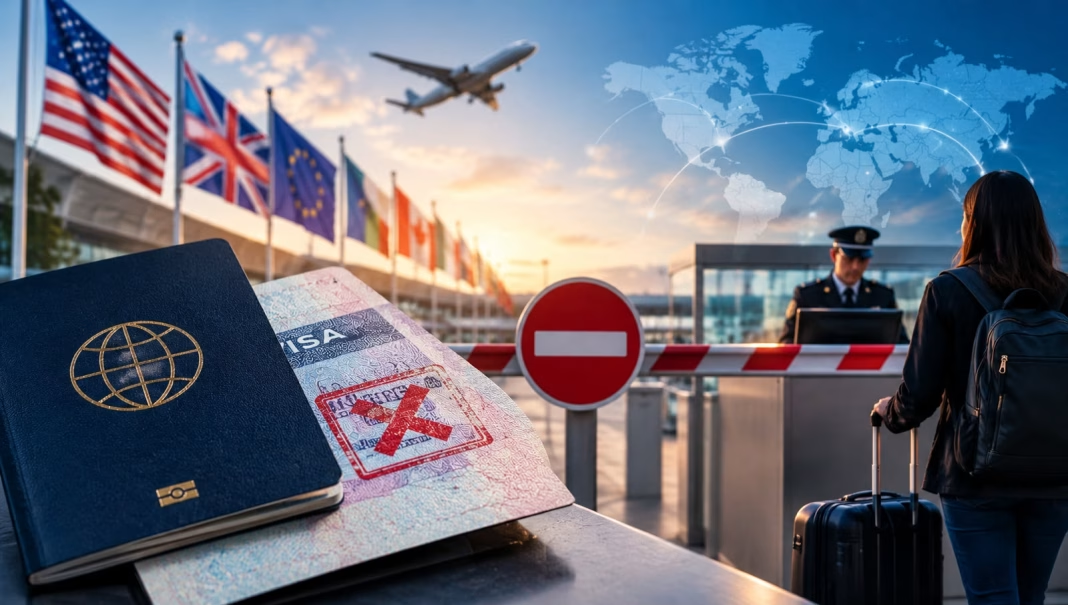


The US and many other countries are experiencing increasing visa restrictions and global travel stoppages. Travel rules internationally are changing very quickly and millions of international applicants are facing serious issues.
Governments are implementing strict security checks and visa applications are being stopped completely for dozens of affected countries. Travelers, business owners, and legal professionals will need to quickly adjust to the new challenges surrounding immigration.
Advertisement
Advertisement
Global travel is at a crucial time with diplomatic tensions, security, and government instabilities causing changes in the way people can travel internationally. The 4 countries currently suffering the most from visa restrictions, travel bans, and stoppages are the United States, Afghanistan, Haiti, and Myanmar. Citizens from these countries are facing strict security checks, visa application stoppages, and strict consular rules. This information is crucial for travellers, international businesses, and legal professionals in understanding the issues within immigration in 2026.
Why Is the United States Enforcing Sweeping Entry Restrictions?
Concerns regarding national security and identity verification have prompted the United States to enact severe entry restrictions affecting 39 countries. Nineteen of these nations face complete suspensions across immigrant and non-immigrant visas, while twenty others endure processing holds.
The United States has implemented comprehensive executive proclamations to address perceived deficiencies in international identity management and information-sharing protocols. Foreign nationals from nineteen designated countries—including Syria, Iran, Yemen, Burma, and Afghanistan—face total entry bans covering standard tourist, business, student, and immigrant visas.
An additional twenty nations face targeted processing pauses and strict consular holds that delay status adjustments through domestic immigration channels. These protocols enforce mandatory biometric screening, deep background checks, and detailed historical vetting before any international traveler receives travel clearance.
Advertisement
Advertisement
“The tightening of global entry rules across the United States, Afghanistan, Haiti, and Myanmar reflects a fundamental shift in international immigration governance. Heightened national security demands, systemic administrative breakdowns, and severe diplomatic isolation have effectively dismantled conventional visa processing pathways for millions of citizens worldwide. As sovereign nations continuously enforce stricter identity verification standards and broad consular holds, international travellers and legal experts must recognize that traditional border clearance can no longer be guaranteed. Navigating this era of unprecedented border restrictions requires deep compliance awareness, active policy tracking, and reliance on complex diplomatic waivers.”
— Anup Kumar Keshan, Founder and Editor-in-Chief, Travel And Tour World
Advertisement
Advertisement
What Factors Have Paralysed Travel Channels in Afghanistan?
Political instability and the withdrawal of international diplomatic missions have virtually frozen conventional visa channels to and from Afghanistan. Most foreign embassies suspended operations in Kabul, leaving citizens reliant on third-country consulates for basic documentation.
The collapse of recognized diplomatic structures in Afghanistan has triggered global travel restrictions and prolonged humanitarian backlogs for its citizens. Foreign governments maintain strict Level 4 “Do Not Travel” advisories due to security risks and the absence of consular support.
Afghan nationals face systemic hurdles when applying for overseas visas, as verifying civil status documents requires extensive third-party authentication. Major Western nations maintain explicit visa suspensions on Afghan passport holders, making legal emigration extraordinarily difficult without specialized international assistance.
How Are Internal Crises Disrupting Migration Pathways in Haiti?
Widespread civil unrest and severe disruptions to administrative infrastructure have crippled Haiti’s civil registry system and foreign visa processing. International authorities have imposed entry restrictions due to difficulties in verifying civil identification records.
Advertisement
Advertisement
Deepening security challenges in Port-au-Prince have severely disrupted essential state functions, hindering the reliable issuance of passports and official credentials. International security agencies cite these infrastructural breakdowns as a primary rationale for applying heightened entry scrutiny to Haitian travelers.
Foreign consulates operating within Haiti have repeatedly paused operations, forcing applicants to seek emergency processing in neighboring nations. Consequently, Haitian citizens face restricted travel pathways, mandatory security holds, and elevated visa refusal rates globally.
For official updates, eligibility guidelines, and consular requirements, you can access the U.S. Department of State Travel Portal.
Why Have International Borders Closed to Myanmar Nationals?
Ongoing internal conflict, international sanctions, and military governance have disrupted Myanmar’s foreign relations and border control protocols. Multiple foreign governments have instituted strict visa freezes and entry restrictions on Myanmar citizens.
The severe political crisis in Myanmar (Burma) has dismantled routine diplomatic operations and disrupted standard international travel frameworks. Western nations have added Myanmar to high-level travel restriction lists, halting the issuance of tourist, business, and educational visas.
Consular services within Yangon remain operate at reduced capacity, while domestic administrative bottlenecks delay passport validation. International airlines enforce strict boarding checks to comply with destination sanctions, effectively isolating the nation’s travel infrastructure.
Advertisement
Advertisement
| Country | Primary Cause of Visa Issues | Key Regulatory / Administrative Mechanism | Main Visa & Pathway Impacts | Current Consular & Travel Status |
| United States | Security policies, identity verification standards, & diplomatic holds | Executive / Presidential Proclamations | • Full bans on immigrant & non-immigrant visas for 19 nations • Processing holds & delays on 20 additional nations |
Strict vetting; mandatory biometric screening; reduced visa validity for flagged regions |
| Afghanistan | Political instability, lack of recognized diplomatic channels | Blanket entry suspensions & Level 4 travel advisories | • Suspended standard non-immigrant & immigrant visa issuances • Multi-year backlogs for humanitarian/refugee pathways |
Foreign embassies in Kabul closed; applicants must route through third-country consulates |
| Haiti | Civil unrest & breakdown of domestic administrative infrastructure | Civil registry disruption & international entry suspensions | • Severe delays in passport/civil document issuance • High visa refusal rates & mandatory security holds |
In-country foreign consulates operating at minimal capacity; processing pushed to neighboring countries |
| Myanmar (Burma) | Civil conflict, military governance, & global sanctions | Level 4 “Do Not Travel” advisories & targeted travel freezes | • Complete pause on non-essential (tourist/business) visa issuances • Heightened scrutiny on student & work visa applications |
Yangon foreign consulates operating under reduced capacity; domestic passport validation bottlenecks |
The United States
- Visa Requirements & Vetting: Applicants must complete the exhaustive DS-160 (non-immigrant) or DS-260 (immigrant) forms, pay substantial fees, and undergo mandatory in-person consular interviews. Vetting involves rigorous background checks, social media history reviews, and comprehensive biometric collection (fingerprints and digital photographs).
- Diplomatic Exceptions & Waivers: Under standard U.S. immigration law (INA § 212(f)), individuals subject to proclamations or bans can apply for a National Interest Waiver (NIW) or consular-discretionary exceptions. These exceptions typically apply to diplomats, international organization personnel (such as UN officials), dual nationals traveling on a passport from an unaffected country, and cases where emergency medical treatment or compelling humanitarian need is proven.
Afghanistan
- Visa Requirements & Vetting: Due to the total suspension of foreign diplomatic missions inside Kabul, Afghan nationals cannot apply for standard visas locally. Applicants must travel to third countries (such as Pakistan, India, or Iran) where foreign embassies process Afghan passports. Even then, vetting requires extreme identity verification, proof of employment with allied forces, or direct referral through international refugee resettlement programs.
- Diplomatic Exceptions & Waivers: Exceptions are virtually non-existent for standard commercial or tourist travel. Diplomatic waivers are reserved strictly for accredited diplomats, international aid workers on mission-critical assignments, or pre-vetted applicants holding approved Special Immigrant Visas (SIVs) or humanitarian humanitarian parole statuses issued directly by destination governments.
Haiti
- Visa Requirements & Vetting: Haitian passport holders face severe scrutiny due to local civil registry disruptions. Standard tourist and business visas (such as the U.S. B1/B2) require proving deep economic, social, and familial ties to Haiti to satisfy consular officers of the applicant’s intent to return—a difficult threshold given the domestic crisis. Applicants must schedule appointments through overwhelmed third-country consulates or specialized regional processing hubs when local operations are suspended.
- Diplomatic Exceptions & Waivers: Consular officers may grant emergency interview appointments or expedited processing for urgent medical emergencies, death or critical illness of an immediate family member, or official government-to-government delegations. However, the underlying visa eligibility criteria remain strictly enforced.
Myanmar (Burma)
- Visa Requirements & Vetting: Foreign travel requires a valid passport and pre-arranged visas for almost all destinations. Outbound citizens face strict exit controls by the military authorities. Consular services inside Yangon (such as those from remaining foreign embassies) enforce rigorous vetting, demanding extensive financial documentation, police clearance certificates, and detailed travel itineraries to screen against economic sanctions and security risks.
- Diplomatic Exceptions & Waivers: Diplomatic and official passport holders traveling on state business enjoy streamlined processing or bilateral exemption agreements. Humanitarian workers, journalists on approved assignments, and individuals holding dual citizenship with an unrestricted nation may bypass certain restrictions, subject to strict clearance from destination ministries of foreign affairs.
The global mobility trend is showing signs of a permanent change in how we approach travel by increasing checks at borders, increased identification and reduced cooperation between countries. As each country updates their security processes, traditional immigration routes into these countries will remain very tight. International travellers, business leaders and legal professionals will need to stay up-to-date with foreign policy changes, apply through a third country consulate and expect long application times. Strategic planning, staying on top of compliance and preparing are key in this ever-changing global environment.