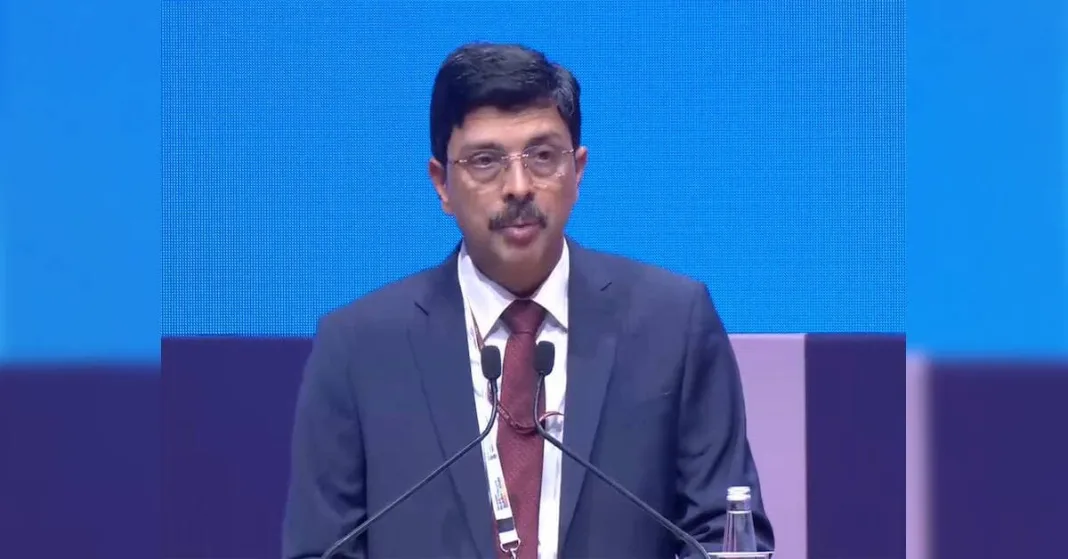

The power ministry is planning to launch the National Electricity Data Sharing Framework this month, Power Secretary Pankaj Agarwal said at an industry event.
The framework is crucial for the country’s power sector as it will replace the current heavily fragmented, siloed data ecosystem with a unified, standardised digital architecture, allowing future technology adoption and implementation.
The draft, released in July this year, aims to make datasets machine-readable and accessible through secure application programming interfaces (APIs), allowing authorised users to integrate datasets directly into their applications and analytical models. However, adoption is currently proposed to be voluntary.
Speaking at the event titled “Making the Indian Power Sector AI Enabled”, organised by the Central Electricity Authority (CEA), Agarwal also said the ministry is setting up a data governance committee at the national level. “This will comprise government officers and representatives from the industry so that we can move hand-in-hand together,” he added.
Agarwal emphasised the need to scale up artificial intelligence applications across India’s power sector and focus on benefits for consumers, rather than limiting AI adoption to pilot projects.
He also pointed out that rising electricity demand from data centres, which is projected to increase from 1.6 GW to 26 GW over the next six years, will increase the complexity of grid management and the need for real-time monitoring and execution.
In a video message played at the event, Power Minister Manohar Lal said that the government’s target for 2037 is to increase installed capacity fourfold, with the share of non-fossil sources rising from 55 per cent today to 84 per cent. He also said, “During this time, per capita electricity consumption is expected to increase 3 times to 4,380 units.” He added that more than 70 GW of capacity is expected to be added in 2026-27.
Moreover, the government is working on a dedicated policy for data centres, Jitin Prasada, Minister of State, Ministry of Electronics and Information Technology, said while speaking at the event, adding that India is fertile ground for hyperscalers and data centres.
Addressing the industry at the same event, CEA Chairman Ghanshyam Prasad talked about the projected growth of nuclear power and pumped hydro storage projects (PSPs) and the investment required. He said India requires an investment of Rs 15 lakh crore to add 91 GW of nuclear capacity by 2047.
Under the Nuclear Energy Mission, the government aims to achieve 100 GW by 2047, with about 22 GW expected by 2031-32. The current capacity stands at 8.78 GW across 24 reactors, constituting about 3 per cent of the total capacity mix.
He also mentioned that the CEA roadmap targets 100 GW of PSP capacity by 2035-36, with an average addition of about 9 GW a year at an estimated investment of Rs 5–6 lakh crore.
He added that its identified potential has increased from 94 GW to more than 325 GW. At present, about 7 GW of PSP capacity is operational, 16 GW is under construction, 9 GW is at the detailed project report (DPR) stage and 75 GW is at the survey and investigation stages, Prasad noted.
“Pump storage delivers 6 to 10 hours of storage at lower cycle efficiencies along with inertia of frequency regulations, black start capability from an asset that can serve for 100 years,” he noted.
He further informed that the CEA has constituted a team of 54 officers dedicated to AI and its application in the energy sector. “They are trained regularly on AI tools, techniques and real-world applications,” he said.