
No country moves funds faster than India. Close to half the world’s real-time payments happen here. The average holder of that phone is under thirty.
The financial guidance in their other hand? Written before the phone existed.
“It was written for one job, one payday, one house,” says Ash Bala. Nobody under thirty has that life. They earn in fragments – salary, side-hustle, resale, creator income – landing on different days, while UPI strips the friction from spending, Buy-Now-Pay-Later the visibility, and AI the entry-level jobs meant to be the first rung.
India built the fastest financial ecosystem in history and handed its children the slowest advice. That gap is the biggest open goal in publishing. In 2026, one of India’s own walks through it.
Her arc reads like a dare. Shri Ram College of Commerce. LSE. Cornell. Stanford and Wharton executive programmes. She turned down the seat waiting in the family business and instead built more than ten years in finance, including serving as Chief of Staff to executives across global businesses – three continents, a $5-billion-plus portfolio, the top percentile of every institution she entered. Her job: deciding where billions lived before they arrived.
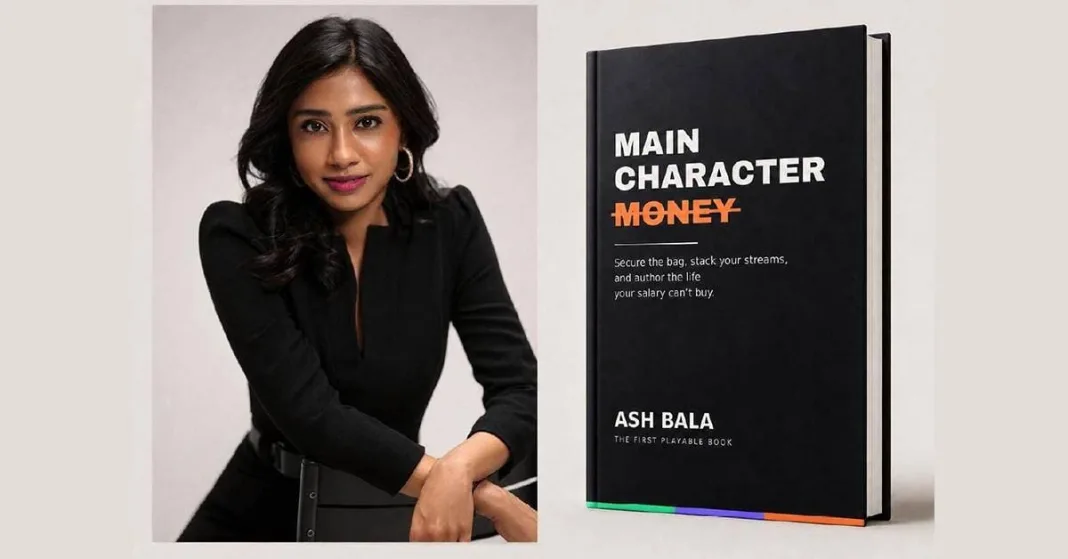
Now she has written down how – for a single salary, an individual side-hustle, a personal life. The publication is Main Character Money, and it launches worldwide. India is where it lands like a homecoming.
At the centre of the book is the 3-Lane Capital Map, which gives every payment three possible exits. Stabilise: rent, groceries, minimum repayments – 50 to 60 per cent of income, untouchable. Strategise: index funds, skills, earning power – 20 to 30 per cent, speculative bets capped at 5 to 10 per cent of the lane. Stylise: joy – 10 to 20 per cent, unlocked the moment the first two lanes are funded.
The guide runs its maths in readers’ own currencies – pounds in London, rupiah in Jakarta – and in rupees here: ₹85,000 a month in Mumbai becomes ₹45,000, ₹25,000, ₹15,000. Simple enough to run in your head. Structured enough to build wealth. Powered by the edge she took from the rooms she ran: “The smartest people in finance never predict. They position. They decide where every rupee lives before it arrives.”
Her fight with fifty years of Indian wealth morality is the third lane. Joy – budgeted, protected, guiltless – as a rule of wealth, not a leak. Every household that ever whispered “save first, live later” will argue with this book. Its readers – a generation refusing to choose between the SIP and the trip – will win that argument at their own dinner tables. Fifty readers aged 16 to 29 – London to New York to Delhi – got the manuscript first. The verdicts came back sounding less like reviews and more like relief.
The experience extends beyond the page through a “Playable Book,” featuring an AI coach, a 60-second “Sovereignty Score” diagnostic, and the FOMO Filter to guide spending decisions.
Behind it runs a marketing swarm of roughly 25 disclosed AI agents under single non-negotiable rule: readers always know when they’re speaking to an agent. Regulators worldwide still debate how to label synthetic content. She shipped the answer.
The homecoming is about more than the book. A trained dancer, recognised by a former President of India. A 16,000-ft skydiver, now earning her private pilot’s licence. Co-Chair of Women on the Wharf, among London’s largest women’s networks, after a decade among the few women in rooms where capital moves – holding the doors open behind her.
Ask what connects choreography to capital and you get the method in single line: “Choreography is systems thinking with music – structure first, then freedom.”
The nation gave her the structure. The world gave her the rooms. The book belongs to both: a global system, landing everywhere in 2026. But only here, in the country holding the fastest money on earth, does it land as a return.
The cover carries the thesis: “Money isn’t the main character. You are.”
India, your main character is finally coming home.
Disclaimer: No Business Standard Journalist was involved in creation of this content
First Published: Sep 04 2026 | 11:46 AM IST