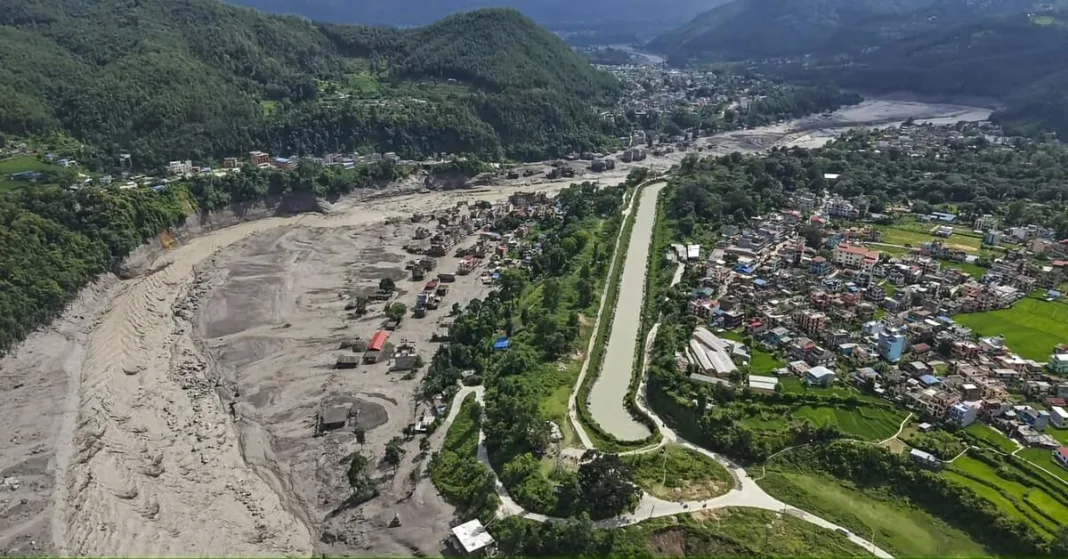

Nepal is reeling from the devastation caused by the August 26 flash floods. On September 3, the death toll stood at 1,252, and 4,216 people remain missing. But even as rescue and rehabilitation efforts remain in full swing, Nepal faces a second, potentially longer phase of the disaster: its impact on the economy and the country’s infrastructure.
Finance Minister Swarnim Wagle said that reconstruction and rehabilitation could require between $4 billion and $5 billion, according to a report in The Kathmandu Post. He cautioned that this was only a preliminary estimate because the complete extent of damage was yet to be assessed.
The figure is especially significant when compared with the size of Nepal’s economy.
The International Monetary Fund (IMF), in its June 2026 assessment, projected Nepal’s nominal gross domestic product (GDP) at $48.1 billion in 2026-27 (FY27). A $4-5 billion reconstruction requirement would therefore be equivalent to roughly 8-10 per cent of projected annual GDP.
While this does not mean the floods have wiped out 8-10 per cent of Nepal’s GDP, the comparison shows the scale of financing Nepal may have to mobilise relative to the size of its economy.
The IMF had projected central government capital expenditure at 4.8 per cent of GDP in FY27. On that basis, the preliminary $4-5 billion reconstruction requirement would be equivalent to roughly 1.7-2.2 times the central government’s projected capital expenditure for an entire year.
Was Nepal’s economy already facing pressure before the floods?
The floods arrived when economic momentum was not particularly strong. The World Bank’s April 2026 Nepal Development Update projected economic growth at 2.3 per cent in FY26, compared with 4.6 per cent in FY25, citing the lingering impact of last year’s GenZ protests and the ongoing West Asia crisis. The IMF also projected FY26 growth at 3 per cent, followed by 4.6 per cent in FY27.
More important for reconstruction is Nepal’s existing difficulty in executing infrastructure expenditure. According to the World Bank, only 12.1 per cent of the FY26 capital budget had been executed during the first half of the year.
Why damage to hydropower matters for Nepal
The most crushing blow to Nepal’s economy has been on the electricity sector. The United Nations Development Programme (UNDP), in a rapid assessment released on September 1, said 11 hydropower stations and one solar facility with a combined capacity of 431.1 megawatts (MW) had stopped operating. Another 15 power projects under construction, with a planned capacity of 470 MW, were damaged.
Hydropower has increasingly become an export industry for Nepal. According to the Nepal Electricity Authority (NEA), Nepal exported electricity worth Nepalese Rs (NPR) 29.32 billion to India and Bangladesh in FY26 while importing electricity worth NPR 10.55 billion, producing an electricity-trade surplus of NPR 18.76 billion, The Kathmandu Post reported.
The flood has already disrupted those exports. Nepal had been exporting around 1,000 MW on average during the wet season, but exports had dropped to about 650 MW by September 2, according to the NEA. Electricity exports to Bangladesh stopped after projects supplying that market were damaged.
Damaged roads can multiply the economic losses
Roads present a similar problem. The Department of Roads said around 40 km of roads between Rasuwagadhi and Malekhu had been damaged, while 41 bridges were damaged or destroyed. The department estimated damage to roads, bridges and related infrastructure alone at around NPR 20 billion, according to The Kathmandu Post. Nepal has sought support from India and China to install 42 Bailey bridges to restore connectivity.
A separate assessment by the department found that the 42-km Betrawati-Rasuwagadhi road, which connects Nuwakot with Nepal’s border with China, had been damaged at multiple points.
Impact on Nepal-China trade
The August flood destroyed customs infrastructure in the area, while hundreds of containers were believed to have been buried or swept away. Officials had not yet established the full value of the goods lost as of September 1.
The disruption becomes more significant because Nepal has limited alternatives on its northern border.
With Rasuwagadhi and Tatopani disrupted, traders have begun diverting cargo through the Korala crossing in Mustang. But Korala handled imports worth only NPR 14.4 billion in FY26, compared with NPR 45.73 billion through Rasuwa and NPR 47.48 billion through Tatopani, according to customs figures cited by The Kathmandu Post. The Korala facility also has limited capacity and lacks a proper customs yard.
Impact on agriculture
The floods have also hit areas dependent on farm income. UNDP said government estimates showed 84,270 people across 17 municipalities in six districts had been affected. Most affected municipalities are rural and located in Nepal’s hill regions, where 67.4 per cent of people work in agriculture.
The timing was particularly damaging because Nepal’s main monsoon planting season runs from June to September. UNDP said damage to crops, livestock and farmland could have lasting consequences for household incomes and food security.
Can tourism suffer even where hotels were not destroyed?
Tourism contributes around 6-7 per cent to Nepal’s GDP. The floods have also begun affecting travel demand through cancellations, including in destinations where the immediate problem is access rather than damage to hotels. According to a report in The Kathmandu Post, Nepal received 85,444 foreign visitors in August, down 3.65 per cent year-on-year, with cancellations surging in the final week after the floods struck.
Langtang Valley in Rasuwa was cut off from the district headquarters at Dhunche after roads, bridges and trails were destroyed. Local officials told The Kathmandu Post that travelling to Dhunche on foot could take two days and that helicopters had become the only practical option for some movements.
According to the local ward office cited by the newspaper, more than 25,000 domestic and foreign tourists visit the Langtang region annually.
Why will simply clearing the destruction be expensive?
Before large-scale reconstruction can begin, Nepal must first clear what the floods left behind. UNDP estimates at least 2.2 million tonnes of debris have accumulated within the areas assessed so far. About 556,200 tonnes is building-related debris, based on satellite assessments covering 2,359 buildings.
Its preliminary modelling estimated $158.6 million in potential building damage, with an uncertainty range of plus or minus 30 per cent. UNDP explicitly cautioned that this figure did not represent total disaster losses.
Debris removal itself consumes money and resources. Roads must be cleared, unstable structures identified, sediment moved, and disposal locations found before rebuilding can properly begin.
What Nepal’s 2015 earthquake reconstruction suggests
Nepal has faced a comparable reconstruction challenge before. After the 2015 earthquakes, the government estimated damage and losses of around $7 billion and recovery requirements of about $6.7 billion, equivalent to roughly 30 per cent of GDP at the time, according to the World Bank.
The National Reconstruction Authority, established in December 2015, oversaw rebuilding and coordinated donors. Homeowners received grants of NPR 300,000 in three tranches, with payments linked to inspections and compliance with earthquake-resistant construction standards. Engineers and masons were trained to promote safer building practices, while digital systems were used to track beneficiaries, inspections and payments.
The reconstruction also extended beyond housing. With support from development partners, Nepal rebuilt schools, roads and government buildings to higher resilience standards. The Asian Development Bank says its programme reconstructed 154 school buildings, rehabilitated 301 km of district roads and rebuilt or repaired more than 100 government buildings.
The experience after the 2015 earthquake offers Nepal a reconstruction template, but the latest disaster presents a different challenge. Restoring damaged roads, power projects and settlements quickly could limit the immediate economic losses, while rebuilding them to withstand future floods may require more money, planning and time.