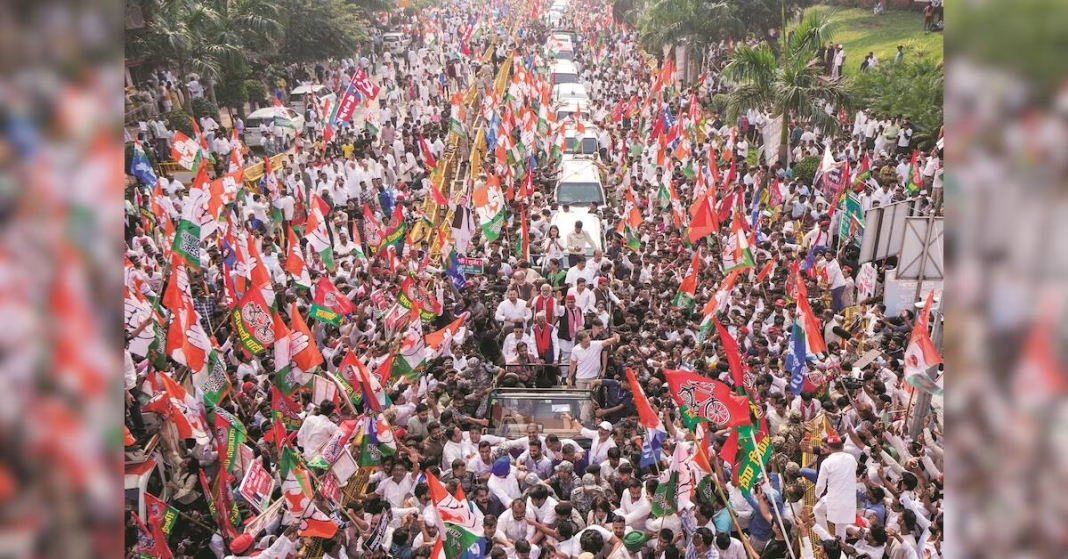

The Congress-led INDIA bloc put up a united front at Delhi’s Ramlila Maidan on Sunday, bringing together Opposition leaders and thousands of supporters to protest what they allege is large-scale “vote chori (vote theft)” through the Election Commission’s Special Intensive Revision (SIR) of electoral rolls. Opposition leaders accused the poll body of undermining the Constitution and democracy, denying citizens their electoral rights and facilitating the concentration of wealth in the hands of a few.
The rally was among the largest Opposition gatherings in the city in recent years, offering the bloc an opportunity to demonstrate its organisational strength at a time when questions persist over its cohesion and political reach.
After the Centre denotified Jantar Mantar as a designated protest site on October 11, the challenge before the INDIA bloc was not merely to sustain the momentum of its “vote chori” campaign until the Winter Session of Parliament, but to demonstrate its ability to fill the much larger Ramlila Maidan. A gathering of around 3,000 is enough to fill Jantar Mantar, while Ramlila Maidan, which has hosted several iconic protests over the decades, can accommodate 50,000 people.
Vehicles carrying INDIA bloc leaders made their way from Minto Road, near Connaught Place, towards Ramlila Maidan, accompanied by thousands of supporters marching alongside. The two-kilometre journey took more than two hours. If the bloc’s October 12 march from Connaught Place to the Supreme Court was a trial run, Sunday’s procession and rally turned out to be a show of strength.
The size of the gathering, and whether the INDIA bloc is united beyond such demonstrations, remained at the centre of the political discourse.
The ruling Bharatiya Janata Party (BJP) leader Sambit Patra claimed that the Congress leadership had promised a turnout of one million but only a handful eventually turned up. The Janata Dal (United), or JD(U), a constituent of the BJP-led National Democratic Alliance, questioned the coherence of an alliance whose parties come together for rallies but contest elections against one another. JD(U) National Spokesperson Rajeev Ranjan Prasad said an alliance without consensus on leadership,
a common agenda and shared issues had no justification for continuing.
The BJP responded to the INDIA bloc rally with ‘Loktantra Bachao, Arajakta Hatao (Save Democracy, Reject Anarchy)’ marches. Party National President Nitin Nabin led one in Haryana’s Rohtak, accusing Leader of the Opposition in the Lok Sabha Rahul Gandhi of acting at the behest of foreign powers to create anarchy in the country.
Nabin said that instead of expressing remorse and apologising for the 1984 anti-Sikh riots, the Congress had chosen to protest on the anniversary of the killings in Delhi. “Modi ji kahin nahin jayenge, 2029 mein phir se Lal Quilay ki prachir se nazar aayenge (Modi will not go anywhere; he will be seen again from the ramparts of the Red Fort in 2029, after the Lok Sabha polls).”
Responding to the Opposition’s allegation that 130 million voters had been deleted from electoral rolls, Nabin claimed that 25 million were deceased, 60 million had shifted residence and 30 million were “ghuspaithiya (infiltrators)”. However, a Hindustan Times report published last week said around 1,600 people had been identified as foreign citizens on electoral rolls in six states where the SIR exercise had been conducted.
The BJP also held rallies in Assam’s Morigaon and Himachal Pradesh’s Shimla. Maharashtra Chief Minister Devendra Fadnavis and Union Minister Nitin Gadkari are scheduled to lead a ‘Save Democracy, Reject Anarchy’ march in Nagpur on November 5, marking the culmination of the party’s nationwide campaign against what it calls Opposition propaganda about democratic institutions.
The INDIA bloc rally saw significant mobilisation by the Congress, Left parties and the Samajwadi Party. The Cockroach Janta Party (CJP), the youth outfit behind July’s anti-paper leak protests that forced Dharmendra Pradhan to quit as Union education minister, had expressed solidarity with the rally, but its leadership did not attend.
The CJP’s absence underlined the Opposition’s continuing difficulty in drawing urban, educated youth and the middle class to its rallies. Several speakers, including Communist Party of India (Marxist-Leninist) Liberation leader Neha Bora, raised the issue of young voters being disenfranchised. Former West Bengal Chief Minister Mamata Banerjee was the only speaker to mention the CJP by name and congratulate its leadership. She had met CJP leader Abhijeet Dipke in the national capital on Saturday evening.
The rally followed a mock Parliament held at Congress President Mallikarjun Kharge’s residence on Saturday, where INDIA bloc leaders and others staged a symbolic “public impeachment” of Chief Election Commissioner (CEC) Gyanesh Kumar. They accused him of facilitating vote deletions to influence election outcomes and demanded that he be tried for treason and jailed.
Gandhi claimed that more than 130 million votes, representing around 15 per cent of India’s electorate, had been deleted. The difference between the Opposition and those who won the 2024 general election was only three percentage points, he said, arguing that the Election Commission’s actions raised questions about the election’s legitimacy.
“You cannot delete these voters and still claim that the 2024 election was legitimate,” Gandhi said. He repeated the allegations at Sunday’s rally, as he warned that Kumar would eventually be removed and jailed for “treason”, while Prime Minister Narendra Modi and Home Minister Amit Shah would also face legal action.
“The country will get justice, and for the vote chori and selling the country to Adani, we will seek justice for that,” he said. “Don’t think of fleeing; you cannot flee. You will stay here, and this voice (of the people) will ensure action against you, Amit Shah and Gyanesh Kumar.”
Referring to the turnout, Gandhi said a message had been sent to Modi, Shah and the CEC.
Citing Banerjee’s remarks about alleged vote theft in West Bengal, Gandhi claimed that similar practices had affected elections in Madhya Pradesh, Haryana, Chhattisgarh and Maharashtra, as well as the 2024 Lok Sabha polls. He alleged that manipulation had taken place through electronic voting machines (EVMs) and the deletion and addition of names on electoral rolls.
Gandhi cited 135 million deletions after the 2024 polls, describing this as one in every seven voters, or around 15 per cent of the electorate. The difference between the Opposition and the NDA, he reiterated, had been three percentage points.
Samajwadi Party chief Akhilesh Yadav claimed that at least 12.7 million names had been deleted from Uttar Pradesh’s electoral rolls and referred to fresh reports of alleged irregularities, including from Pilibhit.
Yadav also raised allegations of donation theft at Ayodhya’s Ram temple, the recently concluded Legislative Council elections, in which the BJP lost in Varanasi, inflation and the falling value of the rupee.
He reiterated his resolve to defeat the BJP in the forthcoming Uttar Pradesh Assembly elections.
The Opposition managed to put up a strong show on Sunday. Its challenge in the coming weeks will be to sustain the momentum around alleged vote theft, draw urban voters, particularly educated youth and the middle class, into the campaign, and link the issue to concerns over livelihoods and jobs.