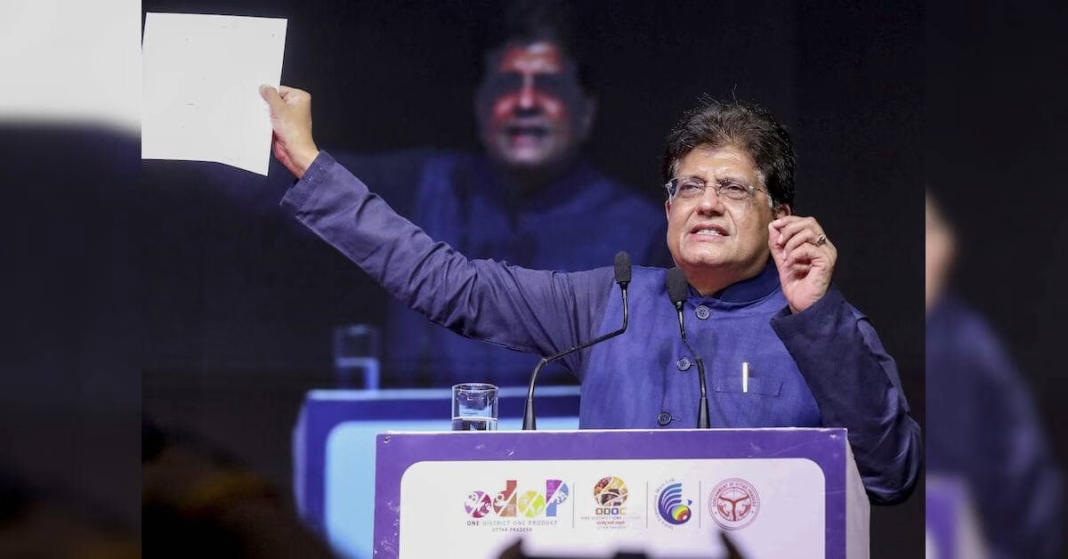

India would stand to gain a strong comparative advantage once its trade agreement with the United States (US) is finalised, Union Commerce and Industry Minister Piyush Goyal said on Thursday. All of India’s sensitive interests would remain protected under the deal, he added.
“I have the courage of conviction to announce that the US trade deal — once details are out — the people of India will celebrate that not a single sensitive interest of our farmers or any stakeholder has been compromised,” Goyal said at an event organised by the Institute for Studies in Industrial Development.
“On the contrary, India will stand at a very strong comparative advantage. And trade is about comparative advantage.”
The conversations around the India-US trade deal have become optimistic after US Secretary of State Marco Rubio visited India earlier this month. During the visit, Rubio had said that the trade deal was only weeks away from conclusion. Recently, Goyal had also reiterated that the trade deal was close to finalisation.
India has concluded eight trade agreements over the past six years and is negotiating several more, as the government seeks to diversify trade and widen market access for domestic exporters.
In the current financial year itself, India has implemented three free trade agreements (FTAs)–with Oman, the United Kingdom (UK), and New Zealand. It is also set to sign an FTA with the European Union (EU) by December.
Each of these agreements covered 38 developed, relatively much more prosperous countries and therefore, they are not in competition with India, Goyal said. “We complement each other. Products that we need to export, they need, and products that they need to export, we need. It’s a win-win situation.”
The government prioritised striking a balanced deal during negotiations with these economies, the minister said. “Imbalanced agreements cannot get you far. All the agreements prior to 2014 only covered $10 trillion (of the global economy), and were largely with countries that were in competition with us,” Goyal said.
Before 2014, India had trade agreements with Japan, South Korea, and the Association of Southeast Asian Nations (Asean), most of which were skewed and led to an extensive widening of the trade deficit after implementation.
Goyal also said that the Regional Comprehensive Economic Partnership (Rcep) would have been the death knell of manufacturing in India, as it would have been equivalent to having an FTA with China.
Besides China, Rcep comprises that Asean members, Australia, New Zealand, Japan, and South Korea. India was also initially a part of the Rcep negotiations. However, New Delhi decided to withdraw from the talks in November 2019 in Bangkok.
“I tell you that one single act of 4th of November, 2019 in Bangkok is the reason today we are discussing manufacturing and India’s industry,” Goyal said. “Otherwise, we would have been a nation of salesmen and salesgirls marketing Chinese goods in India,” he added.