

September 10, 2026 17:12 GMT+5:30
Thailand is moving closer to a more commercially usable overland tourism corridor through Malaysia towards Singapore, not because one new railway has suddenly opened, but because several separate barriers are being addressed at once. A new road border is operating, one-ticket rail integration is planned, dormant rail and ferry links are under revival, Malaysia is improving multimodal booking distribution, and Singapore’s Johor Bahru RTS is approaching its end-2026 opening. The result could reshape how agents package Hat Yai, Malaysia and Singapore without relying on an international flight for every sector.
Thailand’s New Overland Opportunity Is About Removing Friction Rather Than Building One Route
The most important development for travel businesses is easy to miss when the individual infrastructure projects are viewed separately.
Thailand and Malaysia are not building a single railway from Singapore to Bangkok. Nor has a unified three-country ticket been announced. What is taking shape is potentially more significant for itinerary design: several different sources of friction across the Malay Peninsula are being tackled simultaneously.
According to the Royal Thai Government, Thailand and Malaysia agreed in July to accelerate a single-ticketing system covering the Bangkok–Hat Yai–Butterworth railway route, restore the Su-ngai Kolok–Rantau Panjang railway connection, revive ferry services between Satun and Kuala Perlis and improve cross-border infrastructure. The Malaysia–Thailand joint statement separately confirms a policy commitment to multimodal connectivity and stronger tourism links through road, rail, air and sea transport.
Advertisement
Advertisement
That distinction matters. For travellers, infrastructure becomes useful only when services can be booked, borders crossed predictably, connections protected and onward travel easily arranged.
| Corridor element | Verified position on 10 September 2026 | Travel friction being addressed | What remains unresolved |
|---|---|---|---|
| Sadao–Bukit Kayu Hitam road | Operational since 11 July | Road-border access and physical checkpoint connectivity | Peak-period immigration delays and vehicle formalities can still affect journeys |
| Bangkok–Hat Yai–Butterworth ticketing | Governments agreed to accelerate single ticketing | Fragmented rail booking | No official launch date for the unified system found |
| Su-ngai Kolok–Rantau Panjang railway | Revival remains under discussion and implementation planning | Missing eastern cross-border rail continuity | No passenger reopening date announced |
| Satun–Kuala Perlis ferry | Governments have agreed on revival | Missing sea link between southern Thailand and northern Malaysia | No official timetable, fare structure or commencement date found |
| Singapore–Johor Bahru RTS | Targeted for end-2026 passenger opening | Congestion and immigration friction at the southern gateway | Service has not yet opened |
| Singapore–Malaysia multimodal distribution | Tourism Malaysia collaboration launched in 2026 | Fragmented booking of buses, trains and ferries | Does not yet constitute a Thailand–Singapore through-ticket system |
The new angle is therefore commercial connectivity. The peninsula already has transport. What it has lacked is sufficient integration to make complex overland holidays as straightforward to sell as conventional point-to-point trips.
Hat Yai Already Has the Demand Base Needed for an Overland Tourism Hub
Thailand is the principal country in this story because southern Thailand already receives substantial Malaysian traffic by land.
Official Thai government information citing immigration data recorded 2,054,203 Malaysian tourists entering Thailand between 1 January and 21 June 2026. Of these, 1,768,663 arrived through land checkpoints, equivalent to 86.1 per cent. Sadao alone handled 1,041,816, about 50.7 per cent of all Malaysian tourist arrivals during that period.
Advertisement
Advertisement
Those figures change the interpretation of the new infrastructure.
The projects are not attempting to persuade an overwhelmingly air-dependent market to experiment with land travel. They are improving a travel pattern that already exists at scale.
Hat Yai becomes particularly important in that structure. The Tourism Authority of Thailand describes the city as southern Thailand’s major transport, commerce and tourism centre and identifies it as a gateway towards Malaysia and Singapore.
That gives the planned Bangkok–Hat Yai–Butterworth single-ticket system a tourism significance beyond railway convenience. A simpler booking path could allow Hat Yai to function as a genuine interchange between longer-distance Thai rail journeys and Malaysia’s peninsula network.
It could also make stops in Songkhla and surrounding southern destinations commercially easier to insert into multi-night itineraries instead of treating southern Thailand primarily as a border transit zone.
The Sadao Upgrade Has Already Changed One Part of the Journey
Unlike several projects in the package, Sadao is not theoretical.
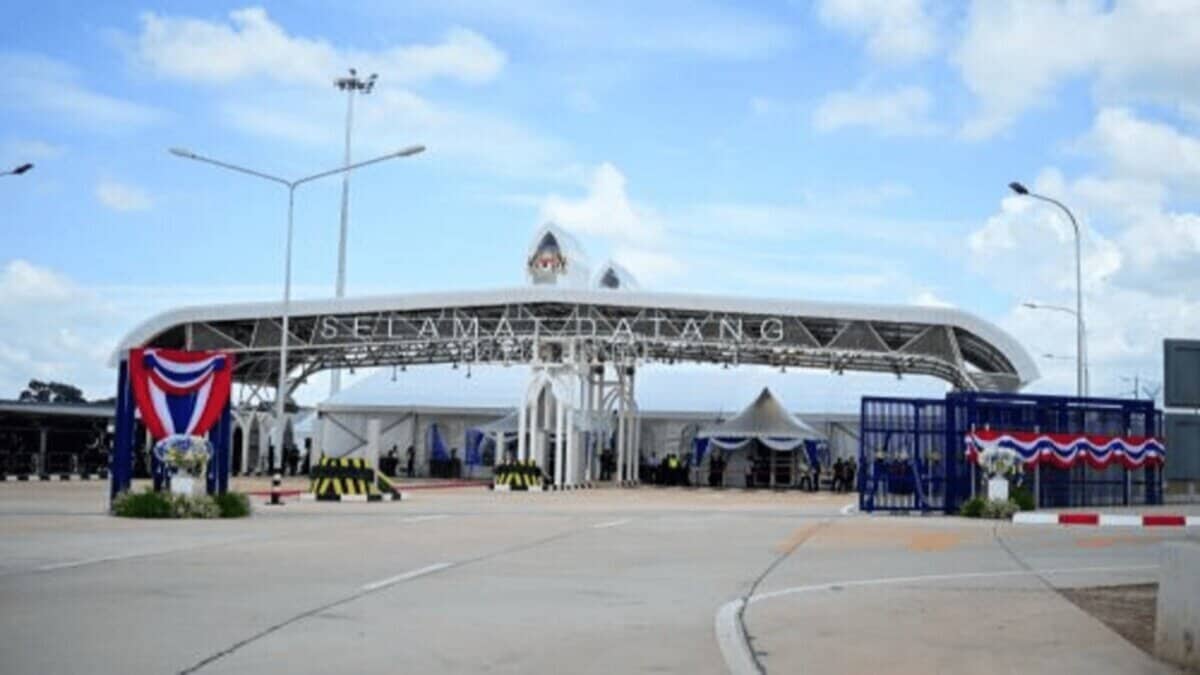
The road connection between Thailand’s new Sadao Customs House in Songkhla and Malaysia’s Bukit Kayu Hitam complex officially opened on 10 July and became available for public movement from 11 July 2026. Thailand authorised the new permanent crossing to operate from 05:00 to 23:00 Thai local time each day.
Thai authorities are explicitly positioning this infrastructure around private-car, caravan and cross-border tourism, alongside plans to spread visitors from Hat Yai towards other southern destinations.
This matters for agents designing road programmes from Malaysia. The principal western road gateway can now be treated as functioning infrastructure, while the ferry and eastern railway proposals should still be regarded as forward inventory rather than confirmed transport products.
The operational difference is important. Marketing the whole corridor as already seamless would be inaccurate.
Malaysia Is Becoming the Distribution Layer Between Thailand and Singapore
Malaysia is the indispensable middle country because virtually any continuous Singapore-to-southern-Thailand surface itinerary must cross it.
Its visitor data also show that land travel is structurally important in the opposite direction. According to Tourism Malaysia, 91.6 per cent of Malaysia’s 2.5 million Thai visitor arrivals in 2025 entered through land borders.
That creates a striking two-way pattern.
| Official flow indicator | Volume | Why it matters |
|---|---|---|
| Malaysian tourists entering Thailand, 1 Jan–21 Jun 2026 | 2,054,203 | Large near-haul tourism market |
| Malaysian tourists reaching Thailand through land borders | 1,768,663 | 86.1 per cent of the Malaysian market |
| Malaysian tourists using Sadao | 1,041,816 | More than half of the measured Malaysian arrivals |
| Thai visitors to Malaysia in 2025 | Around 2.5 million | Major reciprocal travel market |
| Share of those Thai arrivals using land borders | 91.6 per cent | Shows overland travel is established in both directions |
Malaysia is also working on the booking side of the equation. During its 2026 Singapore tourism promotion, Tourism Malaysia partnered with BusOnlineTicket.com specifically to streamline high-volume overland movement between Singapore and Malaysia through bus, rail and ferry inventory.
That development becomes much more interesting when read beside Thailand and Malaysia’s proposed Bangkok–Hat Yai–Butterworth single-ticket arrangement.
One addresses travel distribution south of the peninsula. The other seeks greater railway booking integration at its northern end.
They are separate initiatives, but together they expose where the next competitive battle may sit: not simply in building transport capacity, but in making multi-country surface journeys easy to discover, combine and purchase.
Johor Bahru Is the Southern Anchor Travel Sellers Should Watch
Singapore introduces scale as well as urgency.
Its Immigration and Checkpoints Authority is currently warning of very heavy traffic at Woodlands and Tuas from 4 to 14 September 2026, meaning the warning remains relevant on the publication date of this article.
During the National Day weekend from 7 to 10 August, more than 2.1 million traveller crossings were recorded at the two land checkpoints. Volume exceeded 593,000 crossings on 7 August alone, while car travellers encountered waits of up to three hours during peak periods. These figures represent traveller movements rather than tourist arrivals, but they demonstrate the extraordinary pressure on the Singapore–Malaysia land interface.
This is why the Johor Bahru–Singapore Rapid Transit System Link matters to the wider tourism proposition.
According to Singapore’s Land Transport Authority, the approximately four-kilometre RTS will connect Woodlands North with Bukit Chagar in Johor Bahru, offer a rail journey of about five minutes and support up to 10,000 passengers per hour in each direction during peak periods. Customs, immigration and quarantine facilities will be co-located so passengers clear both countries’ formalities before departure. Passenger service remains targeted for the end of 2026.
Malaysia Rapid Transit Corporation has identified 31 December 2026 as the targeted service commencement date in its project material. Construction-related traffic arrangements around Johor Bahru also remain active, reinforcing that this is still an implementation-stage project rather than usable tourism inventory today.
A Singapore to Thailand Holiday Becomes More Interesting Once the Journey Can Be Packaged
The information gain for travel agents lies in connecting these developments commercially.
Imagine the peninsula not as three separate national destinations but as several saleable surface-travel modules.
Singapore and Johor Bahru could form the high-volume southern gateway. Malaysia’s railway and coach network provides the central northbound movement. Butterworth can feed Penang and northern Malaysia. Hat Yai becomes the principal Thai urban gateway. Sadao supports road-based products. Satun–Kuala Perlis could eventually provide a maritime branch. Su-ngai Kolok–Rantau Panjang could eventually reopen another eastern land-rail option.
That is a fundamentally different tourism proposition from a single railway story.
It allows operators to consider open-jaw and mixed-mode itineraries in which customers travel by rail in one direction, road in another and potentially ferry through the Andaman-side border region.
It could also increase overnight stays in gateway cities because transfers stop being merely administrative border events and become natural break points in longer journeys.
There is no official evidence yet that these developments are reducing demand for short-haul flights. The correct current interpretation is that they may give travellers more surface alternatives. Any claim of a measurable air-to-rail or air-to-road shift should wait for passenger and booking data.
Travellers Can Use Parts of the Spine Now But Not the Entire Product
Existing railway inventory already shows that demand does not have to wait for every infrastructure project.
KTMB’s official 2026 MySawasdee programme lists a KL Sentral to Hat Yai departure on 25 September 2026 and a return from Hat Yai on 28 September among its scheduled services. KTMB’s booking environment also includes Hat Yai and Butterworth within its network inventory.
But travellers should distinguish between an existing cross-border train, a planned integrated ticketing system and an eventual peninsula-wide itinerary.
The official material reviewed for this report does not yet provide a single Singapore-to-Hat Yai or Singapore-to-Bangkok booking reference covering the entire journey. Nor does it publish an operational date for the revived Satun–Kuala Perlis ferry or Su-ngai Kolok–Rantau Panjang passenger railway.
That gap is precisely why the emerging story is commercially important.
Late October Is the Next Thailand Malaysia Connectivity Watchpoint
The latest official development came only days before this article.
According to Thailand’s Ministry of Foreign Affairs, Thai and Malaysian foreign ministers followed up on the July agreements during meetings in Kuala Lumpur on 7 September 2026, with transport connectivity remaining part of the bilateral agenda.
Thailand is due to host the 16th Joint Commission for Bilateral Cooperation and the 7th Ministerial Joint Development Strategy for Border Areas meeting in late October 2026.
Those meetings now deserve close attention from rail operators, destination management companies and regional tour planners. The official announcement does not guarantee that launch dates will emerge, but the meetings provide the next clearly identified bilateral forum through which border development and connectivity can advance.
Operational Takeaways for Travel Agents and Tour Operators
- Sell the corridor as an emerging multimodal option, not as an already seamless Singapore–Thailand through journey.
- Treat Sadao–Bukit Kayu Hitam as operational inventory, while keeping the Satun ferry and Su-ngai Kolok railway outside guaranteed programmes until launch details are published.
- Separate existing KTMB services from the proposed Bangkok–Hat Yai–Butterworth single-ticket system.
- Build additional contingency time into Singapore–Johor Bahru sectors, particularly around weekends and school holidays while the RTS remains unopened.
- Monitor the late-October Thailand–Malaysia bilateral meetings for implementation details, border facilitation measures and possible project timetables.
- Recheck nationality-specific immigration requirements before selling multi-country packages, particularly because Thailand’s revised tourism visa framework takes effect on 15 September 2026.
- Design products around overnight stops in Hat Yai, Penang, Kuala Lumpur and Johor Bahru rather than treating every city solely as a transfer point.
- Do not advertise a shift away from aviation as an established market trend until official modal-share or passenger data support it.
What This Could Mean for International Overland Travel
The larger strategic development is not the creation of a single spectacular new railway. It is the gradual reduction of multiple small barriers that collectively make international surface holidays difficult to sell.
Thailand has the northern destination demand and border gateways. Malaysia supplies the geographical bridge, rail network and growing distribution layer. Singapore provides a huge southern movement market whose principal land gateway is about to receive a major capacity and immigration-processing upgrade.
If the proposed rail ticketing, eastern railway restoration and ferry revival move from policy into regular passenger operation, travel companies could eventually assemble a much stronger Singapore–Malaysia–southern Thailand multimodal product.
The route will become truly transformative only when physical links, timetables, border processes and distribution systems work together. As of 10 September 2026, that point has not been reached. But for the first time, several of the pieces required to reach it are advancing at the same time.
FAQs
Is there currently one direct rail ticket from Singapore to Thailand?
No. Official sources reviewed on 10 September 2026 do not show a single through ticket covering Singapore, Malaysia and Thailand. Thailand and Malaysia are working towards integrated ticketing for Bangkok–Hat Yai–Butterworth.
Why is Hat Yai central to this developing corridor?
Hat Yai is southern Thailand’s major transport and commercial centre and is officially identified by the Tourism Authority of Thailand as a gateway towards Malaysia and Singapore. Its position makes it a logical interchange for road and rail tourism.
Has the Satun–Kuala Perlis ferry restarted?
Thailand and Malaysia have formally supported its revival, but the official material reviewed for this report does not yet provide a confirmed passenger launch date, timetable or fare structure.
When will the Johor Bahru–Singapore RTS open?
Singapore authorities continue to target passenger service for the end of 2026. Malaysian project documentation has cited 31 December 2026 as the target date.
Could these projects replace flights between Singapore, Malaysia and Thailand?
They could create stronger alternatives for travellers who prefer rail, road or mixed-mode holidays. There is currently no official evidence showing that the projects have already caused a measurable shift away from short-haul aviation.
Advertisement
Advertisement