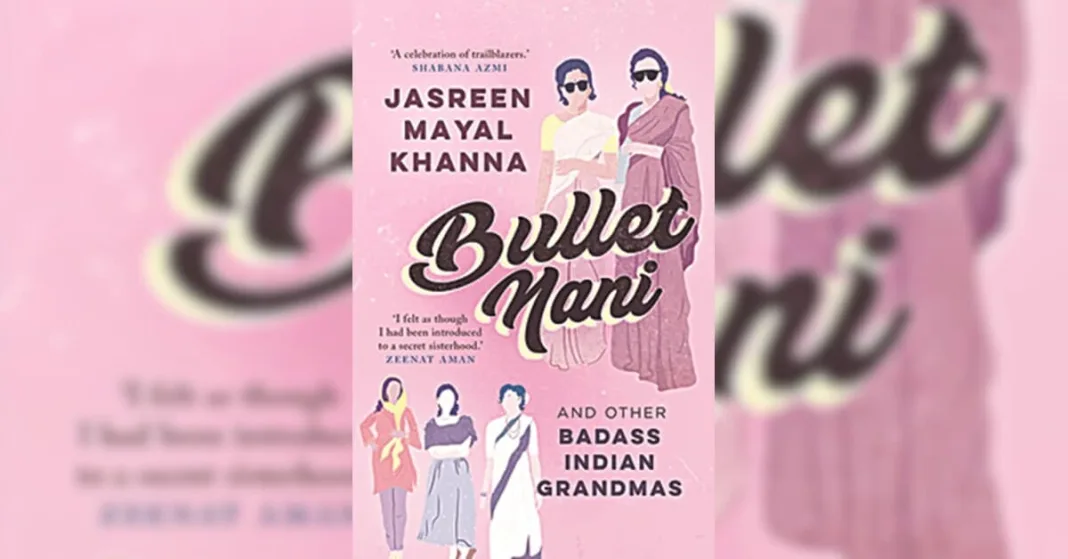

Bullet Nani and other Badass Indian Grandmas
by Jasreen Mayal Khanna
Published by Pan Macmillan India
260 pages ₹399
What do we think about when we think about our grandmothers? Do we catalogue memories of them under a blanket notion of a generation whose contributions are reduced to time-tested home remedies and family recipes?
When I think of my maternal grandmother, yes, I do think of her fragrant Bengali fish curry but I remember her more deeply for her unconventional choices in family life, her passion for news and politics and her far-reaching activism as part of India’s major social movements.
The first generation of women of independent India carried within them important fragments of our history. Many of them have been trailblazers but we rarely read about their intriguing and eventful lives unless they were household names.
Bullet Nani and other Badass Indian Grandmas is a welcome course correction. It is a rip-roaring, rule-breaking and a fiery celebration of early feminists who broke stereotypes and challenged patriarchy — from a nuclear scientist to a winemaker, a war-zone medic to a martial artist, a police officer to a Youtube sensation.
The idea was sparked by loss. When writer Jasreen Mayal Khanna’s grandmother died in 2021, she couldn’t stop thinking about brave choices she made for her time, raising a daughter as a single parent after leaving her difficult marriage in the 1950s. She wondered if there were other grandchildren who had grandmothers they similarly admired. And so sent out a message into the ether, a.k.a Instagram, asking people to get in touch if anyone knew a feminist grandmother with an inspiring life story.
In response, she was flooded with hundreds of messages about women who fit the bill. Ms Khanna focused on women who were still alive, so she could interview them in person and capture their accounts in their own voice. Her selection of 12 stories that made it to the final book is diverse, cutting across 10 states, professions, culture and privilege.
We meet Dr Ramindar Dhillon, the titular Bullet Nani, who after spending her youth raising a family, chose adventure. She joined the United Nations in her 50s as a doctor serving in war zones. Now 80 years old, she is never short of an eye-popping tale, including a brush with the Taliban and surviving a bomb blast in Afghanistan.
The most moving account for me was Rahmath Beegum’s, whom Khanna terms “Lakshwadeep’s Hero,” who earned a medical education against all odds — literally across the ocean, even surviving a near-death experience on a shipwreck. She went on to become the first female doctor on the islands, and later the only gynaecologist there in the 1970s. She drove significant progress in maternal and child health and medical infrastructure in the region, saving many lives and earning immense goodwill, including a Padma Shri in the 1990s.
Then there’s the fiery tale of Augusta Maria do Rosario Noronha, who was born in an aristocratic Portuguese family and married at 18, who took over her in laws’ failing wine business at a time when no one had heard of women in the alcohol business — and made a remarking success of it, fighting threats, goons, even the police. Gita Prakash, the doctor who transformed into a successful model for top fashion designers aged 57 may be a familiar story to some, but not many would know that behind the glamour was a deep personal struggle as she juggled caregiving for multiple family members with devastating health concerns.
Ms Khanna is able to draw out compelling stories and anecdotes from each of the grandmothers, tracing their journeys back to childhood, exploring the circumstances that shaped them, along with their reflections and bits of advice to younger folk. The women do not shy away from sharing the pitfalls of leading unconventional lives. The book could have done with sharper writing though, as the narrative slips into a formulaic pattern after the first couple of stories, at times over-explaining their courage and choices.
Their experiences have tremendous value just as they are, no hyperbole required. The defining feature is determination. Like Imphal-based Loukrakpam Naobi, who made the tougher choice of leaving her husband when he took a second wife, raising their six daughters on her own. Like the IPS officer Sridevi Goel, who prioritised duty above everything else. Some had progressive parents and spouses to help; others had to persist and resist, driven by an intrinsic sense of adventure or moral duty to do more than what was expected. Despite dealing in weighty themes, the book is written with a light touch, and doesn’t moralise or sensationalise their journeys.
At its heart, it is inspiring, with enough soul to stir readers across generations.
The reviewer is a Delhi-based journalist and author who reports on gender, policy, public health and culture