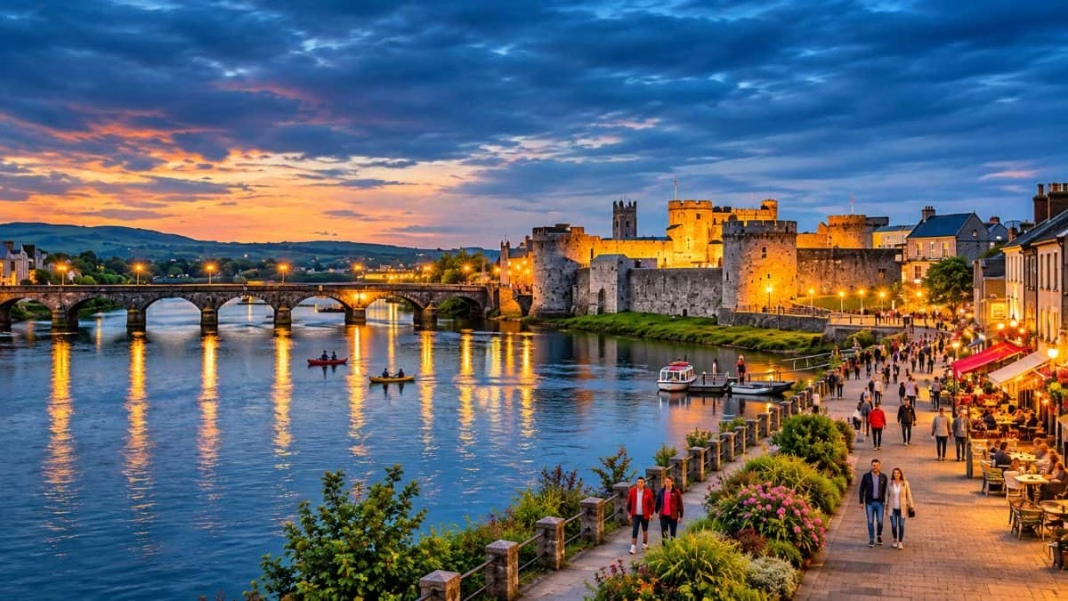


Ireland has positioned its historic Mid-West region at the forefront of European cultural tourism, drawing discerning visitors from the United Kingdom, the United States, Germany, and France toward the storied banks of the River Shannon. While Dublin and Galway have long dominated international itineraries, Limerick is emerging as a vital destination for travellers seeking authentic medieval architecture, thriving independent brewing, and dramatic riverfront landscapes. Located roughly midway between Galway and Cork, the Republic’s third-largest city blends nine millennia of surrounding human settlement with a contemporary arts and sporting renaissance, offering an unhurried alternative to the heavily trodden tourist corridors of western Europe.
Strategic aviation links through nearby Shannon Airport have accelerated this shift, connecting Limerick directly with major transatlantic and continental hubs including Boston, Chicago, London, and Edinburgh. Within a thirty-minute drive of the terminal, visitors pass the fifteenth-century towers of Bunratty Castle before arriving in a city shaped by Viking founders in 922 and Norman builders in 1195. Today, Limerick’s preservation of its Georgian quarters, thirteenth-century fortifications, and traditional public houses reflects a broader international appetite for heritage-led travel, where historical depth and local culinary craftsmanship take precedence over commercialised sightseeing across the modern European travel landscape.
Advertisement
Advertisement
Regional Connectivity and International Visitor Markets
The resurgence of Limerick within the broader Irish hospitality sector demonstrates how secondary cities are capturing global market share through targeted cultural investment and accessible transport infrastructure, as outlined in the Limerick City and County Council Tourism Plan 2025–2030. Travellers arriving from North America and neighbouring European nations increasingly favour regional gateways that eliminate lengthy transfers while delivering immediate immersion into local traditions, a shift supported by national destination development initiatives from Fáilte Ireland. By capitalising on its proximity to the Wild Atlantic Way, the Dingle Peninsula, and Killarney National Park, Limerick functions both as a standalone urban retreat and as a strategic base for extended coastal expeditions throughout the south-west of the island.
Ireland
Within Ireland itself, Limerick occupies a distinctive cultural and geographical niche that sets it apart from both the bustling capital of Dublin and the bohemian harbour streets of Galway. Domestic visitors frequently travel to the city for marquee rugby fixtures at Thomond Park Stadium, theatrical performances, and exhibitions detailing the military legacy of the Wild Geese. Furthermore, the city boasts the nation’s second-largest collection of Georgian architecture, providing an elegant streetscape of red-brick townhouses that complements its older stone fortifications and reinforces its status as a premier domestic heritage destination.
United Kingdom
Visitors from the United Kingdom represent one of the most consistent pillars of Limerick’s tourism economy, supported by frequent short-haul flights into Shannon Airport from London and Edinburgh. British travellers are particularly drawn to the shared, complex historical narratives embedded within Limerick’s stone monuments, notably King John’s Castle, which bears the name of the twelfth-century English monarch immortalised in folklore. Exploring the 1691 Treaty Stone along Clancy’s Strand allows British guests to engage directly with the pivotal events that reshaped seventeenth-century Anglo-Irish relations while enjoying warm local hospitality.
United States
Transatlantic arrivals from the United States form a vital demographic for the Mid-West region, facilitated by direct air corridors linking Boston and Chicago to Shannon Airport with streamlined customs pre-clearance. American visitors often seek ancestral connections alongside iconic Irish experiences, finding both in Limerick’s historic parishes and surrounding county estates. Just forty-five minutes west in Foynes, travellers can trace the 1943 invention of Irish coffee, a beverage created to warm transatlantic flying boat passengers, cementing a lasting culinary and aviation bond between the United States and County Limerick.
Advertisement
Advertisement
Germany
German travellers, widely recognised across European tourism boards for their deep appreciation of archaeological preservation, outdoor exploration, and traditional brewing, find substantial appeal in Limerick’s civic heritage. Walking the cobblestone lanes of King’s Island satisfies a keen interest in authentic medieval urban planning, particularly at the twelfth-century St. Mary’s Cathedral, which remains the oldest building in Limerick still serving its original purpose. Following historical walking tours, German guests frequently gravitate toward Treaty City Brewery to sample locally crafted ales brewed within sight of ancient Norman defensive walls.
France
Cultural ties between France and Limerick stretch back centuries, resonating strongly with French visitors exploring the city’s museums and riverfront walks. The Flight of the Wild Geese following the 1691 Siege of Limerick saw thousands of Irish Jacobite soldiers depart for continental Europe, many entering service in the French Army under Patrick Sarsfield. Today, French tourists explore these shared historical chapters at the Limerick Museum before strolling along the River Shannon to admire Curragower Falls, experiencing a blend of martial history, literary wit, and relaxed riverside gastronomy.
Advertisement
Advertisement
Medieval Heritage Along the River Shannon
At the historical heart of Limerick lies King’s Island, a compact landmass embraced by the flowing waters of the River Shannon where the city’s earliest urban footprint endures. Walking through this medieval quarter offers an immediate architectural timeline, transitioning from tenth-century Viking settlement grounds to imposing Norman stonework. Towering above the water’s edge, King John’s Castle stands as one of best-preserved thirteenth-century fortresses in northern Europe. Visitors ascending its sturdy curtain walls and corner towers are rewarded with panoramic vistas encompassing St. Munchin’s Church, the rushing currents of Curragower Falls, and the pastel-painted residential terraces lining the opposite riverbank.
| Landmark | Historical Era | Primary Architectural Feature | Key Visitor Experience |
|---|---|---|---|
| King John’s Castle | 13th Century | Norman stone towers and curtain walls | Interactive exhibitions and panoramic Shannon views |
| St. Mary’s Cathedral | 12th Century | Romanesque and Gothic stonework | Oldest continuously operating building in Limerick |
| Treaty Stone | 17th Century | Limestone pedestal on Clancy’s Strand | Site commemorating the 1691 Treaty of Limerick |
| Bunratty Castle | 15th Century | Restored medieval tower house | Traditional folk park and historic banquet halls |
| Limerick Museum | Multi-Era | Historic friary exhibition galleries | Comprehensive civic artefacts and Wild Geese relics |
Beyond the castle ramparts, St. Mary’s Cathedral anchors the ecclesiastical heritage of the island, having been founded in 1168 on the site of a former royal palace. Its weathered limestone exterior and intricately carved medieval misericords illustrate centuries of continuous devotion and craftsmanship. Crossing the river to the west bank via Thomond Bridge leads directly to Clancy’s Strand, where the famous Treaty Stone rests upon a stone plinth. This riverside boardwalk provides a tranquil promenade for observing local rowers, photographing the fortress reflections at dusk, and reflecting upon the political turning points that defined modern Irish history.
Direct Aviation Links Unlock High-Yield International Markets
Expanding international connectivity through nearby Shannon Airport has streamlined access for long-haul visitors from the United States, the United Kingdom, and mainland Europe, removing the congestion typically associated with capital-city hubs. Direct transatlantic routes and streamlined pre-clearance facilities allow inbound travellers to transition from arrival gates to Limerick’s historic core in under thirty minutes, encouraging higher per-capita spending and longer overnight stays across the Mid-West region. Tourism stakeholders across the Atlantic corridor have increasingly integrated the city into multi-destination European itineraries, recognising its value as an efficient, friction-free entry point to western Ireland.
Heritage Regeneration Transforms the Shannon Riverfront
Substantial civic and private capital has revitalised Limerick’s medieval quarter and waterfront promenade, turning centuries-old landmarks into dynamic cultural anchors. Anchored by the thirteenth-century King John’s Castle and the historic Hunt Museum, the redeveloped riverfront blends pedestrian-friendly walkways, curated heritage trails, and contemporary culinary venues that appeal to modern cultural explorers. This strategic urban renewal preserves the city’s Norman and Georgian architectural identity while delivering the upscale hospitality standards demanded by discerning global travellers.
Advertisement
Advertisement
Sustainable Itineraries Drive Year-Round Visitor Dispersal
By aligning local tour operators with low-impact mobility networks and seasonal festival programming, Limerick is successfully mitigating overtourism pressures while extending visitor demand beyond traditional peak summer months. Integrated rail and bus corridors connect the city directly to neighbouring rural counties, enabling travellers to explore coastal cliffs, ancient monastic sites, and artisan food trails without relying on private car rentals. This balanced regional dispersal model ensures that economic benefits flow directly to local enterprises, positioning Limerick as a benchmark for resilient, community-focused European tourism growth.
Georgian Elegance and Civic Museums
Moving south from the medieval quarter into the commercial core reveals Limerick’s expansive Georgian district, developed during the late eighteenth and early nineteenth centuries as a symbol of mercantile prosperity. Wide, symmetrical avenues such as O’Connell Street and Pery Square are lined with distinguished red-brick residences featuring fanlight doorways, wrought-iron balconies, and manicured garden squares. This architectural harmony demonstrates how urban planners expanded the city beyond its ancient defensive walls, creating a refined residential environment that rivals the celebrated Georgian streetscapes of Dublin while maintaining a more intimate, walkable scale for contemporary visitors.
Housed within an atmospheric former friary in the city centre, the Limerick Museum curates an extraordinary collection of regional artefacts spanning prehistoric stone tools to twentieth-century decorative arts. Through carefully preserved silverwork, civic charters, and military memorabilia, the institution illuminates the social evolution of the Shannon estuary. Visitors gain nuanced insight into how maritime trade, lace-making industries, and literary traditions shaped local identity. Even the humorous five-line poetic form known globally as the limerick owes its name to the city, traced by linguistic historians to an eighteenth-century Irish military chorus sung by returning brigades.
Craft Brewing and Historic Public Houses
Limerick’s contemporary culinary identity thrives within its vibrant brewing sector, where modern craft innovation honours centuries of local malting and distilling tradition. Located in the shadow of King John’s Castle on Nicholas Street, Treaty City Brewery has anchored the city’s independent beer movement since its establishment in 2014. Operating inside a restored eighteenth-century heritage building, the microbrewery invites guests to tour its copper brewing vessels, learn about small-batch fermentation, and sample tasting flights featuring locally inspired pale ales, stouts, and seasonal infusions that reflect the agricultural richness of the surrounding Golden Vale.
For those seeking the atmosphere of a traditional Irish public house, J.J. Bowles on Thomondgate holds the distinction of being Limerick’s oldest continuously operating tavern. Positioned directly across the water from the medieval castle walls, its timber-panelled interior and riverside seating offer an authentic setting to enjoy a properly poured draught stout or a measure of aged Irish whiskey. Whether concluding an afternoon of historical exploration or gathering before a major sporting fixture, these establishments exemplify the convivial spirit that defines hospitality across the Mid-West region.
Gateway to the Wild Atlantic Way
While Limerick rewards multi-day urban exploration, its strategic position at the crossroads of south-western Ireland makes it an exceptional launchpad for wider regional touring. Travellers arriving at Dublin Airport can reach the city in under three hours via modern motorway links, while direct coach services connect seamlessly with both Galway and Cork. Once settled in Limerick, motorists can join the famed Wild Atlantic Way within minutes, embarking on scenic coastal drives that showcase the dramatic limestone landscapes of the Burren to the north or the rugged Atlantic headlands of County Kerry to the south-west.
Advertisement
Advertisement
Heading south-west along the coast brings travellers to the Dingle Peninsula, celebrated for its winding mountain passes, ancient beehive huts, and vibrant harbour town painted in bold maritime colours. Nearby Killarney National Park offers extensive walking trails beneath the MacGillycuddy’s Reeks mountain range, encompassing glacial lakes, cascading waterfalls, and the nineteenth-century Muckross House. Conversely, journeying north leads swiftly to Galway Bay and passenger ferries bound for the Aran Islands, ensuring that visitors based in Limerick enjoy effortless access to Ireland’s most celebrated natural wonders alongside its enduring urban heritage.
Frequently Asked Questions
What makes Limerick a compelling alternative to Dublin and Galway for travellers?
Limerick offers an authentic blend of thirteenth-century Norman architecture, expansive Georgian streets, and a thriving craft beer scene without the heavy tourist congestion found in Dublin or Galway, all while sitting conveniently midway between major western attractions.
How far is Limerick from the nearest international airport?
Shannon Airport is located approximately thirty minutes by car from Limerick city centre, offering direct flight connections to major hubs across the United Kingdom, continental Europe, and the United States, with Dublin Airport situated under three hours away by road.
What are the primary historical attractions on King’s Island?
Advertisement
Advertisement
King’s Island houses Limerick’s medieval quarter, featuring the thirteenth-century King John’s Castle overlooking the River Shannon, the twelfth-century St. Mary’s Cathedral, and atmospheric cobblestone streets lined with historic stone buildings.
Where is the Treaty Stone located and what is its historical significance?
The Treaty Stone stands on Clancy’s Strand along the west bank of the River Shannon, commemorating the 1691 signing of the Treaty of Limerick, which concluded the Williamite War in Ireland and marked the departure of the Wild Geese.
Can visitors tour a local craft brewery in Limerick city centre?
Yes, Treaty City Brewery on Nicholas Street in the medieval district offers guided tours, tasting flights, and taproom experiences inside a restored heritage building situated just steps away from King John’s Castle.
Which establishment is considered the oldest pub in Limerick?
Advertisement
Advertisement
J.J. Bowles, located on Thomondgate directly across the River Shannon from King John’s Castle, is widely recognised as Limerick’s oldest public house and is celebrated for its riverside views and traditional atmosphere.
How is the famous poetic limerick connected to the city?
Although the exact origins of the five-line verse remain debated by literary scholars, historians widely attribute its name to an eighteenth-century Irish military song chorus referencing the city of Limerick.
Where was Irish coffee originally invented near Limerick?
Irish coffee was invented in 1943 at Foynes, a former transatlantic flying boat port located roughly a forty-five-minute drive west of Limerick city along the southern shore of the Shannon estuary.
What major sporting venue is located in Limerick?
Advertisement
Advertisement
Thomond Park Stadium, situated on the north side of the city, is the renowned home ground of Munster Rugby and hosts major domestic and European championship matches throughout the sporting calendar.
Which coastal and natural destinations are easily accessible from Limerick?
Limerick provides rapid road access to the Wild Atlantic Way, placing the Cliffs of Moher, the Dingle Peninsula, Killarney National Park, and ferry connections to the Aran Islands within comfortable day-trip distance.