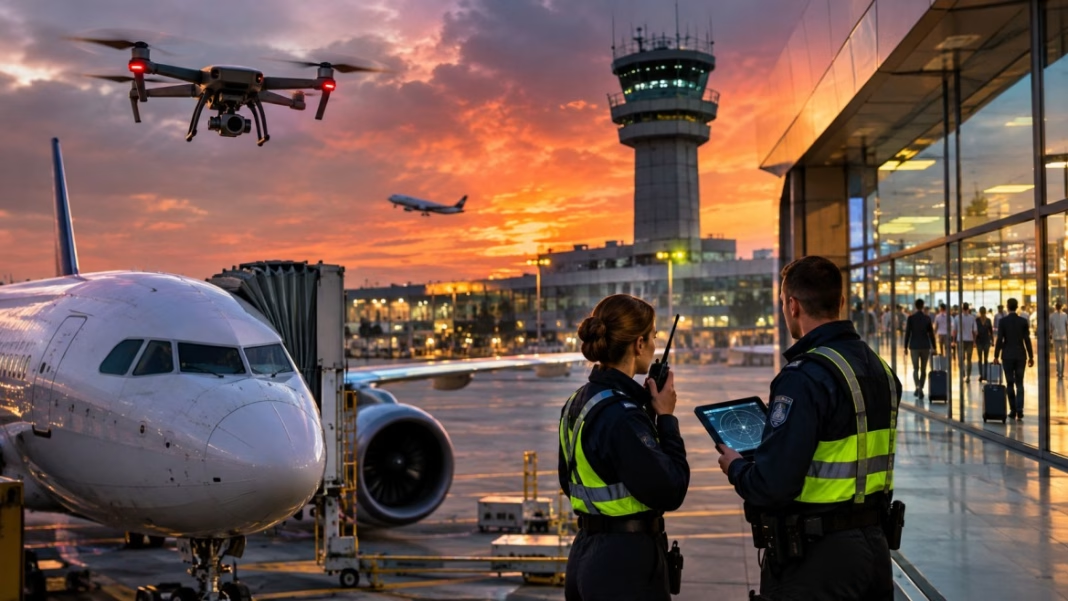


The global aviation industry is being confronted with an increasingly complex security environment as emerging threats continue to challenge traditional airport protection systems. Drone incursions, sophisticated cyberattacks, interference with satellite navigation signals, and false bomb threats are being identified as major operational risks capable of disrupting airline networks, affecting airport infrastructure, and undermining passenger confidence.
These concerns were highlighted by the International Air Transport Association (IATA) during the Global Tourism Forum 2026 annual meeting in Brussels, where the need for stronger international cooperation and more effective aviation security management was emphasized.
During the event, Nick Careen, Senior Vice President of Operations, Safety and Security at IATA, warned that the security of modern air travel could no longer be assessed solely through conventional airport screening procedures or aircraft safety standards.
Instead, greater attention was urged toward the interconnected systems supporting passenger journeys, including airports, airspace management, border controls, digital infrastructure, and airline operations.
Advertisement
Advertisement
The importance of maintaining confidence across the entire travel ecosystem was particularly emphasized as international tourism continues to expand and aviation networks become increasingly dependent on digital technology.
Drone Incursions and GNSS Interference Expose Growing Aviation Vulnerabilities
The changing nature of aviation security threats was illustrated through several incidents that have disrupted airline operations in recent years.
Advertisement
Advertisement
One of the most significant examples was recorded in December 2018, when reported drone sightings resulted in the closure of runway operations at Gatwick Airport in the UK.
Approximately 1,000 flights were affected, while more than 140,000 passengers experienced disruption. The incident demonstrated how relatively small unmanned aircraft could trigger extensive operational consequences at a major international airport.
Beyond immediate flight cancellations and delays, wider concerns were raised regarding the ability of aviation authorities and airport operators to identify, assess, and respond to unauthorized drone activity.
The increasing use of unmanned aerial systems has introduced additional challenges for airspace monitoring, particularly around busy commercial airports and strategically important aviation infrastructure.
Another major security concern was highlighted through interference with global navigation satellite systems (GNSS), which are relied upon for essential aircraft navigation functions.
In 2024, Finnair suspended flights to Tartu, Estonia, following navigation interference affecting operations.
Advertisement
Advertisement
The disruption demonstrated the vulnerability of aviation networks to interference with satellite-based systems and reinforced the importance of coordinated responses involving airlines, aviation authorities, and relevant government agencies.
According to information presented by Careen, more than 200 drone-related incidents were reported within NATO airspace between January 2025 and October 2026.
At least 21 of its 30 European members were affected, illustrating the geographical extent of the reported threat.
The figures were presented as evidence that drone activity could no longer be regarded as an isolated airport security issue. Instead, the challenge was positioned within a broader aviation security framework requiring international coordination.
Cyberattacks and False Bomb Threats Create Major Disruptions Across European Airports
Digital security risks have also become increasingly prominent within the aviation sector, where airport operations and passenger services are heavily dependent on interconnected technology platforms.
In September 2025, a cyberattack targeting a ticketing system provider affected several European airports, including Brussels.
Advertisement
Advertisement
The incident demonstrated how disruption involving a technology service provider could affect multiple airports and create operational difficulties across interconnected aviation systems.
The reliance of airlines and airports on external technology companies has consequently increased the importance of cybersecurity planning, information sharing, and coordinated incident management.
Alongside cyber-related threats, false bomb alerts have been identified as another source of significant disruption.
More than 25 flights across Europe were reportedly targeted through fake bomb threats transmitted by email.
As a result, aircraft diversions were undertaken, security personnel were mobilized, and delays were experienced by thousands of passengers.
Although the threats were described as false, extensive precautionary responses were still required to protect passengers and aviation operations.
Advertisement
Advertisement
The resulting disruptions demonstrated how security incidents could generate substantial operational and financial consequences even when no physical attack occurred.
For airlines, additional costs can be associated with diversions, passenger assistance, cancellations, and operational recovery. For airports and government authorities, considerable resources may be required for emergency responses and security investigations.
IATA Identifies Three Priorities for Strengthening Global Aviation Security
In response to the evolving threat environment, three major priorities were outlined by IATA to support more resilient aviation security systems.
The proposed approach was centered on stronger cooperation between governments and aviation operators, wider adoption of risk-based security management, and greater international recognition of equivalent security standards.
These priorities were presented as essential components of a modern aviation security framework capable of addressing emerging threats without creating unnecessary operational complexity.
Greater cooperation was identified as particularly important because the protection of an international passenger journey is distributed across multiple organizations.
Advertisement
Advertisement
Airlines, airports, border agencies, air navigation service providers, and national authorities are assigned different responsibilities, while the consequences of security disruptions are frequently experienced across the entire aviation network.
The limitations of fragmented security management were therefore highlighted, with permanent mechanisms for exchanging threat intelligence and coordinating operational responses being recommended.
Governments and Airlines Urged to Improve Security Information Sharing
The importance of government-industry cooperation was strongly emphasized during the discussions in Brussels.
Access to reliable threat intelligence was identified as a critical requirement for airlines, particularly when operational decisions must be taken in response to drone incursions, airspace restrictions, or other security incidents.
However, the information required for effective risk assessment is often controlled by national authorities or specialized security agencies.
Closer cooperation was therefore recommended to ensure that relevant intelligence could be communicated efficiently to organizations responsible for passenger transportation.
Advertisement
Advertisement
Greater airline participation in security planning was also encouraged, particularly when new measures could affect flight schedules, airport procedures, or route availability.
The financial implications of security-related disruptions were additionally raised as an important concern.
According to the position outlined by IATA, the costs associated with diversions, cancellations, and passenger assistance should not be placed exclusively on airlines when disruptions arise from threats requiring broader government and industry responses.
A more coordinated approach to responsibility and operational planning was consequently presented as necessary for maintaining aviation resilience.
Risk-Based Aviation Security Measures Recommended Over Additional Regulations
A second priority was identified through the adoption of security systems based on risk assessment rather than the automatic introduction of new regulations following every emerging threat.
Under the approach advocated by IATA, security effectiveness would be evaluated through the identification of specific vulnerabilities and the assessment of measures designed to reduce operational exposure.
Advertisement
Advertisement
The strengthening of airline and airport security management systems was recommended as a practical way to improve preparedness and response capabilities.
Greater emphasis was placed on understanding how security threats develop, how existing systems could be affected, and whether current protective measures remain effective.
The introduction of additional regulations without sufficient operational consultation was presented as a potential source of complexity.
For this reason, governments were encouraged to consult airlines and other operators before implementing new requirements.
Such consultation was considered necessary to ensure that regulatory decisions reflected actual operating conditions and could be implemented without unnecessary disruption.
Security performance was therefore proposed to be measured not simply through procedural compliance, but through demonstrated capabilities to prevent incidents, manage risks, and respond effectively when disruptions occur.
Advertisement
Advertisement
IATA Supports Recognition of Equivalent Airport Security Standards
The third priority was focused on reducing unnecessary duplication of security checks during international passenger journeys.
Under the principle supported by IATA, passengers and baggage already screened through security systems recognized as reliable would not necessarily require repeated inspections during international connections.
The mutual recognition of equivalent aviation security standards was presented as an opportunity to improve passenger convenience while maintaining appropriate levels of protection.
Existing arrangements involving the European Union, the United States, and Canada were identified as examples of how this principle could be applied.
A wider extension of comparable arrangements to additional markets was encouraged.
The potential benefits were linked to more efficient airport transfers, reduced passenger processing requirements, and improved use of airport security resources.
Advertisement
Advertisement
For international connecting passengers, the removal of unnecessary repeated checks could contribute to smoother journeys, particularly at major aviation hubs handling large volumes of transfer traffic.
European Union Border Modernization Faces Operational Challenges
Beyond traditional aviation security concerns, the modernization of border management systems was identified as another important issue affecting international travel.
Particular attention was directed toward the European Union Entry-Exit System (EES), which has been associated with implementation challenges across various member states.
Operational disruptions, insufficient infrastructure, and lengthy passenger processing times were highlighted as areas requiring further attention.
Concerns were raised that border modernization initiatives could create additional pressure on airports and airlines if implementation requirements were not adequately coordinated.
The establishment of clear operating parameters and maximum passenger waiting times was therefore recommended.
Advertisement
Advertisement
Greater involvement of airlines and airports in system planning was also considered essential to ensure that border processing arrangements reflected actual passenger flows and infrastructure capabilities.
The importance of reliable information was further emphasized in relation to the European Travel Information and Authorisation System (ETIAS).
Airlines were identified as requiring dependable mechanisms for verifying passenger travel authorizations associated with the future system.
Without adequate coordination, additional operational complications could be created during check-in, document verification, and passenger boarding procedures.
Digital Identity and Biometrics Could Transform Airport Passenger Processing
Digital identity systems and biometric technologies were presented as potential solutions for improving passenger processing efficiency.
According to the IATA Global Passenger Survey, 78% of respondents indicated a willingness to use digital biometric identification systems.
Advertisement
Advertisement
The findings suggested substantial passenger interest in technologies designed to reduce repeated document checks and simplify airport procedures.
Through digital identification, opportunities could be created for more streamlined passenger verification across different stages of the journey.
The potential benefits were associated with reduced processing requirements and improved coordination between airline, airport, and border systems.
However, the wider introduction of biometric identification was also recognized as presenting important challenges involving personal data protection and information processing.
The management of sensitive passenger information would therefore require appropriate safeguards and clearly defined responsibilities.
As digital transformation continues across the aviation industry, the balance between operational efficiency, passenger convenience, and data protection is expected to remain an important consideration.
Advertisement
Advertisement
International Meetings Tourism Increases Demand for Reliable Air Connectivity
The security priorities outlined by IATA were presented against a wider background of expanding international travel and increasing demand for reliable aviation connectivity.
Particular importance was attached to meetings tourism, where international conferences, conventions, and association events depend heavily on efficient transportation networks.
The scale of this market was illustrated through the GlobeWatch: Business Analytics – Country & City Rankings 2025 report, prepared by the International Congress and Convention Association (ICCA).
A total of 12,438 international association meetings held worldwide were analyzed in the publication.
The report also provided expanded insights into meeting activity through classifications based on region, event size, and industry.
Through this broader analytical approach, a more detailed understanding of international meetings activity and destination positioning was made available.
Advertisement
Advertisement
The significance of association meetings was highlighted beyond their immediate tourism contribution.
Long-term benefits for host cities were associated with knowledge exchange, policy development, and the creation of professional and institutional connections.
However, the successful organization of international events was shown to depend on more than the availability of suitable convention centers and meeting facilities.
Efficient air connectivity, dependable airport operations, and accessible international travel services were also identified as essential requirements.
For destinations seeking to attract major conferences and international business events, aviation reliability was consequently positioned as a significant competitive factor.
ITB Americas Highlights Expanding Tourism Opportunities Across the Region
The wider expansion of international tourism was also reflected in the first edition of ITB Americas, held from November 10-12 at Expo Guadalajara, Mexico.
Advertisement
Advertisement
The event was organized by Messe Berlin Americas and designed to strengthen commercial connections between North America, Central America, South America, the Caribbean, and the international tourism industry.
Nearly 300 companies and organizations were brought together, alongside more than 5,000 professionals and buyers representing 50 countries.
The exhibition was supported by an extensive professional program featuring more than 40 sessions, over 100 speakers, and six thematic areas.
Participation was drawn from multiple segments of the travel industry, including airlines, hotel chains, tour operators, technology companies, and payment providers.
The event was positioned as a platform for business development, market engagement, and industry cooperation across the Americas.
A longer-term commitment to the destination was also established, with five consecutive editions planned in Jalisco through 2030.
Advertisement
Advertisement
During its first edition, exhibition space reached 8,000 square meters, representing a level 60% above initial projections.
The expansion was presented as an indication of strong commercial interest in the event and the wider regional tourism marketplace.
Brazil, Colombia and Mexico Record Strong Growth in Travel Searches
Additional evidence of tourism market activity was presented during ITB Americas through insights into travel search trends.
Olivier Ponti, Director of Market Intelligence and Strategic Analysis at Amadeus, highlighted growing travel interest across several Latin American markets.
Double-digit increases in travel searches were reported for Brazil, Colombia, and Mexico.
The figures were presented as an indication of the dynamism of regional travel demand and the commercial opportunities emerging across Latin America.
Advertisement
Advertisement
Such developments were also associated with growing requirements for international connectivity and efficient transportation infrastructure.
As travel demand increases, additional pressure may be placed on airlines, airports, and supporting travel systems.
The ability to accommodate expanding passenger movements while maintaining dependable operations was therefore identified as an important consideration for the industry’s future development.
Aviation Security and Operational Efficiency Become Central to Tourism Competitiveness
The security challenges outlined by IATA were closely connected to the broader development of international tourism and business travel.
As international passenger movements expand, aviation systems are being required to accommodate greater demand while responding to increasingly sophisticated operational threats.
The protection of aircraft alone was presented as insufficient for maintaining confidence in modern air transportation.
Advertisement
Advertisement
Instead, security across airports, airspace, border management systems, and digital infrastructure was identified as an essential component of reliable international mobility.
Greater cooperation between governments and industry operators was emphasized as a necessary foundation for managing these challenges.
At the same time, risk-based security measures, international recognition of equivalent standards, and the responsible introduction of digital technologies were identified as opportunities for improving efficiency.
The continued expansion of international meetings, tourism exhibitions, and regional travel markets was also shown to depend on dependable aviation networks.
Through the priorities presented at the Global Tourism Forum 2026 in Brussels, the importance of aligning aviation security development with the pace of international travel growth was reinforced.
For the global tourism industry, passenger confidence, operational continuity, and efficient international connectivity were positioned as interconnected requirements.
Advertisement
Advertisement
The future resilience of air transportation will increasingly be shaped by the effectiveness of cooperation between public authorities, airlines, airports, and technology providers, with aviation security remaining central to the stability and competitiveness of international tourism.