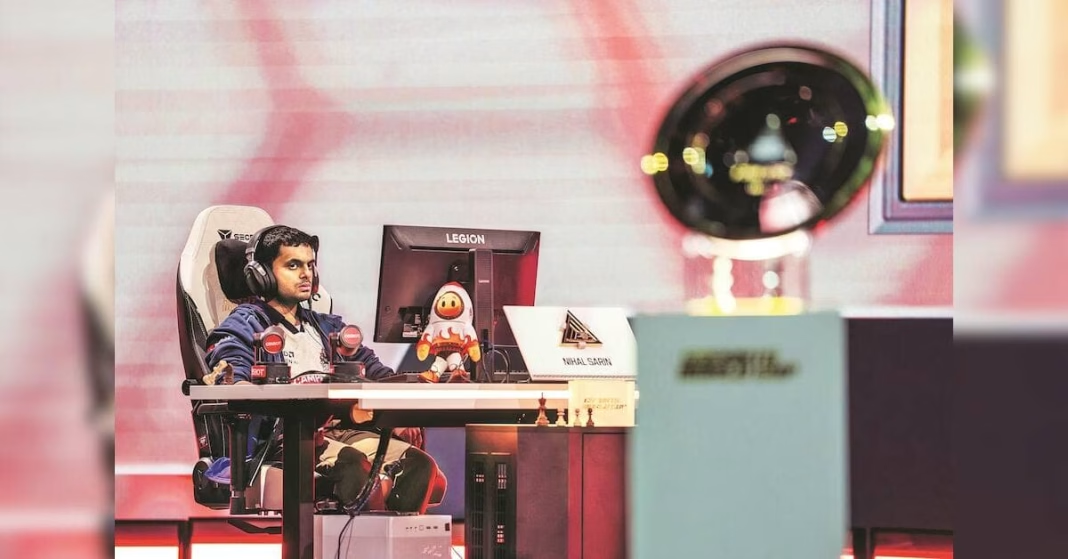

For Mayank Prajapati, better known as MiKeYROG, the problem goes beyond just poor connectivity. The Indian Street Fighter V player, who represented the country at the 2023 Asian Games, says limited exposure to international opponents leaves Indian players less prepared for competition at that level. In fighting games, players must anticipate unfamiliar moves, execute combos consistently and capitalise on fleeting openings.
With domestic competition often pitting them against the same players, Indian gamers rely on replays to study unfamiliar characters and playing styles, but that’s no substitute for facing those opponents in a real-life match. And that’s not happening in any great numbers.
His experience points to a wider challenge. India has a vast gaming audience, but competitive success depends on what players can access, learn and practise long before they represent the tricolour.
Esports made its appearance as a demonstration sport in the 2018 Asian Games in Jakarta-Palembang before becoming a full medal sport in Hangzhou 2022, held in 2023. In Aichi-Nagoya in 2026, the tournament expanded to 11 medal events across 13 titles.
India sent a 15-member contingent to the Asiad this year, competing in four of the 11 medal events: League of Legends, Pokémon UNITE, eFootball and Puyo Puyo Champions. The Esports Federation of India (ESFI) had initially proposed conducting selection trials for the Asian Games version of PUBG Mobile through Battlegrounds Mobile India (BGMI), its Indian counterpart. In its February announcement, the federation said final participation would be subject to approval from the competent authority. It subsequently removed the title from its selection process, citing regulatory considerations and the continuing ban on PUBG Mobile, which was among the Chinese-linked apps blocked by the government in 2020.
India’s campaign in the Games ended without a medal, with its best performance coming in Puyo Puyo Champions, where Paritosh, who goes by a single name, reached the quarterfinals before losing to South Korea’s Kang Dongshin. The League of Legends and Pokémon UNITE teams exited in the group stage, while India failed to reach the eFootball knockouts.
That’s particularly disappointing given India has an estimated 511 million video game players (2025 figures), projected to exceed 700 million by 2030, according to Niko Partners, a video game market research and consulting firm.
The country’s video game market generated $1.04 billion in player spending that year, up 14.8 per cent year-on-year. Around 95 per cent of Indian gamers play on mobile devices, and the estimate spans everyone from a schoolchild playing on a smartphone to an adult playing casually. But Niko estimates that only 26.5 per cent of these gamers spend money on games. To be sure, these figures capture the scale of India’s gaming market, not its pool of esports athletes or the number of players capable of competing professionally.
For Akshaj Shenoy, captain of India’s League of Legends team in the last two Asian Games, Indian players lack good preparation.
“The biggest gap was in the depth of preparation and the experience of competing consistently against top international teams. At that level, individual mechanical skills are only one part of the game,” he says.
Established esports markets have years of structured competition, experienced coaches and regular international exposure. Shenoy is part of S8UL, an Indian esports organisation that fields competitive teams across gaming titles and which fielded India’s League of Legends team this year. Its preparation involves regular practise, defined roles, coaching and performance reviews. But the national team, by contrast, comes together hurriedly, leaving little time for opponent analysis, scrims and specialised coaching.
Shenoy argues that preparation must be continuous, with each Asian Games campaign building on the last.
Leagues, open qualifiers and third-party tournaments have widened access. But Animesh Agarwal, founder and chief executive of S8UL and 8Bit Creatives, a talent management company, says spotting good players is only the first step. Missing are vital ingredients such as a consistent calendar, transparent qualification routes, stronger opponents, coaching and funding.
A report by the Federation of Indian Chambers of Commerce and Industry (Ficci) and EY, citing data from Nodwin Gaming, an esports and gaming company, puts tournament participation at 2.074 million in 2024, against one million in 2022. Professional teams numbered 36 in 2024, with the report projecting 40 in 2025. EY did not independently verify the figures. This points to an organised circuit, but does not show how many participants become professionals eventually.
What a hit title can bring
BGMI offers a glimpse of what sustained investment around an established title can achieve. Krafton, the South Korean video game developer and publisher behind BGMI, says its College Campus Tour reached 128 colleges and engaged more than 75,000 students in 2025-26. The programme has since been expanded to 256 colleges for 2026-27, according to the company.
The Battlegrounds Mobile India Pro Series (BMPS) 2024 recorded nearly 494,000 peak concurrent viewers during its Grand Finals and more than 11 million hours watched across 154 broadcast hours, according to Esports Charts. Krafton says its tournaments have drawn nearly one million registrations in four years.
The 2025 Battlegrounds Mobile India Series (BGIS) had a ₹2 crore prize pool. BMPS 2025 also started at ₹2 crore, potentially rising to ₹4 crore through in-game progression. Recurring tournaments give players opportunities to compete and teams a platform to build brands.
But the model is title-specific. Each game has its own mechanics, community and international circuit. India’s mobile strength does not automatically translate across a multi-game programme. The 2025 Valorant Challengers South Asia Split 3, organised by Nodwin Gaming and game publisher Riot Games, had a prize pool of ₹53 lakh. The Esports World Cup, by comparison, announced a prize pool exceeding $70 million for its 2025 edition.
Chess featured at the Esports World Cup, and four Indian Grandmasters competed in the 2026 edition. Mike McCabe, deputy chief executive officer and chief operating officer of Saudi-based Esports Foundation, which organises the Esports World Cup and Esports Nations Cup, says inclusion reflects a game’s competitive depth, talent and community. Different titles bring distinct audiences.
Gautam Virk, cofounder and chief executive of Nodwin Gaming, says competitive depth depends on the games India plays, their communities and investment in talent. Less popular titles need more development opportunities to build participation before attracting audiences and commercial support.
Virk argues that development and qualification leagues, run by publishers and experienced operators, could bridge amateur and professional competition. Nodwin has run such leagues for its own intellectual properties. The task is to build a year-round pipeline from grassroots tournaments and talent scouting to training, performance analysis and international exposure.
At a virtual Business Standard dialogue on esports, Vishal Parekh, chief operating officer of CyberPowerPC, a computer hardware company, said players accustomed to hardware with lower specs can struggle against competitors with faster machines, higher refresh-rate monitors and lower latency.
The Ficci-EY report, drawing on Nodwin estimates, put the total prize money across major tournaments at ₹18.7 crore in 2024 and projected it to reach ₹25 crore in 2025. But prize money alone cannot sustain a circuit: Teams need resources to retain talent, and organisers need audiences and commercial partners beyond individual events.
Charlie Cowdrey, chief executive officer of JioBLAST, an esports joint venture involving Reliance Jio, BLAST and RISE Worldwide, says its tournaments, Gully Wars and India Rising: Road to EWC (esports world cup) widen entry points for emerging talent. Their long-term value, he says, lies in creating structured pathways — from grassroots participation to professional competition — while bringing players, fans, publishers and brands into a sustainable multi-game ecosystem.
The route to international competition also depends on how the industry is organised. Virk says transparent selection and clearly defined responsibilities are essential.
The Promotion and Regulation of Online Gaming Act, 2025, and accompanying rules came into force on May 1, 2026. The framework covers esports while banning online money games. The rules provide for registration of esports and certain categories of online social games. Not every esports title has been registered.
Regulation alone cannot settle tournament governance, national selection or intellectual-property rights. McCabe says publishers, organisers and professional clubs have distinct responsibilities for competitive integrity and player support.
The size of India’s gaming audience is an advantage, but hardly a measure of competitive readiness. Organised competition is growing, established titles are attracting audiences and investment, and new initiatives are widening entry points. The challenge is to sustain those opportunities across games and beyond individual tournaments.
For MiKeYROG, the gap is access to unfamiliar opponents. For Shenoy, it is the difference between an individual’s ability and a team prepared for international pressure. For players in less established titles, it may begin with limited competition or no clear route into a professional roster.
What makes an esports powerhouse?
Scalevs skill: A large gaming audience isn’t necessarily a deep talent pool
Mobile might vs multi-game muscle: Mobile strength doesn’t guarantee competitiveness across PC and console titles
Events vs ecosystem: Regular circuits turn tournament participation into professional careers
Investment vs audience: Competitions need funding to build audiences, but audiences attract sponsors and investors
Selection vs preparation: National selection is no substitute for sustained international exposure
Growth vs ground rules: Fragmented governance complicates regulation, team selection and tournament oversight