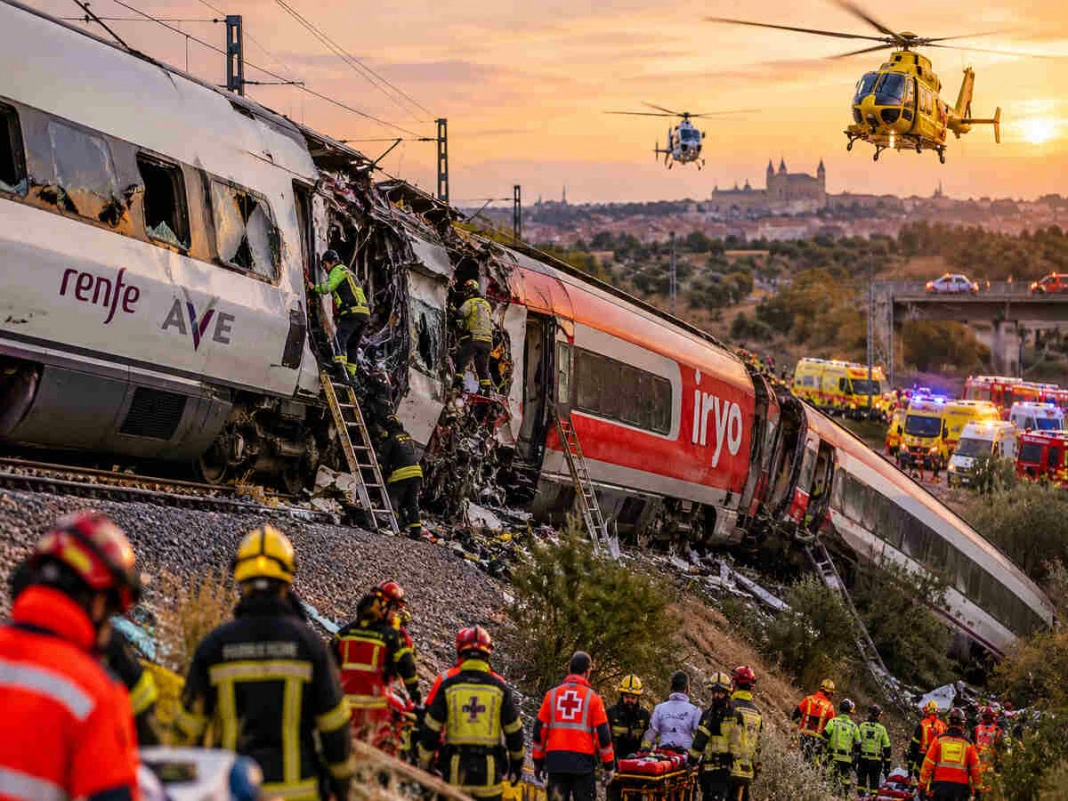


Deadly train crash near Madrid prompts emergency action, service disruptions and concerns about passenger safety. The tourism and transport industries of Spain are going through a tough time after a horrific collision between two high-speed trains in the province of Toledo on Wednesday, 28 October 2026. This tragic accident, in which two passenger trains belonging to Renfe and Iryo have collided, has caused deaths, injuries and disruptions in the railways that connect Madrid to southern Spain.
The disaster has raised urgent questions about railway signalling, passenger protection and the reliability of Spain’s extensive high-speed network. It also comes months after another deadly railway collision in January 2026, intensifying concerns about transport safety. For tourists travelling between Madrid, Seville, Córdoba and other Andalusian destinations, the immediate consequences include interrupted journeys, uncertain departure schedules and the need to reconsider travel arrangements.
Advertisement
Advertisement
Deadly High-Speed Train Collision Near Madrid Sparks Major Emergency Response
The accident occurred on Wednesday morning in Toledo province, within the Castilla-La Mancha region of central Spain. Preliminary reports place the collision near Urda, between the municipalities of Los Yébenes and Urda, along the Madrid–Seville high-speed railway corridor.
Two trains travelling in the same direction were involved. According to the initial regional account, one train had stopped when another approached from behind and struck its rear carriages.
The force of the impact caused two carriages to derail, leaving passengers trapped or injured and prompting an extensive rescue operation.
Regional spokeswoman Esther Padilla initially confirmed at least ten deaths and warned that the number could increase as emergency personnel continued their work.
Advertisement
Advertisement
Later Spanish media reports cited significantly higher casualty figures, including reports of 46 deaths and 179 injuries. However, those figures had not been consistently established through a definitive official statement in the information available for this report.
The circumstances surrounding the collision remain under investigation.
Renfe and Iryo Trains Carrying Hundreds of Passengers Caught in Disaster
The collision involved Spain’s state-owned railway operator Renfe and private high-speed train company Iryo, two major providers of passenger services on the country’s railway network.
Initial regional statements indicated that approximately 544 passengers were travelling aboard the two trains.
The reported passenger distribution was:
- Renfe train: 397 passengers, according to the initial regional account.
- Iryo train: 147 passengers, according to the same account.
- Combined passenger count: 544.
- Derailed carriages: At least two.
- Railway corridor: Madrid–Seville high-speed line.
Some subsequent reports reversed the passenger totals attributed to the two operators. The combined number remained consistent, but the operator-specific figures require further confirmation.
Advertisement
Advertisement
The large number of people aboard both trains complicated the emergency response. Rescue teams needed to assess injuries, assist survivors, account for passengers and coordinate transport to medical facilities.
The involvement of both Renfe and Iryo also attracted attention because trains operated by the same two companies were involved in the deadly Adamuz railway disaster earlier in 2026.
Madrid–Andalusia Railway Shutdowns Create Fresh Challenges for Travellers
Spain’s railway infrastructure manager, Adif, suspended high-speed railway operations along the affected Madrid–Ciudad Real–Andalusia corridor following the accident.
The suspension was necessary to allow emergency teams to reach the scene, secure damaged railway infrastructure and begin preliminary investigations.
The disruption affected an important transport connection between Spain’s capital and its southern regions.
| Major travel route | Reported or potential impact |
|---|---|
| Madrid–Seville | High-speed services disrupted by the collision |
| Madrid–Ciudad Real | Railway operations suspended on affected sections |
| Madrid–Córdoba | Connections affected by corridor restrictions |
| Madrid–Málaga | Potential disruption to services using the Andalusian network |
| Madrid–Granada | Possible effects on connecting travel arrangements |
| Madrid–Puertollano | Services subject to restrictions along the affected route |
Not every service on these routes was necessarily cancelled. Individual departures depended on railway operating arrangements and the extent of the suspension.
Advertisement
Advertisement
For tourists, the incident highlights the importance of checking departure information before travelling to railway stations.
Spain’s high-speed railway system plays an important role in connecting major cultural destinations, historic cities and coastal tourism regions. Disruptions along the Madrid–Andalusia corridor can therefore affect both domestic visitors and international travellers.
Rescue Helicopters, Firefighters and Civil Protection Teams Rush to Toledo
The scale of the accident prompted a coordinated emergency operation involving regional authorities, firefighters, medical teams and Civil Protection personnel.
Emergency services received notification of the collision at approximately 08:54 local time. Firefighters from Alcázar de San Juan and Orgaz were among the first specialist teams deployed to the area.
Three medical helicopters and two advanced medical response units were also mobilised to support rescue and evacuation operations.
Castilla-La Mancha activated its territorial emergency plan, PLATECAM, allowing authorities to coordinate resources and provide additional assistance.
Advertisement
Advertisement
The response focused on several priorities:
- Reaching passengers inside damaged and derailed carriages.
- Providing emergency medical treatment and identifying serious injuries.
- Transporting casualties to appropriate medical facilities.
- Establishing safe areas for survivors and emergency workers.
- Coordinating information for relatives seeking news about passengers.
The mayor of Urda, Manuel Galán, confirmed that local authorities had been asked to prepare a sports pavilion to accommodate affected passengers.
Regional president Emiliano García-Page travelled towards the accident scene as emergency operations continued. Europa Press+1
Railway Signalling and Passenger Protection Come Under Fresh Scrutiny
One of the most pressing questions concerns how two high-speed trains could collide while travelling along the same railway corridor.
The preliminary account suggests that the Renfe train struck an Iryo service that had stopped ahead of it. Investigators must determine why the first train was stationary and whether the following train received the necessary warnings.
Earlier reporting raised questions about a possible malfunction involving the LZB train-control system and the use of backup signalling procedures.
Advertisement
Advertisement
However, these possibilities remain investigative hypotheses. Authorities have not established whether a technical defect, signalling failure, operating decision or combination of factors caused the accident.
The investigation will need to examine train-control records, signalling information, communications and the actions taken immediately before the collision.
Passenger protection extends beyond preventing accidents. It also involves carriage safety, emergency exits, medical access, evacuation procedures and timely communication with affected travellers.
The findings could have important implications for public confidence in Spain’s high-speed railway services.
Spain Faces Renewed Railway Safety Concerns After January’s Deadly Collision
The Toledo disaster follows another major railway accident in January 2026 near Adamuz in Córdoba province.
That earlier tragedy involved a train derailing and colliding with another train travelling in the opposite direction. Approximately 46 people were killed, making it one of Spain’s deadliest railway disasters in recent decades.
Advertisement
Advertisement
The January collision was particularly significant because it occurred on the same broad Madrid–Andalusia high-speed corridor.
The October accident has consequently revived questions about railway maintenance, infrastructure investment and operational safety.
| Safety concern | Why it matters |
|---|---|
| Railway signalling | Helps maintain safe separation between trains |
| Train-control systems | Monitor train movements and enforce operating restrictions |
| Infrastructure maintenance | Supports reliable railway operations |
| Emergency preparedness | Determines how quickly casualties receive assistance |
| Passenger communication | Helps travellers understand disruptions and evacuation instructions |
| Independent investigation | Establishes causes and identifies necessary improvements |
Although the two accidents involved the same operators, investigators have not established a common cause.
It would therefore be premature to conclude that either collision resulted from the same infrastructure or operational weakness. Reuters
Seville, Córdoba and Málaga Tourism Connections Face Uncertainty
The Madrid–Andalusia high-speed railway corridor serves some of Spain’s most popular tourism destinations.
Seville attracts international visitors with its historic architecture, flamenco heritage and cultural attractions. Córdoba is renowned for its historic centre and the Mosque–Cathedral, while Málaga provides access to the Costa del Sol.
Advertisement
Advertisement
High-speed rail services allow travellers to combine these destinations with Madrid during a single holiday.
When a major railway corridor closes, tourists may face missed connections, disrupted hotel arrangements and additional transport costs.
The effects can extend beyond passengers travelling on the two trains involved in the accident. Visitors scheduled to use later services may also need alternative arrangements.
However, the railway disruption should not be interpreted as a nationwide tourism shutdown. The immediate restrictions concern the affected high-speed network, and travellers should verify the status of individual services.
Renfe Introduces Free Ticket Changes and Cancellations for Affected Passengers
Renfe announced arrangements allowing passengers affected by the railway suspension to change or cancel their tickets without additional charges.
The measure offers flexibility to travellers whose planned journeys can no longer operate as scheduled.
Advertisement
Advertisement
Passengers should check their booking details, departure station and operator before making alternative arrangements.
Travellers using Iryo services should contact the company directly for information about affected departures and available assistance.
Those with connecting flights, accommodation reservations or organised tours should inform the relevant providers as early as possible.
Tourists should also retain booking confirmations and receipts for any additional expenses, particularly where travel insurance may provide applicable coverage.
The availability of refunds, reimbursement or compensation beyond the announced ticket arrangements depends on the circumstances and relevant passenger rights.
What Tourists Should Know Before Travelling Through Spain
The accident has created immediate uncertainty for passengers using high-speed services between Madrid and southern Spain.
Advertisement
Advertisement
Travellers should prioritise reliable information and avoid making decisions based on unverified social media reports.
Important travel precautions include:
- Check official Renfe, Iryo and Adif service updates before departure.
- Confirm whether your train is cancelled, delayed or operating on a modified route.
- Allow extra time when connecting with international flights or other transport.
- Contact accommodation providers if the disruption affects arrival plans.
- Review refund, rebooking and travel insurance conditions.
- Follow railway staff instructions at stations and avoid restricted emergency areas.
Alternative buses, domestic flights and other railway connections may be useful, depending on availability and the destination.
Passengers should confirm these alternatives before travelling because demand may increase while the high-speed corridor remains restricted.
Spain’s Railway Recovery Depends on Investigation, Infrastructure Safety and Public Confidence
The immediate priority remains the rescue operation, medical treatment for injured passengers and support for bereaved families.
Railway authorities must also inspect the damaged infrastructure and establish whether the affected section can safely return to operation.
Advertisement
Advertisement
The investigation will be essential in determining the circumstances of the collision and identifying any necessary improvements.
For Spain’s tourism industry, restoring reliable connections between Madrid and Andalusia will be important for maintaining visitor mobility.
The country remains a major European tourism destination, supported by extensive transport infrastructure and internationally recognised attractions. Nevertheless, repeated serious railway accidents can raise understandable concerns among passengers.
The challenge for authorities is not simply to reopen the railway. They must also communicate clearly, establish the causes of the disaster and demonstrate that appropriate safety measures are in place.
The deadly high-speed train collision near Madrid has placed Spain’s railway system under renewed scrutiny at a time when dependable transport connections remain essential for tourism.
With hundreds of passengers involved, significant loss of life reported and the Madrid–Andalusia corridor disrupted, the accident represents a major emergency for the country’s transport authorities.
Advertisement
Advertisement
The immediate focus remains on victims, survivors and their families. Beyond the emergency response, the investigation will need to answer difficult questions about train movements, signalling and passenger protection.
Spain is facing severe disruption in travel following the death of passengers in a train accident outside of Madrid.
For travelers, the key is to remain abreast of all information. For Spain, regaining its reputation will depend on an investigation, safety procedures, and resuming train service.