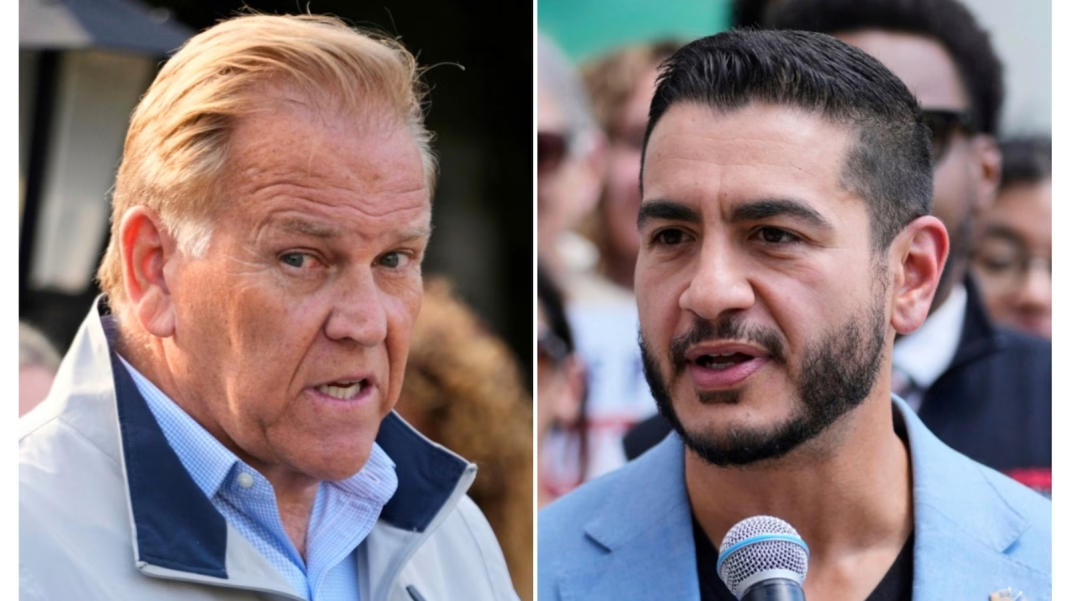

After weeks of assailing Democratic Senate candidate Abdul El-Sayed in rallies across the country, President Donald Trump on Sunday is bringing his midterm barnstorming to Michigan, where Republicans see a chance to pick up an open seat on Election Day.
El-Sayed, a onetime public health official, faces Republican Mike Rogers, a former congressman backed by Trump in the Nov. 3 race to succeed retiring Democrat Gary Peters.
The Republican president has described El-Sayed as a “jihadist,” rhetoric that Democrats denounce as an attack on his faith. El-Sayed would be the first Muslim senator if elected.
Trump’s planned visit to Port Huron follows former Democrat President Barack Obama’s appearances Saturday in Michigan and Ohio for his party’s candidates. It will be Trump’s latest stop on a packed campaign schedule to bolster Republicans on the midterm ballot as the GOP is weighed down by voters’ frustration with the economy and the war with Iran.
Unlike Trump’s earlier trips to Republican-controlled states where his party is on defense, the GOP has not won a Senate race in Michigan for more than three decades. El-Sayed has taunted Trump, encouraging him to come to Michigan in the belief that a visit would backfire on Rogers.
“Donald, if you’re watching, don’t wuss out, man,” El-Sayed said. The progressive, who won a divisive primary in August, has said the country needs to “turn the page on Donald Trump.”
The campaign has been one of the most contentious this year. Republicans have portrayed El-Sayed, who was born in the United States to Egyptian immigrant parents, as a dangerous radical. Trump falsely claims that the Democratic nominee is a member of the Muslim Brotherhood, a group founded in the 1920s in Egypt that has inspired Islamist political movements around the Mideast. In January, Trump’s administration labeled three Middle Eastern branches of the Muslim Brotherhood as terrorist organizations.
During their second and final general election campaign debate, Rogers questioned El-Sayed’s loyalty to the United States.
“Are you for America, or are you for these terrorist groups overseas?” Rogers asked.
El-Sayed said that questioning was “shameful.”
“I’m proud of our Constitution that guarantees all of us the right to pray as we choose to pray,” he said.
Rogers denied that his criticisms were rooted in religion, saying “you can pray any way you want.”
Trump has referred to El-Sayed as “Mohammed” and said he “goes back to the days of the jihad.”
El-Sayed has faced criticism for his own rhetoric, particularly when he said “hurt people hurt people” after an attack on a synagogue in the Detroit area. The attacker had lost four relatives in an Israeli airstrike on Lebanon the week earlier. El-Sayed later apologized, saying he was not trying to justify what happened.
“To anyone who feels like my comments might have been hurtful, I’m really sorry,” he said. “That was not my intention.”
The significance of El-Sayed’s candidacy has grown beyond Michigan, with Republicans casting him as a symbol of a radicalizing Democratic Party. Meanwhile, progressives hope that he will help demonstrate their clout in a swing state, which could shape how the 2028 presidential primary unfolds.
El-Sayed previously served as a public health official in Detroit’s Wayne County and ran unsuccessfully for governor in 2018.
Rogers lost the 2024 Senate race to then-Rep. Elissa Slotkin by less than a percentage point.