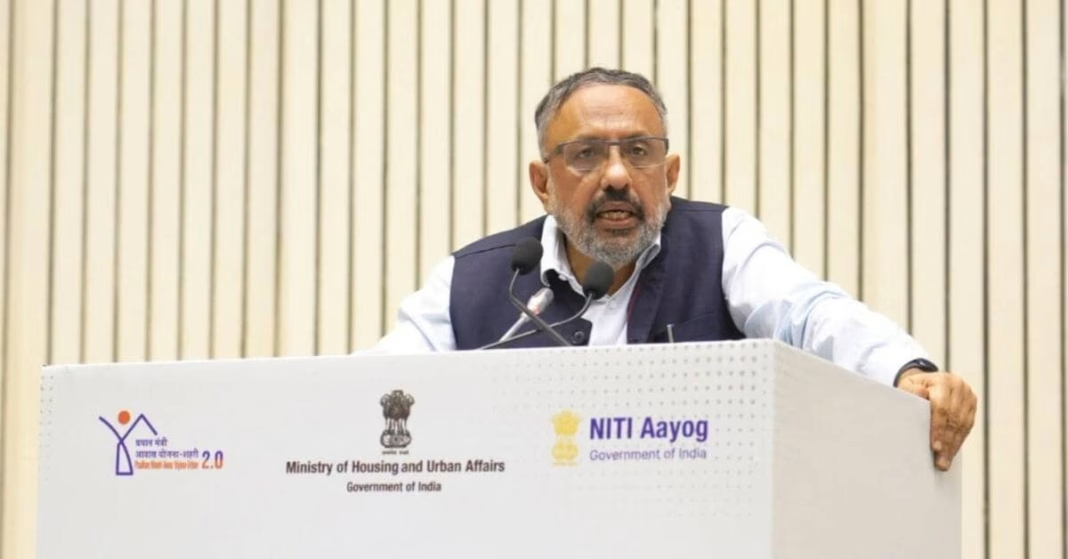

NITI Aayog member Rajiv Gauba on Sunday called for sweeping reforms in urban governance, including directly elected mayors, greater financial autonomy for municipal bodies and stronger powers for city governments, saying India’s cities cannot be effectively governed from state capitals.
Addressing the valedictory session of the 2nd National Urban Conclave, Gauba stressed the need to empower urban local bodies (ULBs) to improve service delivery, strengthen citizen participation and unlock the economic potential of Indian cities.
Highlighting India’s urban transition, he said the country’s urban population was projected to increase from approximately 500 million at present to 850 million by 2050, when nearly half of India’s population would be living in cities.
He said meeting the infrastructure, housing and basic service requirements of this growing population would require fundamental changes in how cities are planned, governed and financed.
Gauba calls for elected mayors, greater municipal autonomy
Referring to a report jointly developed by NITI Aayog and the Ministry of Housing and Urban Affairs, Gauba called for directly elected mayors with five-year terms, a Mayor-in-Council system and timely municipal elections.
He urged states to devolve all 18 functions specified under the 74th Constitutional Amendment to urban local bodies, including master planning, water supply, fire services and traffic management.
“We can’t run cities from state capitals,” Gauba said, stressing that local governments must have the authority and institutional capacity to address local needs.
Flagging weak municipal finances, he called for better property tax collections, improved recovery of user charges and adequate fiscal transfers from states.
He noted that Central Finance Commission grants to urban local bodies had more than doubled compared with the previous allocation, with their share increasing from 36 per cent to 45 per cent.
Urban planning and housing reforms
Gauba also called for relaxing restrictive floor area ratio (FAR) limits and building regulations, promoting mixed-use zoning and transit-oriented development, and encouraging land pooling to increase land supply and reduce housing costs.
He urged states to adopt the Model Tenancy Act to expand affordable rental housing for migrant workers, industrial labourers, students and young professionals.
Highlighting government investments, he said the urban sector’s budgetary outlay had increased tenfold since 2014, while approximately ₹3.7 trillion had been invested in metro rail and bus systems.
He also referred to the ₹1 trillion Urban Challenge Fund announced in the 2025-26 Budget and the allocation of ₹5,000 crore each for seven city economic regions over five years in the 2026-27 Budget.
Gauba urged states to implement these reforms through new municipal legislation and called on the Centre to link support under urban development missions to their implementation.