
Jio Platforms (JPL), the parent company of India’s largest telecom services provider (TSP) Reliance Jio, is preparing a capex-light strategy to commercially launch 6G services, the next generation of connectivity with native artificial intelligence (AI), through software upgrades in the early 2030s rather than fresh infrastructure investments.
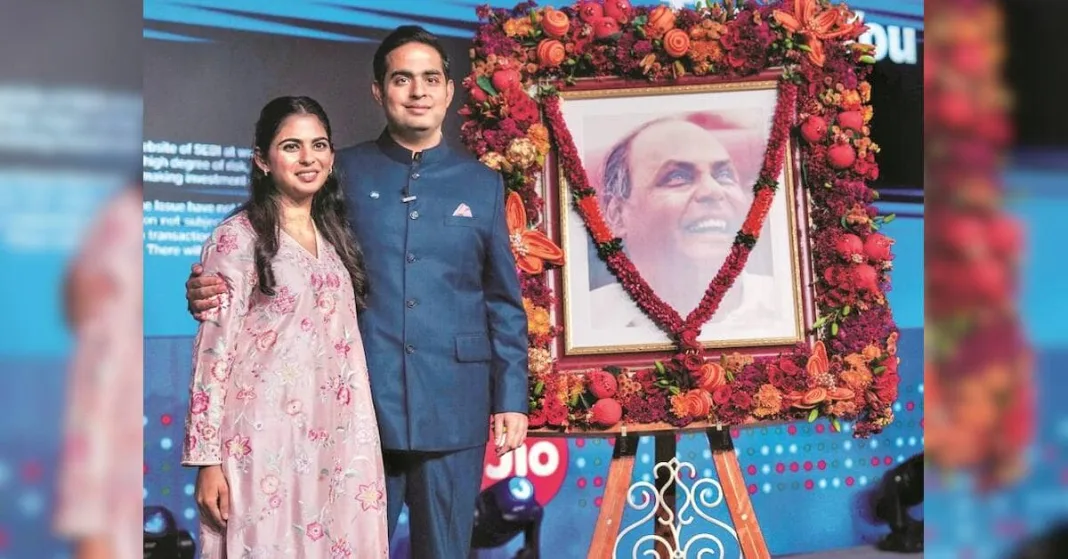
“We have over 360,000 towers and over 1 million km of fibre across India. 6G is on our horizon. What this really means is that we will do 6G as a software upgrade rather than a new infrastructure build out,” Akash Ambani, managing director of JPL, said at the firm’s press briefing on Thursday.
This comes ahead of the opening of the over ₹30,000-crore JPL’s public offer from October 21 which will be India’s largest ever.
JPL was in the pre-standard phase with standards getting set by 2029, he said.
“The rollout of commercial 6G technologies will be in the early 2030s,” he added.
Standards are decided by global consensus by the International Telecommunications Union. This could well make JPL, effectively Reliance Jio, the first carrier globally to give a firm commitment of launching 6G services, experts said.
“No operator has launched commercial 6G or committed to a firm commercial launch date. Currently, we are seeing pre-standard trials in some countries like the US, Japan and China while operators in India are aiming to be among the first countries to introduce commercial 6G,” said Rohan Lobo, partner and telecom, media and technology leader, Deloitte South Asia.
Ambani, who is also chairman of Reliance Jio, outlined a triple-engine growth strategy — mobility, home broadband, and enterprise and international services — underpinned by an end-to-end deeptech stack. This will enable it to expand globally as a managed services provider rather than a pureplay TSP.
The company has been building its technology portfolio with 7,220 patent applications across 4G, 5G, 6G Cloud-native core network architectures, AI-driven network automation, and digital technologies, as of June 2026. The majority of these were filed in foreign jurisdictions.
With over 533 million subscribers on its networks, Ambani aims to take a chunk of the 340 million subscribers that are likely to come in over the next five years — 100 million new subscribers and the rest transitioning from 2G to 4G/ 5G.
Ambani said that since its 5G network was utilised only a third of its potential, the immediate focus will also be on transferring a larger number of users to 5G.
He added that these customers will create opportunities for realising higher average revenue per user (ARPU), a key measure of telecom operators’ profitability.
He also noted that while the carrier can raise tariffs since its tariff plans were nearly the lowest among peers but the company would derive revenues from offering more services, outside its licensed business. It will give value to customers who will then be willing to pay more for what they’re getting. For instance, offering voice AI service will also add to the ARPU growth, he said.
Home broadband will be another growth driver as the company plans to take the service from 40 million to 100 million homes using unlicensed broadband radio (UBR) technology. Jio had 28.6 million fixed broadband customers and accounted for 67.5 per cent of India’s net fixed broadband additions in FY26.
“What we want to deliver to the home is not a broadband service, but an integrated consumption story for broadband, TV and digital applications… For me, this is our biggest growth engine for the coming years,” Ambani said.
The company was already offering its connectivity and broadband services to enterprises, including the banking and financial services sectors. It intends to expand the number of business lines, going forward, targeting India’s estimated ₹5.1 trillion addressable market.
JPL also plans to go global, but in a capex-light manner. It plans to monetise its technology stack by partnering telcos in other countries to become a managed service partner.
“Our international roadmap is very different. Providing an end-to-end technology stack, not as a vendor or a software service, but really being a managed service partner to enable future growth vectors for our partner is a preferred model of our deployment,” Ambani said. He said India will serve as a ready and scalable example of the technology.
“We believe there is a huge market opportunity all across the world, including developed and developing nations. We will choose our partners very carefully on the basis of the market opportunity so that it would make a significant difference to our balance sheets and the ability for us to partner deeply for the growth of their business,” he added.