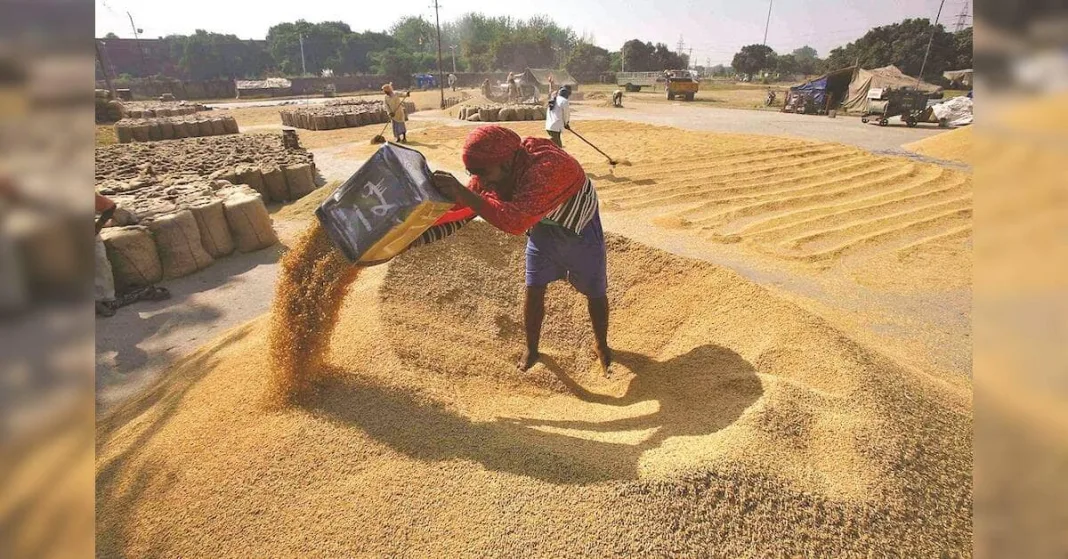

World Food Day, celebrated on 16 October every year, offers an occasion to revisit a diplomatic standoff when India said “no” at the World Trade Organisation (WTO), a stand that helped safeguard food security for millions and amplified the voice of many developing countries. In July 2014, barely two months after Prime Minister Narendra Modi took office, India refused to let the Trade Facilitation Agreement (TFA) move forward at the WTO. International criticism mounted, and India was accused of blocking trade reforms. Behind its refusal was a concern closer to home, shared by many developing countries: securing greater certainty that it could continue buying foodgrains from farmers and distributing them to vulnerable people. Why did the government hold firm, and what do international trade rules have to do with India’s food security and farmers’ livelihoods?
India’s food security and WTO constraint
The answer lies in India’s food security system, which connects the farmer’s field with a vulnerable family’s plate. The government purchases rice and wheat from farmers at minimum support prices (MSP), maintains public stocks and distributes foodgrains through ration shops. This practice of buying and holding food stocks for food security is known as public stockholding (PSH). Today, around 80 crore people receive free foodgrains under this system. Procurement provides an assured market for participating farmers, while public distribution helps vulnerable families meet basic food needs.
But WTO rules impose limits on agricultural support. What India sees as food security can be treated as excessive support. For a crop like rice, the subsidy India can give is capped at 10 per cent of the value of production. The real trouble is how this “support” is measured. The WTO rules calculate the subsidy by comparing today’s MSP with world prices from 1986-88, almost four decades ago. For rice, that old reference price works out to roughly ₹3.5 per kg. No one can grow or buy rice at that price today. Yet every rupee paid above it is counted as a subsidy.
It is like measuring today’s salary against 1987 prices and then declaring it far too generous. By this yardstick, a programme designed to support low-income, resource-poor farmers and feed vulnerable families ends up looking like a rule-breaker. Meanwhile, several developed countries enjoy much larger subsidy entitlements that were locked into the very same rules.
These concerns were not new. Recognising the deep flaws in WTO rules, India, along with many developing countries, has been demanding reforms since 2000 to protect their food security programmes.
When India said “No”
These concerns brought food security to the centre of WTO negotiations at Bali, Indonesia, in 2013. Members agreed to a temporary safeguard known as the peace clause. Subject to certain conditions, it shielded existing PSH programmes from legal challenges, even if a developing country breached the subsidy limit. In return, developing countries agreed to sign the TFA. Members also committed to finding a permanent solution to PSH by 2017.
But what if that deadline passed without a permanent solution? That uncertainty became central to the 2014 confrontation. Developed countries backtracked on their commitment, stating that the peace clause would only remain valid until 2017. The stakes were serious: if a permanent solution was not achieved by then, MSP-backed food security programmes risked legal challenges.
The Indian government faced a diplomatic test. In a bold and unprecedented move, India refused to ratify the TFA, sending shockwaves through the global trade community. Media outlets around the world criticised the decision harshly, calling India a ‘blocker’.
But behind the headlines was a principled stand. India continued to explain its concerns and engage with other WTO members to find a way forward. In Parliament, then Commerce Minister Nirmala Sitharaman explained that proceeding with the TFA before resolving PSH could undermine the food security concerns of developing countries.
The negotiating strategy involved considerable diplomatic engagement. As India’s Ambassador to the US, S. Jaishankar played a key role in diplomatic efforts amid trade-related tensions between the two countries. The September 2014 meeting between Prime Minister Modi and President Barack Obama brought the food security discussions to the leaders’ table. An India-US understanding paved the way for a multilateral settlement. In November, the WTO General Council confirmed that the peace clause would continue until a permanent solution was agreed upon and adopted. Members also adopted the legal protocol needed to bring the TFA into the WTO’s framework, ending the deadlock.
A safeguard tested in a crisis
The foresight behind the government’s 2014 stand is evident in the policy space it preserved for India. In 2020, India first invoked the peace clause after its support for rice in 2018-19 exceeded the WTO limit. India has used this safeguard seven times so far. This protects India’s PSH programmes from legal challenges, allowing the government to buy foodgrains at MSP from farmers and distribute them to vulnerable families.
The value of this policy space was particularly evident during Covid-19, when around 80 crore people received additional free foodgrains under the Pradhan Mantri Garib Kalyan Anna Yojana. Today, El Niño risks and global uncertainty reinforce why the ability to procure and maintain food reserves matters when livelihoods and access to food are disrupted.
India’s continued efforts
India’s 2014 stand continues to protect farmers’ livelihoods and preserve food security for millions of vulnerable people. Yet, a permanent solution promised at the WTO remains unfulfilled. The battle continues under Commerce Minister Piyush Goyal, with India’s coalition-building efforts bringing together over 75 WTO members to press for a permanent solution, preserve existing safeguards and protect the food security interests of developing and least-developed countries. More recently, Prime Minister Modi, during his 2025 Independence Day address, reiterated that he stands “like a wall” against harmful policies affecting India’s farmers, fishermen and cattle rearers, asserting that India would never compromise on their interests.
World Food Day provides an opportunity to reflect on the different paths countries take to ensure food security. There is no one-size-fits-all approach. Preserving the policy space for developing countries to feed their people, support their farmers and address their diverse food security needs remains essential.
(Prof. Sachin Kumar Sharma is Director General, and Lakshmi Swathi Ganti is a Consultant at RIS, a New Delhi-based think tank)