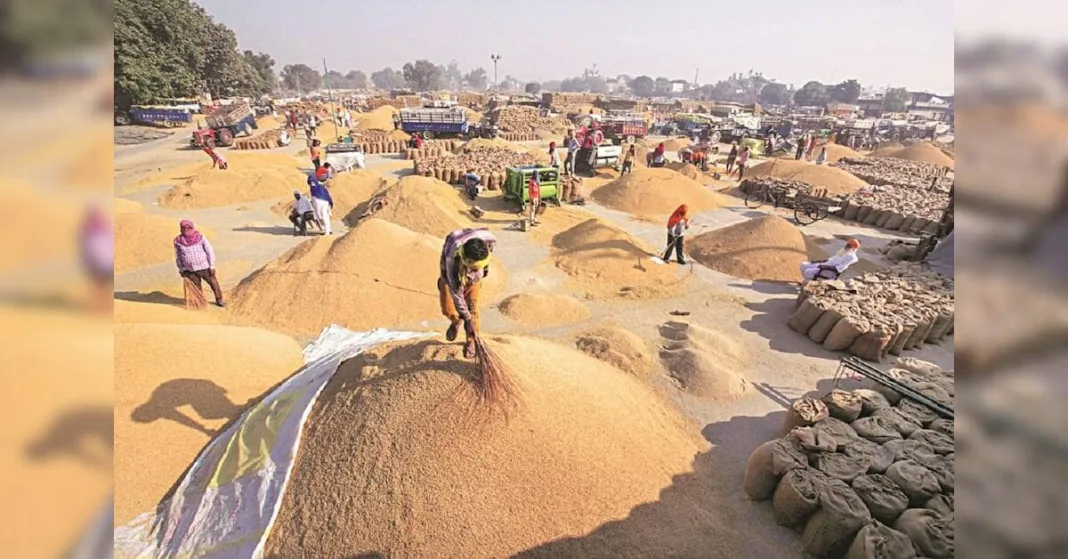

The trouble, which is beginning to acquire a political colour with the Opposition Congress making it a major issue, is also starting to resonate in neighbouring poll-bound Punjab. The two states share a border and face many similar farming challenges.
In Punjab, paddy procurement for the central pool has also started and is expected to gather full steam over the next 10 days.
Sources said farmers in Haryana are facing delays in procurement at mandis and are also troubled by a cap on per-acre purchases by agencies.
“The paddy crop in the entire Haryana state has turned out exceptionally well this year, with average yields in the range of 35-37 quintals per acre. However, there is an alleged cap of 25 quintals per acre in some regions that prevents farmers from selling their entire produce through the official procurement system,” Inderjit Singh Goraya, national spokesperson of the All India National Kisan Congress, told Business Standard. “If the average yield is 35-37 quintals per acre, what is the farmer supposed to do with the remaining 10-12 quintals?”
One quintal is equal to 100 kilograms, while 1 tonne is 1,000 kilograms.
He alleged that the government had also not completed the allocation of procurement agencies to mandis or clarified how much paddy each agency was expected to procure. Meanwhile, paddy procured last year was still lying in storage and had not been lifted.
“Farmers have been waiting in mandis for five-six days. Furthermore, their produce is being purchased at ₹100-200 per quintal below the minimum support price (MSP) due to excess moisture,” Goraya said.
He alleged that while the Centre had fixed the paddy MSP at ₹2,441 per quintal for the 2026-27 season, farmers in several places were being forced to sell their produce for ₹2,200-2,300 per quintal. He also questioned the Haryana government’s paddy production figures.
In neighbouring Punjab, too, farmers are bracing for a scratchy start to the paddy procurement season. The state has reportedly targeted procurement of around 18 million tonnes (mt) of paddy in the 2026-27 season, against estimated production of around 19 mt.
However, farmers said actual production could exceed 20 mt, given this year’s good yields.
They also argue that the prescribed moisture limit for paddy in Punjab is difficult to meet because some newly introduced varieties naturally have high moisture content. The problem is compounded when the crop is harvested mechanically, making it difficult to reduce moisture levels.
Experts and academics said the main problem is India’s excessive paddy production and limited avenues for sale. This is beginning to strain the official procurement system, leading to bulging stocks in the central pool, particularly in North India.
The scale of the problem is evident in Punjab. The state is planning to procure around 18 mt of paddy, which would yield approximately 12.06 mt of rice after milling.
Yet, a report from the Union Ministry of Food shows that Punjab had around 15.3 mt of rice stocks from previous procurement as of August 31, 2026.
Punjab’s combined wheat and rice storage capacity, with the Centre and state government taken together, was reportedly around 26.84 mt as of August 1, 2026. Its total foodgrain stocks, however, stood at around 27.64 mt on August 31.
Haryana faces a similar situation. The Centre is believed to have set a target of procuring around 5.8 mt of paddy from farmers, translating into nearly 3.8 mt of rice after milling.
According to the same ministry report, the state’s rice stocks from previous years stood at around 4.3 mt as of August 31, 2026.
Haryana’s combined wheat and rice storage capacity, including facilities held by the Centre and the state, was around 13.94 mt as of August 1. Its total wheat and rice stocks stood at around 14.32 mt on August 31, according to official records.
These figures pre-date the new procurement season and do not account for stock drawdowns during September and October. Even so, they underline the pressure on storage and procurement systems as a fresh crop arrives in two of India’s major paddy-producing states.