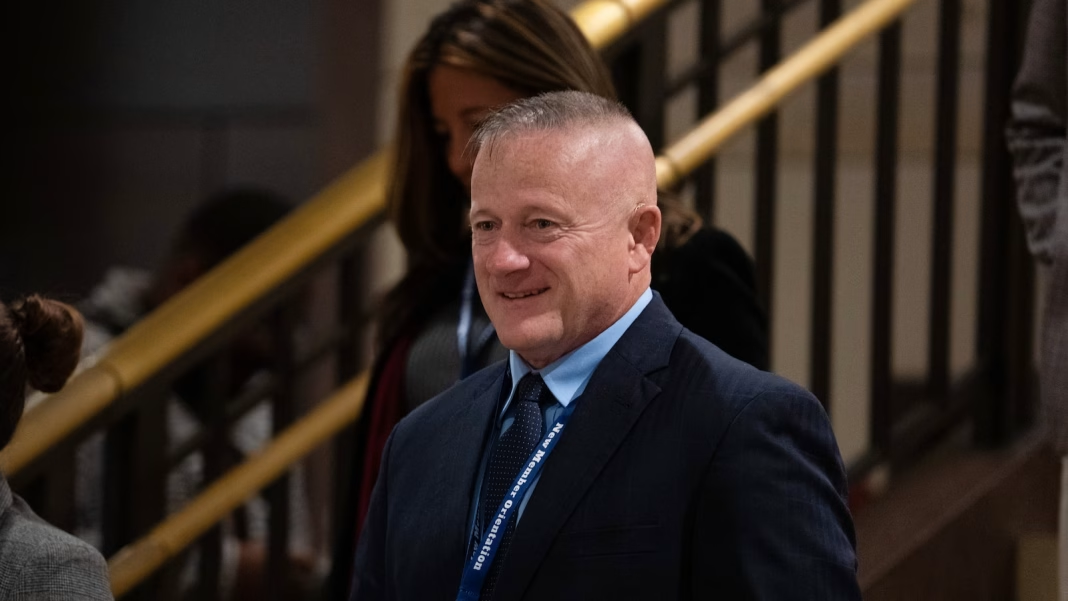

WASHINGTON — Rep. Richard Hudson of North Carolina was in charge of the National Republican Congressional Committee, the organization dedicated to supporting his party’s House campaigns.
But the seven-term congressman wasn’t able to save his own seat this year. Republicans floundered in the state after party organizations pulled support from Michael Whatley, their U.S. Senate candidate, as he failed to gain traction against Democratic nominee Roy Cooper.
Hudson lost North Carolina’s 9th district to Richard Ojeda, a former Army major who became a liberal social media phenomenon during President Donald Trump’s first term. He ran multiple races in West Virginia then moved back to North Carolina, where he had served at Fort Bragg, and successfully ran against Hudson.
“Our victory is not just impressive because of how many seats we gained — although we did gain a lot — what was incredible last night was how far we reached into deep red territory,” said Rep. Suzan DelBene, chair of the Democratic Congressional Campaign Committee.
Ojeda arrived on Capitol Hill this week, one of several new members who pulled off upset victories this year. Here’s a look at some of them.
This district is home to NORAD, Fort Carson and the Air Force Academy, as well as the evangelical group Focus on the Family.
Although Colorado Springs has been a conservative stronghold for years, the city has been slowly turning more moderate as young families move in. Its veteran population has also been unsettled by Trump’s approach to the military and the Iran war.
Jessica Killin, a Democrat and former Army captain, capitalized on this to run as a moderate against Rep. Jeff Crank, who had previously run the Colorado chapter of the conservative group Americans For Prosperity. She hammered him for falling in line behind Trump once he got into the House.
Former state lawmaker Teresa Benitez-Thompson made history as the first Democrat to win Nevada’s 2nd Congressional District after her Republican opponent David Flippo’s campaign was muddied by accusations of exaggerating his military record and failing to release his required financial disclosures on time.
Benitez-Thompson campaigned as a moderate with longtime northern Nevada roots, contrasting herself with Flippo, who aligned himself closely to Trump and moved from southern Nevada to join the race after longtime Republican Rep. Mark Amodei announced his retirement. Amodei refused to endorse Flippo, calling him a fraud.
For the first time ever, all of Nevada’s congressional seats will be held by Democrats.
Republican Rep. Bryan Steil won all four of his previous elections in this southeast Wisconsin district by at least 9 points. Before him, former House Speaker Paul Ryan held the seat for two decades, and no Democrat had won since 1993.
All of those factors made it improbable that Democratic newcomer Mitchell Berman, running his first campaign for any office, would come out on top this year. But Berman, an emergency room nurse, tapped into voter anger and leveraged his middle-class background to beat Steil by nearly 4 points.
The outcome will ripple through Wisconsin politics because Steil was widely considered as a likely candidate for U.S. Senate down the road.
The race opened up when Republican Rep. Tony Gonzales announced he wouldn’t run for reelection after admitting to an affair with a former staff member who later died by suicide. Primary voters chose Brandon Herrera, a gun enthusiast YouTuber with some 4 million subscribers and a history of caustic commentary, to run in his place.
Democrats put up Katy Padilla Stout, a lawyer and former teacher, but she was believed to have little chance. The district hadn’t elected a Democrat since 2012. She ended up winning by 8 points.
This district used to be considered so blue that Republicans didn’t even put up a candidate to run there in 2024. But a year later at Trump’s urging, the state legislature redrew the congressional map, making it far more conservative. Democrats and their donors figured the seat was a lost cause as Democrat Leticia Gutierrez, who had previously worked in Houston city government, went up against Republican Alex Mealer, a well-financed military veteran who was active in conservative politics.
“Everyone felt it was a done deal that this was written for Republicans,” said Gutierrez in an interview with The Associated Press. “They just weren’t going to invest their time, money, and resources into someone that had never run a congressional campaign.”
Then Gutierrez beat Mealer by a little over 15 points.
Rep. Victoria Spartz has been a wildcard in the Republican caucus, often withholding her support for legislation until the last minutes as she seeks concessions from party leadership.
But the Ukrainian-born lawmaker seemed to be a safe reelection prospect in conservative Indiana, particularly in her affluent suburban and rural district north of Indianapolis. The seat only became more red in 2021, when the state legislature removed portions of more Democratic-leaning areas of Marion County and added conservative rural tracts. Two years ago, Trump won by 17 percentage points, and Spartz won by even more.
But this year J.D. Ford, a Democratic state senator, beat Spartz by 3.4 percentage points.
There’s not many red seats left in the Northeast, but one of them has been in the southeastern corner of New Jersey. The district stretches from shore resorts to the pine barrens, and it’s been represented by Rep. Jeff Van Drew. He was first elected to Congress as a conservative Democrat in 2018 only to switch parties in 2020 after Trump’s first impeachment.
Van Drew kept winning reelection until this week, when he lost to Zack Mullock, the Democratic mayor of Cape May. Mullock focused on Van Drew’s support for the president, attacking him in a debate over the Iran war and tariffs. Van Drew argued that his connections with Trump would benefit the district.
When Republican Rep. Ashley Hinson decided to run for U.S. Senate, that left an open race for her House seat in the northeastern corner of Iowa. The Republican candidate was Joe Mitchell, a former state lawmaker, and Trump visited Dubuque just two days before the election to try to boost turnout.
Mitchell lost to Lindsay James, a Democratic state lawmaker and a minister.
“I am going to stay laser-focused on lowering costs for hard-working families here in my district because that’s what they have asked me to do,” James said in an interview.
Her victory was boosted by two other candidates on the ballot — one libertarian and one unaffiliated — who received more votes than James’ margin over Mitchell.
___
Associated Press writers Hannah Fingerhut, Mike Catalini, Thomas Beaumont, Jesse Bedayn, Scott Bauer and Jessica Hill contributed to this report.