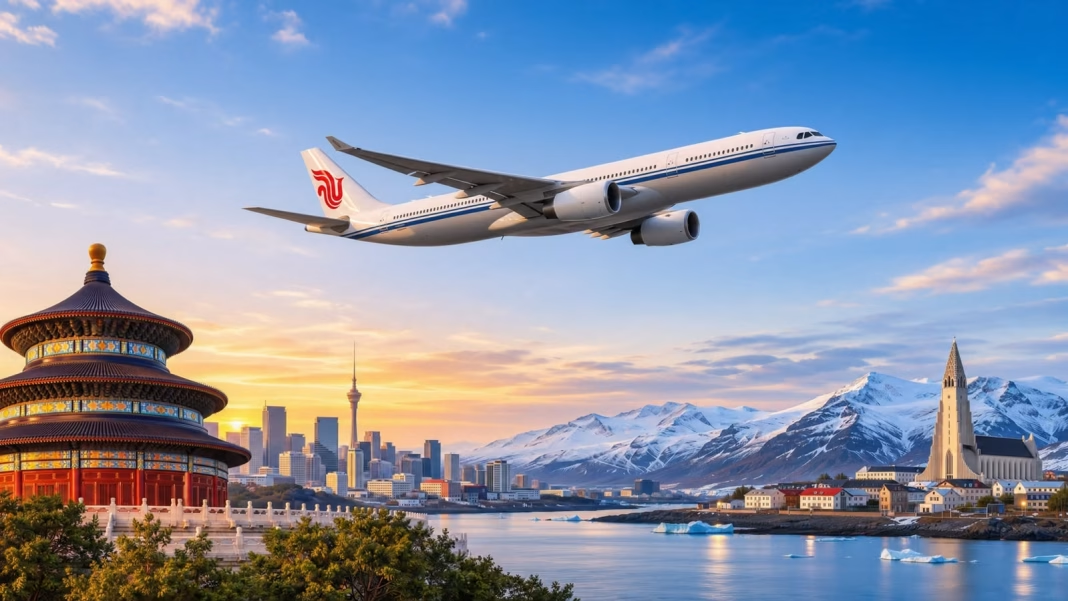


China and many other countries involved in this new service by Air China using the A330 is creating a whole new way to fly around the globe. This brand new long haul flight provides critical new direct connectivity between East Asia and the North Atlantic. The airline uses a modern wide body Airbus A330 aircraft to cater for higher passenger volumes. There is also an important stopover in Denmark which helps strengthen business links throughout Scandinavia. Fifth freedom traffic rights enable passengers to book local sectors easily. This gives passengers unrivalled convenience, premium lie flat seats and increased global connectivity between four different countries all in one journey.
Air China’s multi-stop long-haul service connects Beijing Capital International Airport (PEK) to Reykjavik Keflavík International Airport (KEF) via an intermediate stop at Copenhagen Kastrup Airport (CPH). Deployed on widebody Airbus A330-300 aircraft, this strategic corridor interlinks four national territories—China, Denmark, Iceland, and international connecting markets—while utilizing rare fifth-freedom traffic rights across the Scandinavian-Atlantic sector.
Advertisement
Advertisement
What is the strategic role of China in this long-haul corridor?
China serves as the foundational origin point and operational hub for Air China’s intercontinental network. Operating out of Beijing Capital International Airport (PEK), the flag carrier leverages vast domestic and regional feeder networks across East Asia. This trunk route establishes a direct link between mainland China and northern European economies.
As the originating nation, China supplies significant passenger volume consisting of outbound tourists, business executives, and commercial trade traffic destined for Scandinavia and the Nordic region. The deployment of widebody Airbus A330-300 aircraft allows Air China to maintain strong cargo belly capacity alongside dual-class passenger configurations. By anchoring this operation in Beijing, China enhances its geopolitical and commercial aviation presence across key transatlantic and North Atlantic air passages.
China’s centralized hub model optimizes transit efficiency, drawing passengers from major Chinese metropolitan areas to consolidate long-haul international demand. The route highlights China’s strategy of expanding direct aviation infrastructure into specialized European destinations through intermediate technical and commercial stops.
How does Denmark function as the critical European intermediate hub?
Denmark plays a vital role in this flight itinerary by hosting the intermediate stopover at Copenhagen Kastrup Airport (CPH). Situated at a geographical crossroads in Northern Europe, Copenhagen provides seamless operational infrastructure for long-haul carriers transiting between Asia and the North Atlantic region.
Advertisement
Advertisement
Air China uses Denmark as a commercial and operational pivot on the journey between Beijing and Reykjavik. Ground crews at Copenhagen Kastrup facilitate aircraft refuelling, crew rotations, and passenger boarding during the scheduled layover. Beyond technical operations, Denmark’s involvement unlocks crucial bilateral aviation permissions that permit local traffic embarkation.
By connecting Copenhagen directly to both Asia and Iceland, Denmark strengthens its standing as Scandinavia’s premier international aviation gateway. The flight path reinforces trade and tourism ties between Denmark, East Asia, and the Nordic islands, ensuring high capacity utilization on both long-haul and regional sectors.
Why is Iceland an important destination for this North Atlantic route?
Iceland represents the North Atlantic terminus of the routing through Reykjavik Keflavík International Airport (KEF). Historically reliant on European and North American connections, Iceland gains expanded global access through direct widebody links to East Asian markets via Copenhagen.
The inclusion of Reykjavik provides Iceland with vital connectivity for inbound international tourism, a cornerstone of the national economy. Chinese travelers seeking Arctic natural attractions benefit from streamlined transit options without needing multiple hub transfers across Western Europe. Additionally, Icelandic exporters gain direct air freight capacity for high-value perishables, such as seafood, heading to Asian markets.
Reaching Keflavík Airport positions Air China as a unique Asian carrier operating within the North Atlantic sector. This direct gateway lowers travel times between East Asia and Iceland, promoting bilateral cultural exchange, diplomatic links, and commercial partnerships between the two nations.
You can access official services, public notices, and regulatory updates directly on the GOV.UK Official Portal.
Advertisement
Advertisement
How do secondary connecting nations benefit from global alliance networks?
The fourth national category in this ecosystem encompasses secondary connecting countries linked through alliance networks at Copenhagen and Beijing. Passengers originating from neighboring European and Nordic nations utilize feeder flights into Copenhagen to join Air China’s service.
Through partner networks like Star Alliance, passengers from countries such as Sweden, Norway, Germany, and the UK can connect to this routing seamlessly. Copenhagen acts as a regional collector, gathering passengers from across Northern Europe and channeling them toward either Iceland or China.
This global network integration boosts overall route profitability by tapping into diverse international origin-and-destination markets. Travelers across Europe gain access to flexible flight itineraries, unified ticketing, and streamlined baggage transfers across multiple participating partner airlines.
“Air China’s innovative multi-leg service highlights how strategic route planning can successfully bridge distant continents while maximizing operational efficiency. Connecting Beijing, Copenhagen, and Reykjavik via a modern Airbus A330-300 not only satisfies rising long-haul travel demand between East Asia and the Nordic region, but also transforms regional European aviation through valuable fifth-freedom traffic rights. Providing passengers with a superior widebody experience on intra-European sectors creates a win-win scenario for both international tourists and local commuters. This operational model exemplifies how smart alliance integration and flexible bilateral agreements can boost global connectivity, stimulate local economies, and elevate the overall passenger experience.”
— Anup Kumar Keshan, Founder and Editor-in-Chief, Travel And Tour World
What makes the Airbus A330-300 the ideal widebody aircraft for this flight?
The Airbus A330-300 serves as the primary aircraft type chosen to service this multi-leg intercontinental journey. Renowned for its operational reliability and favorable seat-mile economics, the twin-engine widebody provides the balance of range and capacity required for mid-to-long-haul sectors.
Advertisement
Advertisement
Configured with lie-flat business class seats and a spacious economy cabin, the A330-300 delivers long-haul passenger comfort on both the main ocean-crossing segment and the shorter European leg. The aircraft’s lower-deck cargo capacity offers significant freight payload, generating supplementary revenue from transpacific and European cargo flows.
Deploying a widebody aircraft on the shorter Copenhagen-to-Reykjavik sector provides Air China with a distinct product advantage over regional narrowbody operators. The A330-300 provides enhanced passenger comfort, superior cabin quietness, and consistent premium service levels throughout the entire multi-stop flight path.
How do fifth-freedom traffic rights transform the Copenhagen to Reykjavik leg?
The operational highlights of this route include fifth-freedom traffic rights on the segment connecting Copenhagen (CPH) and Reykjavik (KEF). Fifth-freedom privileges grant an airline the right to carry revenue passengers between two foreign countries on a flight originating or ending in its home country.
These commercial traffic rights allow Air China to sell standalone tickets specifically for the flight between Denmark and Iceland. Local European travelers can book passage solely for the intra-European leg, filling seats that might otherwise remain vacant during the intermediate tag sector.
This operational flexibility provides European passengers with a unique widebody flight option featuring premium lie-flat seating on a route typically dominated by narrowbody aircraft. For Air China, fifth-freedom rights optimize load factors, boost route yields, and maximize aircraft utility across complex intercontinental schedules.
Country Breakdown & Roles
| Country | Primary Airport / Node | Strategic Role in Route Network |
|---|---|---|
| China | Beijing Capital International (PEK) | Origin & Flag Carrier Hub: Feeds outbound Asia-Pacific passenger and cargo traffic onto the North Atlantic trunk corridor. |
| Denmark | Copenhagen Kastrup (CPH) | Intermediate Technical & Commercial Hub: Serves as a refuelling, crew-change, and transit pivot, while generating local Scandinavian O&D traffic via 5th-freedom rights. |
| Iceland | Reykjavik Keflavík (KEF) | Terminus Destination: Establishes direct widebody connectivity to East Asia, supporting inbound Arctic tourism and high-value export cargo (e.g., seafood). |
| Partner Countries (e.g., UK, Germany, Sweden, Norway) | Regional Partner Airports (e.g., LHR, FRA, OSL, ARN) | Feeder Network Connections: Leverages global airline alliances (such as Star Alliance) to aggregate secondary European traffic into Copenhagen. |
This maximises profits on this route by giving the carrier beneficial 5th freedom rights through Copenhagen, and also provides passengers from Asia with direct access to Nordic tourism. This also helps grow the international passenger market by having strong alliances. This creates a sustainable revenue stream for multiple countries.
Overall, this is a huge success for international aviation, as China and other countries connected by this A330 flight are now linked together. The flag carrier has successfully brought these different passenger markets together by connecting Beijing, Copenhagen and Reykjavik. Locals also have access to a premium wide-body flight which they would not usually get on such a short European flight. The strong trading connections and increased Nordic tourism will help provide a constant increase in revenue for all the countries involved. This intercontinental route demonstrates the benefits of using clever traffic rights and fleet positioning to connect far apart countries together. Creating a modern gateway between Asia and Europe.