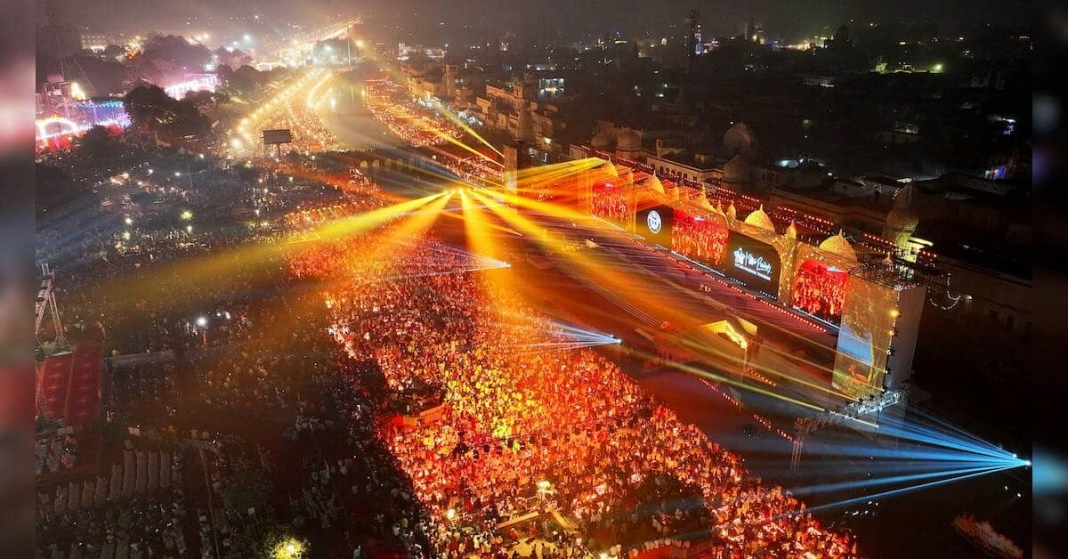

The temple town of Ayodhya figuratively mimicked a starlit skyline, with more than 3 million diyas (earthen lamps) illuminating the banks of the Saryu on the eve of Diwali, which is now celebrated as Deepotsav in the temple town.
Preparations for the record display of 3 million diyas across 56 ghats at the iconic Ram ki Paidi on the banks of the Saryu river had been going on for the past several days.
This spectacular feat was led by Uttar Pradesh Chief Minister Yogi Adityanath, sporting a saffron turban. He also performed the auspicious aarti amid the chanting of verses.
Vice President C P Radhakrishnan was the chief guest at Deepotsav 2026, accompanied by UP Governor Anandiben Patel.
In his speech, Yogi remarked that Ayodhya was illuminated with 3.6 million diyas, in keeping with the state’s current gross state domestic product (GSDP) of ₹36 trillion.
He said that under the Narendra Modi government, a new Bharat was surging ahead by espousing both development and heritage, even as he took potshots at the opposition parties for their criticism of the dispensation.
Today, Ayodhya has an international airport, while four-lane roads connect all the major urban centres in the temple town and its periphery, the CM underlined.
The Vice President said he had been told that almost 7 million diyas had been lit across the temple town of Ayodhya.
Meanwhile, more than 2,100 Hindu priests collectively performed Maha Aarti on the banks of the Saryu.
International Ramlila performances and an aerial display of episodes from the epic Ramayana using 2,100 drones were the major highlights of the evening.
Over the past few years, the UP government has been making and breaking its own world record for lighting the maximum number of diyas at one place.
During Deepotsav in 2023, 2024 and 2025, the Yogi government illuminated the banks of the Saryu river with more than 2.2 million, 2.5 million and 2.6 million diyas, respectively.
To make the 10th Deepotsav historic, students from colleges affiliated with Dr Rammanohar Lohia Avadh University, as well as local intermediate colleges, were engaged as volunteers.
The diyas were systematically placed in accordance with the prescribed target to ensure coordination among volunteers.