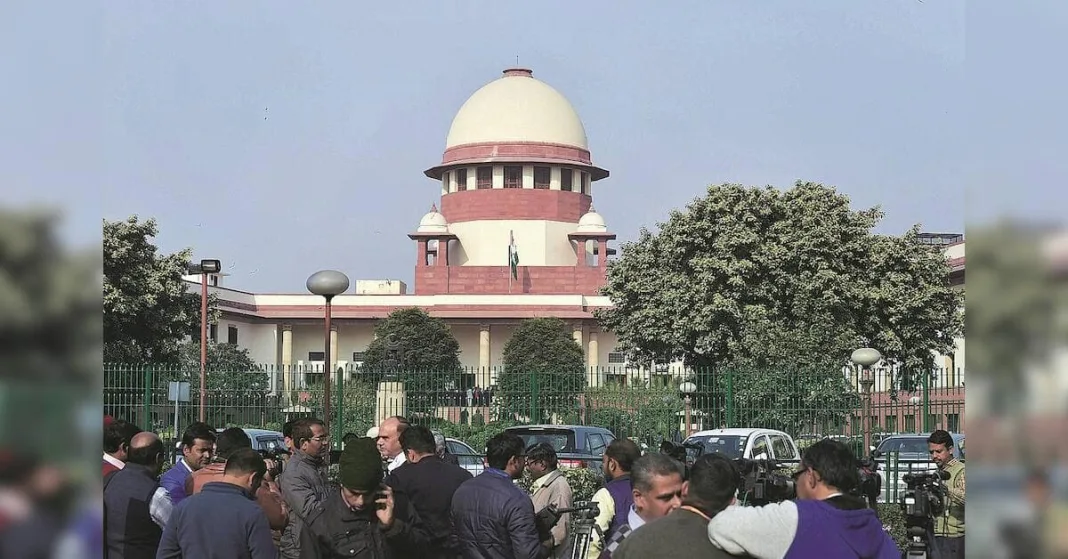

Union Home Secretary Govind Mohan and Delhi Police Commissioner Anurag Kumar on Thursday filed affidavits before the Supreme Court tendering unconditional and unqualified apologies, in a matter related to the alleged contempt of a Court order.
The plea pertains to an October 9 court order directing authorities to guarantee there was not a “complete prohibition” on Metro and train services in Delhi ahead of protest called by the Cockroach Janta Party (CJP).
The officials in their affidavit explained and defended the measures taken by the administration. Solicitor General (SG) Tushar Mehta however later clarified that the “unconditional apology” was part of the first paragraph of every affidavit in compliance with that law.
“But now, in the media and on social media, it is being said that the government has apologised, that they have nothing to say,” he said before a Bench of Chief Justice of India (CJI) Surya Kant and Justice Joymalya Bagchi.
“What the media does is not relevant. We are not holding proceedings for the media,” the CJI said.
Union Home Secretary Mohan said the Centre processed a request to suspend cellular internet services for a day, received from Delhi Police, in conformity with the law.
The request was considered proportionate, owing to the prevailing conditions on ground, to maintain public order, he said.
Defending the detention of protesters, the police said those taken into custody were kept at makeshift centres and released within two to six hours. The detainees were provided “hot, fresh and good meals”, while political leaders were accommodated in station house officer (SHO) chambers and offered tea, coffee, meals and other refreshments, the commissioner stated.
The police also said curbs on metro stations were scaled back after the court’s directions and normal services resumed by 10 pm on October 10.
CJI Surya Kant and Justice Bagchi on Thursday took up multiple petitions arising from the recent protests in Delhi, issuing notices to the Centre, Delhi Police, the Congress Party and Opposition leaders while directing authorities to preserve closed-circuit television (CCTV) footage and other digital evidence linked to the demonstrations.
The Court issued notice to the Election Commission of India and Chief Election Commissioner (CEC) Gyanesh Kumar on petitions filed by Congress leader Rahul Gandhi and other Opposition leaders challenging alleged large-scale voter deletions and irregularities in the ongoing SIR exercise.
The petitions were tagged with existing cases challenging the revision in several states. The Bench also indicated that one of the petitioners would be asked to explain his conduct at the next hearing, without specifying the name.
The Bench issued notice to the Congress Party, Rahul Gandhi and other INDIA bloc leaders on a petition seeking restrictions on political demonstrations within court premises and action over the October 12 march to the Supreme Court.
The petition, filed by four lawyers, also sought contempt proceedings over social media posts by the Congress’ Kerala unit and Trinamool Congress MP Mahua Moitra that criticised the CJI.
Senior advocate Gaurav Bhatia, appearing for the petitioners, argued that demonstrations within court premises amounted to an attempt to intimidate the judiciary. CJI Kant responded that nobody could browbeat the judiciary.
The court, however, declined to issue notice on the contempt prayer at this stage, saying it would first examine the respondents’ replies.
In connection with the protests, the Supreme Court directed law enforcement agencies to preserve CCTV footage and other digital material. Private parties were also permitted to preserve relevant material.
Issuing notices on a batch of petitions, the court asked the SG’s side and the petitioners to appoint nodal counsel to consolidate the overlapping issues.
With 46 matters already before it, the Bench appealed to lawyers against filing further petitions on the same subject. The court did not grant broader interim relief on Thursday.
On the denotification of Jantar Mantar as a protest site, the Court declined to direct immediate restoration of Jantar Mantar as a protest site, opting instead to seek the Centre’s explanation in response to a plea challenging the order issued by the Delhi Police on October 11.
The SG told the court its October 9 order was not the basis for the decision, as the committee had submitted a detailed report.
Hearing a petition concerning alleged sexual harassment and assault of women journalists covering the demonstrations, the Court indicated that an inquiry committee could be composed predominantly or exclusively of women, potentially including a former woman judge, an IPS officer and a social worker.
Senior advocate Indira Jaising sought permission to submit details of the allegations in a sealed cover to protect the identities of women willing to come forward. The CJI agreed to the request.