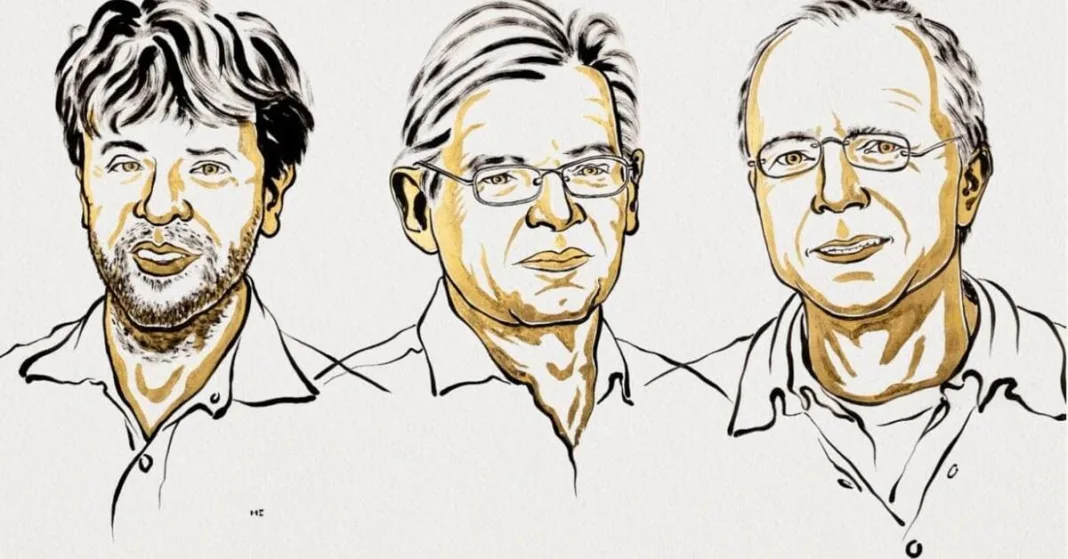

The 2026 Nobel Prize in Physiology or Medicine has been awarded to Peter Hegemann, Georg Nagel and Karl Deisseroth for their discoveries concerning light-gated ion channels and optogenetics.
Optogenetics is a technique that allows scientists to control nerve cells using light, providing a powerful way to study how the brain governs memories, feelings and behaviour in living organisms. The Nobel Committee said the laureates’ work has laid the foundation for a new era in neuroscience. “Optogenetics provides opportunities for mapping the brain in a way that we could once only dream of,” says Per Svenningsson, Chair of the Nobel Committee for Physiology or Medicine.
The Journey
For much of the 20th century, researchers tried to understand how different areas of the brain influence specific functions. However, the methods available to them often could not establish direct cause-and-effect relationships. Optogenetics has changed that by allowing researchers to activate or inhibit specific nerve cells with precise timing.
The work began with Hegemann’s efforts to understand how Chlamydomonas, a single-celled alga, moves towards a light source. In the early 2000s, Hegemann and Nagel discovered channelrhodopsin, a light-sensitive protein found on the surface of the alga’s cells.
When exposed to blue light, channelrhodopsin opens a channel through which charged ions can flow into the cell, generating an electrical impulse. The researchers found that introducing the protein into other types of cells could make those cells sensitive to light.
Deisseroth then took the discovery a step further. He introduced the gene responsible for channelrhodopsin into nerve cells taken from rats and showed that blue light could be used to trigger nerve signals. He published the breakthrough in 2005. In 2007, he demonstrated that the light-controlled switch could be used to control nerve cells in the brains of living mice.
The technique became known as optogenetics and has since transformed neuroscience. By controlling specific groups of nerve cells with light, researchers can investigate neural circuits involved in memories, emotions and behaviours, including those linked to neurological and psychiatric disorders.
The technique is also being explored for potential medical applications. Researchers are using optogenetics in attempts to restore vision in people with visual impairment, among other areas of research.
The Nobel Committee said optogenetics provides opportunities to map the brain with a level of precision that researchers could previously only dream of. The technique has helped scientists move beyond a broad “sketch map” of the brain towards a clearer understanding of how individual neural circuits contribute to its functions.
The discoveries by Hegemann, Nagel and Deisseroth have therefore changed the study of the brain, opening new ways to investigate one of science’s enduring questions: how the brain controls our memories, feelings, behaviour and bodily functions.