
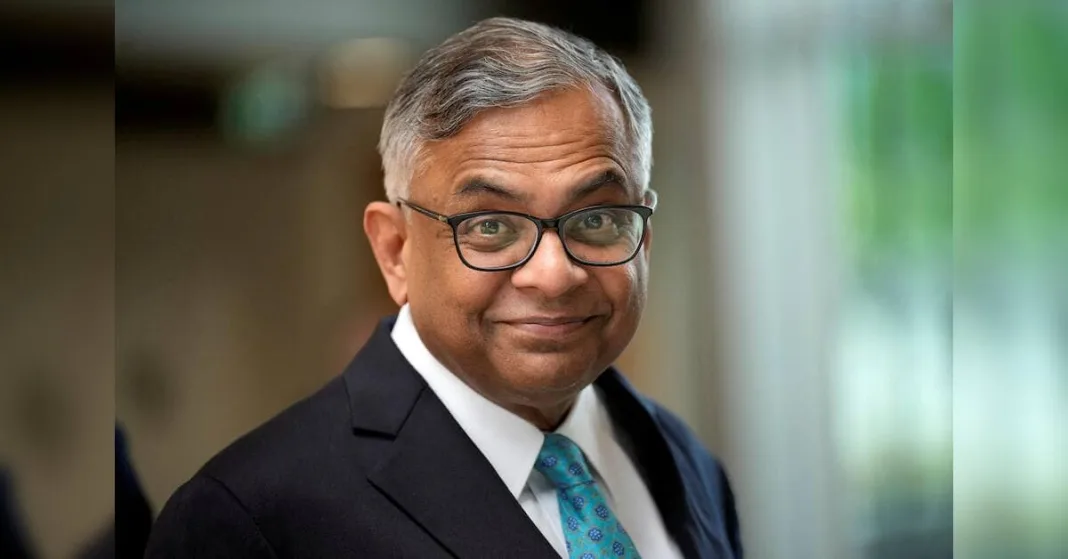

India’s economy is robust in a world that is uncertain and difficult, and multiple indicators show that the country is in a stable and strong place, Tata Sons Chairman N Chandrasekaran said on Monday and highlighted that energy security, advanced manufacturing jobs and investments in human capital will be “critical” for sustaining long-term growth.
He noted that the Viksit Bharat 2047 vision has percolated across multiple sectors in the country. Delivering on the vision will require inclusive and sustainable development, built on world-class infrastructure, institutions and intellectual property, he said.
The Tata Sons Chairman also emphasised the importance of focusing on quality and moving from current assembly-led growth to an end-to-end full product range of capabilities.
“Viksit Bharat 2047 vision of Prime Minister has percolated across multiple disciplines in all parts of the country. But to execute that vision is going to require inclusive, sustainable development by creating world-class infrastructure, institutions and intellectual property. All three will be critical,” he said, addressing the Indian Foundation for Quality Management (IFQM) Symposium 2026.
Chandrasekaran — who was recently handed his third five-year term at the helm as Tata Sons Chairman amid an intense boardroom battle — further said the Indian economy is doing very well and, over the last several years, has consistently exceeded expectations by posting the highest growth “in a world that is uncertain and difficult”.
India’s growth is backed by strong domestic demand, services exports and an enabling policy environment, he said, observing that fundamentals remain strong.
He also pointed to double-digit demand in high-frequency indicators like auto sales, credit growth, as well as power and cement sectors.
The overall economy is robust, he said, citing multiple parameters such as current account deficit consistently below one per cent of GDP, strong services exports and forex reserves, and low bank NPAs, all of which show India is in a “stable and strong place”.
He added that sustaining growth over a long period will require more measures, and drew attention to energy security, advanced and precision manufacturing jobs, and investments in human capital. These, he said, will be “critical” for sustaining long-term growth.
“Energy security must be ensured because that is going to be fundamental for growth. Second, manufacturing jobs… advanced manufacturing jobs, precision manufacturing jobs…because we need to shift from a low-productivity agricultural workforce to highly-productive manufacturing and modern services with the right investments in all the areas,” he said.
Chandrasekaran also stressed on the importance of investments in human resources, be it education or skill development.
Citing the example of Toyota, Chandrasekaran said the Japanese auto giant never looked at quality as just a mere outcome, but as a driver of innovation and competitive edge at the same time.
“Quality is definitely important to produce the outcome that we want… But it became a key driver for innovation, productivity and competitiveness for Toyota,” he said.
Nations such as Germany transformed their national competitive advantage by focusing on quality.
“Be it in terms of engineering of their products or defining standards, precision or building their entire supplier and SME or the middle strand ecosystem… I think in India, we need such a transformation,” he said.
He also urged the Indian manufacturers to integrate sustainable manufacturing processes, besides quality and other factors. It has to “get embedded in our whole manufacturing ambition,” he pointed out.
Chandrasekaran hoped that the process will create a strong leadership of not only big companies, but also for middle strand ecosystem. It will also create experts who will act as a force multiplier by not only helping the country, but becoming a global voice in shaping the future of how these products are made.
Pointing to Tata Group’s diverse operations from automotive to aerospace, he said that the conglomerate is also making big investments, including in telecom infrastructure.
“But what we need to do is to ask the question: how do we seriously move from the current assembly-led growth to an end-to-end domestic capability? It is very important to build the assembly-led growth, and that is going to lead to creating a strong SME segment,” he said.
From there, moving to end-to-end full product, and building a range of capabilities is going to require investments into R&D, creation of intellectual property and being in tune with the market.
“… To build not only the products, but the equipment that are necessary….and skill sets that we need to create, focus on vocational skills and use quality at the centre of everything, so that it is not seen only as ensuring a product outcome but used as a mechanism, tool for innovation, productivity and competitiveness,” he said.