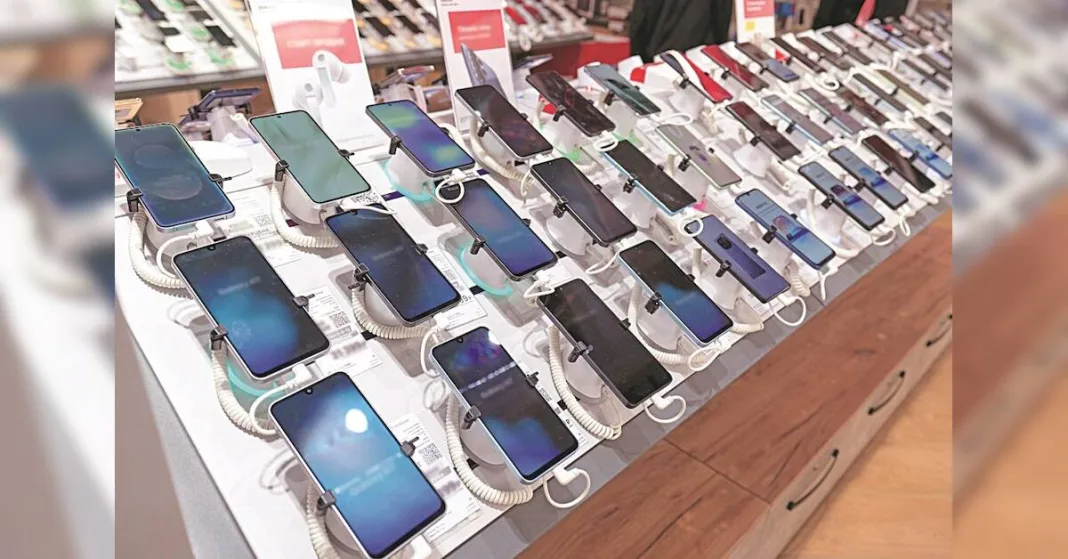

The big local boys churned out large volumes by sourcing white label 3G, or third-generation technology, phones from Chinese manufacturers, which were stamped with Indian brand logos and then shipped to the country. These brands leveraged their aggressive retail distribution networks and played on price. Indian consumers lapped up these devices. The honeymoon, however, lasted less than four years. In 2017, the share of homegrown brands tumbled to a mere 16 per cent. Many of the companies shut shop as Chinese brands like Xiaomi, Vivo and Oppo moved in to grab over 55 per cent market share.
A dramatic twist followed when Reliance Jio launched 4G services in 2016, rendering the large inventory of 3G phones held by Indian brands useless. They had failed to anticipate the speed of 4G adoption.
Chinese brands leveraged their massive research and development (R&D) centres to offer 4G phones with high-quality cameras and other premium features. They also brought in their own trusted distributors, who sold products at thin margins. The Indian brands wilted before the Chinese onslaught.
Incentives for Indians
Now, the government has for the first time put together a plan to try and change the game by encouraging homegrown players to build a mobile brand. In a notification under a ₹62,500 crore mobile phone manufacturing scheme released this month it has published rules to incentivise and support Indian mobile brands.
Officials said the Ministry of Electronics and Information Technology (Meity) has earmarked around ₹5,000 crore out of the ₹62,500 crore for the five-year scheme and that money will not be a constraint if more is needed. IT Minister Ashwini Vaishnaw says the government is looking to support around three Indian mobile brands.
To ensure only serious players come in, Meity has listed some conditions to qualify: The companies must have a minimum revenue of ₹1,000 crore per annum; Indian nationals must hold at least 51 per cent stake in the company; and it must own the mobile patents in the country.
In return the government is offering an incentive which could go up to 9.5 per cent of sales — 5 per cent on the incremental sales a company makes each year from the phones, another 1.5 per cent if it buys key components such as batteries and camera modules from local players and 3 per cent for setting up a research and development (R&D) centre to be audited by Meity. Without an R&D facility a company will not be eligible for the scheme.
Will the big push for building Indian branded phones work? At least three companies have publicly shown interest — Lava International, NxtQuantum Shift Technologies, founded by Madhav Sheth who built the Chinese smartphone brand Realme in India, and Hyderabad-based audio electronics manufacturer Mivi, which is just launching its first 5G mobile phone.
This, however, is not the first time that the government has tried to push homegrown mobile brands. The previous production linked incentive scheme for mobiles, which ended in financial year 2025-26 (FY26), aimed to build “national champion companies” but did not take off.
Out of the five homegrown companies eligible under the previous scheme for incentives in the range of 4-6 per cent of sales, only Dixon Tech was able to meet the incremental investment and production value criteria each year to qualify. Dixon, however, is an electronics manufacturing services player that assembles phones for a variety of brands such as Lenovo to Xiaomi and, therefore, could not compete with its clients to build a brand of its own.
Besides, the earlier scheme was designed to build global scale in mobile production and push exports — both of which it succeeded in doing — rather than build an Indian mobile brand.
Many argue that Indian mobile companies have not learnt from their experience. Said Neil Shah, founder of Counterpoint Research: “It’s a good step but it follows a playbook similar to what Micromax, Karbonn and Lava did 17 years ago — leveraging China-based design, R&D without any vertical IP (intellectual property), design or unique differentiated innovation except competing on price, marketing and channel. These vectors are neither core competencies nor long-term success markers. Also the definition of R&D in the scheme needs to be transparent, along with the audit process.”
Ajai Chowdhry — cofounder, HCL, and now chairman of the governing board at the National Quantum Mission — who has been pushing to build Indian mobile brands, said, “We must get back at least a 11-20 per cent share of the smartphone market to Indian brands from near-zero… the aggressive incentives offered by the government can make it happen. We can’t give away the Indian market to China. We need secure phones for India, and design our own sovereign chips.”
At least one company, NxtQuantum Shift Technologies, has shown serious intent. It had launched the Ai+ mobile brand online on ecommerce website Flipkart and has already sold over 1 million units.
“We will surely participate in the scheme to build an Indian brand mobile phone,” NxtQuantum’s Sheth said.
“The government does not need fly-by-night operators, they are looking at 2-3 players, who will have to compulsorily invest in R&D first that will lead to revenues. We are already aiming to get a 3-4 per cent share of the market in this financial year. We also hope to increase our average selling price from ₹13,500 to ₹15,000 by Diwali,” he added. The company has already invested $6 million on R&D and is planning to spend a total of $34 million (around ₹350 crore) by next year in this space — money that will go into hiring around 80 expats from across the world and 300 engineers to help them, apart from buying machinery and building servers, among other heads. At a later stage, it will look at coinvesting with companies for manufacturing key components.
The good news for Indian brands is that there’s a new opening in the market. According to Shah, “There is an opening in the sub-$150 or ₹15,000 segment where the gap has been created due to chipflation (memory chip prices hitting the roof due to a supply crunch). Major brands are moving away from it due to profitability reasons, so this market remains unserved.”
However, this market is still the largest in volume terms — accounting for 51 per cent of sales. That is why new brands like Boltt, Ai+ and Mivi have positioned themselves in this segment.
Midhula Devabhaktuni, cofounder, Mivi said: “We see an opportunity in this segment with global players moving out — our first phone is positioned here at ₹11,999. We also plan to participate in the government scheme if we are eligible.” She said Mivi has built the design of the phone through its in-house team and, like in audio products, will eventually manufacture the phone in-house. But it views the minimum revenue requirement of ₹1,000 crore as a dampener for new companies. It requests, instead, that candidates should be judged by their R&D capability.
To be sure, the sub-₹15,000 space is not enough for a firm to build and sustain an Indian brand — it has to play in the premium and high-end segments, where the Chinese dominate globally. In this segment, the phones get more complex.
Sheth acknowledged this. It’s why his company is already making the first move with three models in the ₹15,000-25,000 bracket. “We are already competing with the Chinese in this market. We have three products in this segment, and the idea is to offer a product with a similar quality to that of the Chinese.”
In a market dominated by major global mobile giants, can Indian brands, with their relatively limited financial heft and technology know-how, hold their own and make a dent in the Indian market?
The market will watch for clues to the answer. Appropriately, IT Minister Vaishnaw appears to be aiming cautiously — incentives to build three domestic mobile brands could be just the push India requires in this vital consumer sector.