


In banking, insurance, and lending, a correct number is not enough. Regulators, internal auditors, and model validators also ask how it was produced: where the source data came from, which transformations touched it, who changed what and when, and whether the result could be reproduced next quarter.
Most pipelines were built for speed and freshness, not proof. Lineage lives in a wiki page, quality checks run but leave no record, and a March regulatory report cannot be rebuilt in September because upstream tables were overwritten. Audit-ready data pipelines close that gap by treating evidence as a first-class output of engineering.
The pressure is growing because data now feeds decisions made by machines. Credit scoring, fraud detection, and KYC screening all depend on training and scoring data that must be traceable, and BFSI model risk management frameworks, such as those Samta.ai outlines for regulated institutions, start from the same premise: a model is only as defensible as the data lineage behind it.
Traceability also depends on knowing what data exists in the first place. Before lineage or quality controls can be applied, an institution needs an inventory of its sources, owners, and sensitivities. This article covers what audit-ready means in practice, the regulations driving it, eight design principles, a reference architecture, common failure modes, and a phased rollout.
Key Takeaways
- Audit-ready means evidence on demand: lineage, reproducibility, quality evidence, access traceability, and defensible retention.
- Many rules point the same way: including BCBS 239, GDPR, DORA, SOX, and the EU AI Act.
- Keep raw data immutable: and version everything that shapes an output, so any past result can be rebuilt.
- Capture lineage automatically: and store quality results, since a check that leaves no record proves nothing.
- Start with the five to ten pipelines: behind regulatory reports and credit and fraud models, then run a mock audit to prove the controls.
What “Audit-Ready” Actually Means
An audit-ready pipeline can produce five kinds of evidence on demand.
- Lineage. The path from any output back to source systems, including every transformation, join, and filter, ideally down to individual fields.
- Reproducibility. A past result can be rebuilt exactly from the data and code as they existed then.
- Quality evidence. Completeness, validity, uniqueness, and timeliness checks ran, and the results were stored.
- Access traceability. You know who and what accessed sensitive data, under which identity, and why.
- Defensible retention. Data is kept as long as rules require and deleted when they require it, with proof of both.
A practical test: pick a figure from a recent regulatory report and ask an engineer to trace it to source records within one working day. If that takes a week of digging through notebooks and chat threads, the pipeline is not audit-ready, however clean the data.
The Regulatory Pressure Behind It
No single rule says “build audit-ready pipelines,” but many overlapping ones require the capabilities above.
- BCBS 239. The Basel Committee’s principles for effective risk data aggregation and risk reporting cover data architecture, accuracy, completeness, timeliness, and adaptability. They apply to global systemically important banks, and supervisors are encouraged to extend them to domestic ones, so many institutions use them as a benchmark.
- GDPR. Controllers must be able to demonstrate compliance, which includes knowing where personal data flows. Fines can reach €20 million or 4% of global turnover for serious infringements.
- DORA. Applicable since 17 January 2025, it requires banks, insurers, investment firms, and other financial entities to manage ICT risk, report ICT incidents, and oversee ICT third-party providers.
- SOX and record-keeping. Under SOX Section 404, management of SEC-registered companies must assess internal control over financial reporting each year, and auditors test the access, change-management, and operational controls of the systems behind those reports. SEC Rule 17a-4, since its 2022 amendments, lets broker-dealers keep electronic records in non-rewriteable storage or in an audit-trail system that can recreate an altered or deleted record.
- US model risk guidance. The federal banking agencies replaced SR 11-7 with SR 26-2 in April 2026. Data quality and provenance for model inputs remain part of managing model risk.
- EU AI Act. High-risk systems, including those that evaluate the creditworthiness of individuals, need documented data governance for training, validation, and testing data (Article 10). Under the Digital Omnibus, these obligations now apply from 2 December 2027.
- RBI and MAS. India’s RBI Master Direction on IT Governance, Risk, Controls and Assurance Practices has applied since 1 April 2024 to banks, most NBFCs, and credit information companies. Singapore’s MAS Technology Risk Management Guidelines, revised in January 2021, apply to all MAS-regulated institutions.
The common thread: regulators want evidence, and evidence is far cheaper to capture as data flows than to reconstruct afterward.
Eight Design Principles for Audit-Ready Pipelines
1. Keep an immutable raw layer
Land source data exactly as received in append-only storage, with load timestamps and source identifiers. Never overwrite it, so every downstream table can be rebuilt from an unaltered starting point.
2. Capture lineage automatically
Manual lineage documents go stale within weeks. Instrument orchestration and transformation tools to emit lineage on every run, down to column level for critical datasets. Open standards such as OpenLineage, which integrates with Spark, Airflow, and dbt, help avoid lock-in.
3. Define data contracts at the boundaries
A contract states the schema, semantics, freshness, and quality expectations between producer and consumer, so a renamed field or changed definition fails loudly instead of silently corrupting a regulatory report.
4. Store quality results as evidence
A check that runs and disappears proves nothing. Write each result, with its threshold, observed value, and outcome, to a durable table. Block failed checks from reaching downstream layers, and require a named approver for any waiver.
5. Version everything that shapes an output
Code, configuration, reference data, and feature definitions should be versioned and tied to each run. Table formats with time travel make point-in-time reproduction practical.
6. Enforce least privilege with individual identity
Shared service accounts make access logs meaningless. Use role- or attribute-based controls, tag sensitive columns so masking applies automatically, and log reads of sensitive data, not just writes.
7. Manage retention and deletion as code
Encode retention periods per dataset and jurisdiction, and generate evidence when deletion runs. Because lineage shows where personal data has propagated, erasure requests become a query instead of an investigation.
8. Make the pipeline observable
Track run status, row counts, freshness, and schema changes, route alerts to named owners, and store run metadata permanently. “The job ran and here is its record” beats “the job usually runs.”
A Reference Architecture
A layered design shows where each control sits.
Raw layer. Immutable, append-only source data with ingestion metadata. Contracts are validated at entry.
Standardized layer. Cleansed and conformed data. Quality gates run here with stored results, and sensitive fields are tagged, masked, or tokenized.
Curated layer. Business-ready tables for reporting and model features, each with a named owner, a documented definition, and lineage back to raw.
Cross-cutting services. A data catalog, a lineage service, an orchestrator that stamps each run with a version and identity, an audit store for quality results and access logs, and a policy engine for access and retention rules.
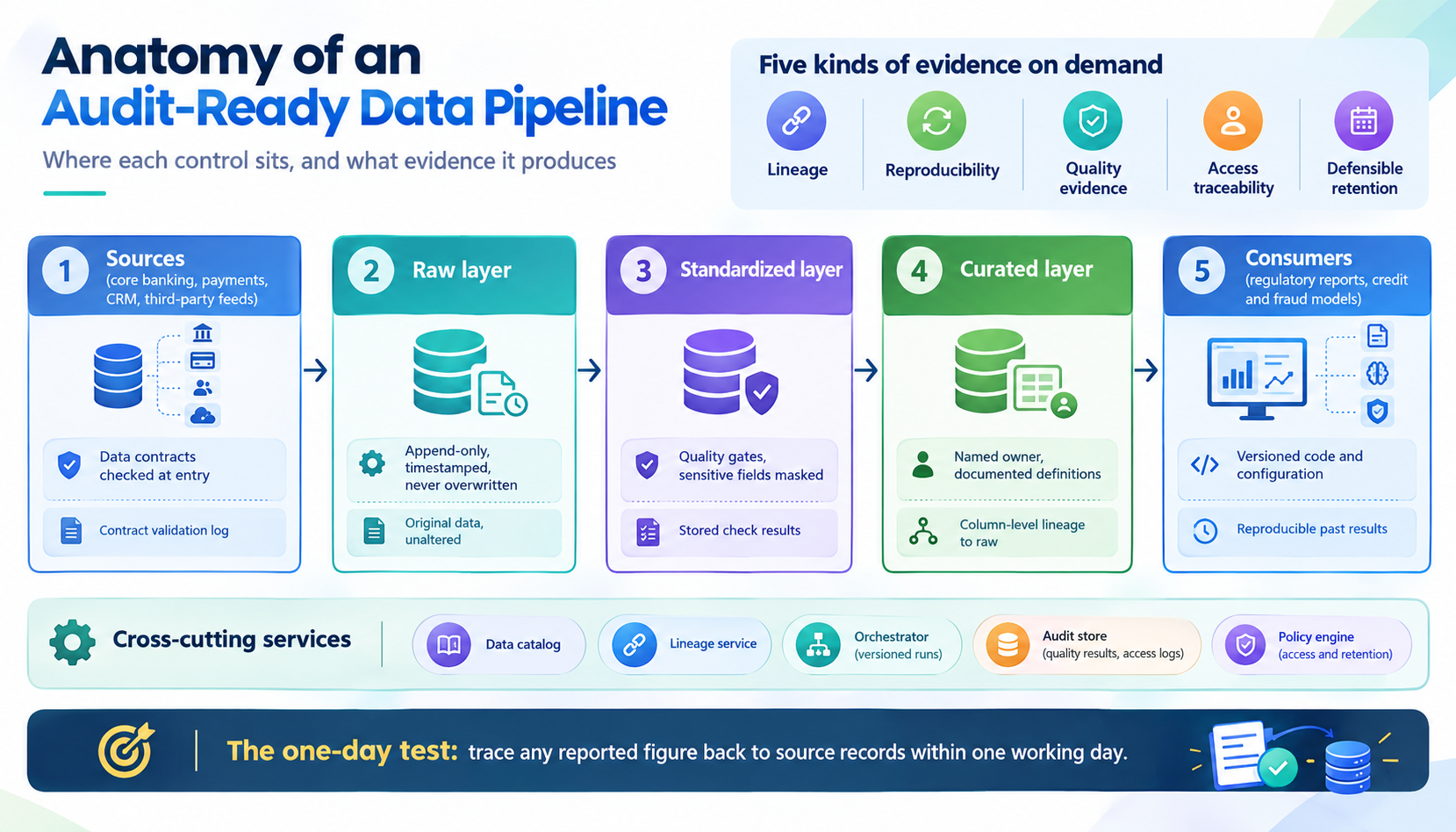
The tools matter less than the controls between them. Warehouses and lakehouses such as Snowflake and Databricks, dbt, and Airflow can all support this pattern when configured deliberately. The table below contrasts audit-ready and typical designs.
| Aspect | Typical pipeline | Audit-ready pipeline |
| Lineage | Manual, table-level | Automatic, column-level for critical data |
| Quality checks | Run, results discarded | Stored per run with thresholds and waivers |
| Raw data | Overwritten by later loads | Append-only and versioned |
| Reproducibility | Best effort | Point-in-time rebuild from versioned code and data |
| Access | Shared service accounts | Individual identity, least privilege, logged |
Common Failure Modes
- Lineage that stops at the warehouse, so the last mile of a report in a BI tool or spreadsheet is untraceable.
- Quality checks nobody records. Teams say checks exist but cannot show last quarter’s results.
- Manual overrides. Hand-edited values and “temporary” patches never reach version control.
- Unreproducible reports. Mutable sources and unversioned code return different answers months later.
- Model inputs without provenance. A hypothetical example: a credit model is retrained on a feature table quietly rebuilt with a new join, and months later no one can say why approval rates shifted.
A Practical Rollout Checklist
Retrofitting every pipeline at once stalls most programs. A phased approach works better.
First 30 days: find and rank. Inventory sources, pipelines, and owners. Identify the five to ten pipelines feeding regulatory reports and credit and fraud models, and classify their sensitive fields.
Days 31 to 60: instrument. Make raw layers append-only, add automated lineage capture and contracts at key boundaries, store quality results with blocking gates, and replace shared credentials with individual identities.
Days 61 to 90: prove it. Run a mock audit: trace three reported figures to source and reproduce one past report from versioned data and code. Formalize retention and waiver approvals, then expand to the next tier of pipelines.
Treat the mock audit as the acceptance test. Every gap it exposes is one a real auditor would have found first.
Conclusion
Audit-ready pipelines are less about new technology than about what engineering delivers. The data is still the product, but evidence of how it was made is now part of the product too.
The essentials: keep raw data immutable, capture lineage automatically, enforce contracts at boundaries, store quality results as evidence, version everything that shapes an output, log access by individual identity, manage retention as code, and make pipelines observable.
Start with the pipelines that carry the most regulatory weight, prove the controls with a mock audit, and expand from there. Institutions that build this discipline early will spend less time on audit response and be better placed as regulators turn to the data behind AI decisions.
Frequently Asked Questions
- What is an audit-ready data pipeline?
It is a pipeline that can produce five kinds of evidence on demand: lineage, reproducibility, quality evidence, access traceability, and defensible retention. - Which regulations drive it in BFSI?
No single rule requires it, but BCBS 239, GDPR, DORA, SOX, SEC Rule 17a-4, the EU AI Act, and the RBI and MAS guidelines all require similar traceability and documented evidence. - How can we test whether our pipelines are audit-ready?
Pick a figure from a recent regulatory report and trace it to source records within one working day. For a fuller test, run a mock audit: trace three reported figures and reproduce one past report from versioned data and code. - Where should we start?
Start with the five to ten pipelines that feed regulatory reports and credit and fraud models. Inventory them first, then add lineage, stored quality results, and individual access identities over the next 60 days.
About the author: Rashi Lachuriya works in marketing at Samta.ai, an enterprise AI consulting firm helping regulated industries deploy governed, production-ready AI systems. She writes about AI strategy, governance, and adoption trends.