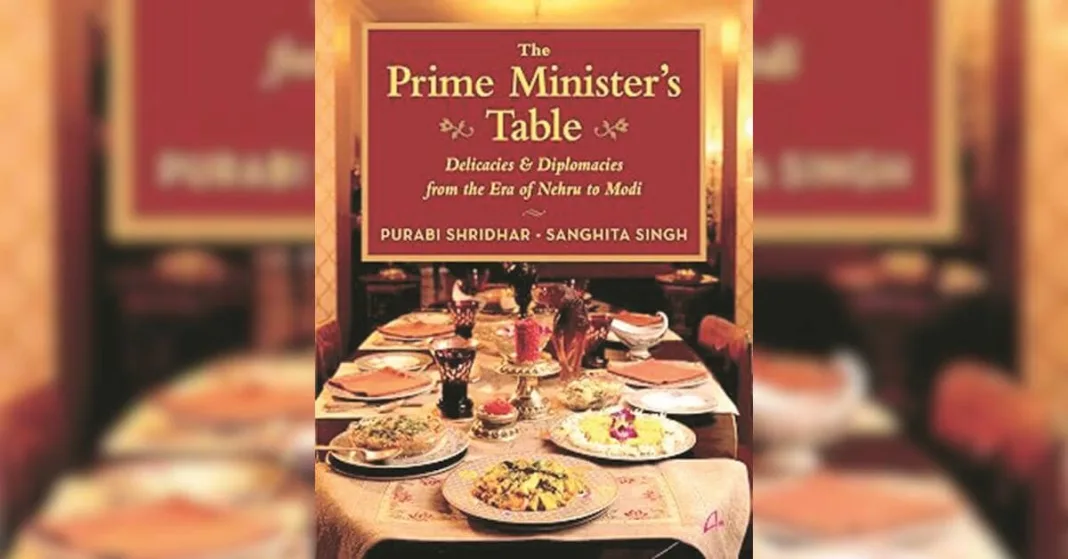

The Prime Minister’s Table: Delicacies and Diplomacies from the Era of Nehru to Modi
by Purabi Shridhar and Sanghita Singh
Published by Amaryllis
305 pages ₹1499
Given the growing appetite for micro-analysing menus at key government events — as seen during the recent Brics summit in Delhi — a new book, The Prime Minister’s Table: Delicacies and Diplomacies from the Era of Nehru to Modi — comes with plenty of insider detail to chew on.
What did India’s prime ministers eat on a daily basis? What did their dinner parties look like? What were they particular about on the dining table? How did they interact with chefs and associates? What were the favourite dishes that fuelled their busy schedules? What did they eat when they travelled? Authors Purabi Shridhar and Sanghita Singh document these tales from the kitchens and living rooms of the political elite.
The book has all the right ingredients, from simple comfort foods to regional specialities, it explores the intersection of culinary tradition, politics and post-Independence history.
The authors are interested in exploring how Indian food evolved from the colonial era into a tool of modern political diplomacy, shaping kitchen traditions along the way. It succeeds to some extent.
The authors also attempt to demystify the lives of the men and women who occupied the highest office, and make readers “meet them as one of your own”. It softens the prime ministers’ public images and offers a glimpse into personal tastes that defined them as people beyond politics.
So readers are treated to a ringside view of how hosting and feasting unfolded with world leaders, family and friends. At I K Gujral’s house, for example, the authors write, the door was always open to family, friends, and cultural connoisseurs. His wife, Sheila, played a great hostess with a table groaning with exotic continental food — her soufflés in particular were a favourite.
Structured as a series of profiles, every chapter focuses on a single prime minister and is peppered with archival black-and-white and colour photographs and short episodes from their lives. These chronicle some of their childhood experiences and how their tastes and dietary preferences were shaped as their work in public life unfolded. The book also spotlights the role of spouses and partners in shaping both their careers and dining room staples.
At the end of each chapter, readers are treated to family recipes (including Mr Gujral’s favourite cheese soufflé). Dishes like Hare Chane Ka Halwa (V P Singh), Almond Vegetable (Manmohan Singh), Tawas (Indira Gandhi), and Gujarati Lasagne (Narendra Modi) are especially sumptuous and worth bookmarking.
Thanks to considerable access, the authors stepped into former prime ministers’ homes and interviewed dozens of family members, friends, colleagues, staff, hoteliers, and chefs who have shared private stories and impressions. The book is also sprinkled with fond recollections of their children and grandchildren.
Anecdotes range from Indira Gandhi’s preference for local food when travelling (and Kashmiri food when hosting) to Narasimha Rao’s fondness for serving Gongura Idlis. Although Rao was never a big foodie, recalls his daughter Vani, he was health-conscious and counted calories for every meal. Diagnosed with diabetes, he avoided insulin and instead maintained his sugar levels through diet and exercise, the book notes.
For Atal Bihari Vajpayee, food was a more elaborate affair: chaatwallas and jalebiwallas from Chandni Chowk would set up stalls for his private parties at 3, Race Course Road. Although Prime Minister Narendra Modi is known for his love for Gujarati khichdi, chef Sanjeev Kapoor recalls a formal banquet he whipped up when Mr Modi travelled to the UAE in 2015, where the star of an Indo-Arabic spread was a Gujarati thali. But Mr Modi surprised everyone by feasting on the vegetarian Arabic dishes on that occasion.
What the authors also discovered on this food trail was a set of commonalities between the leaders. Chief among them was a deep-rootedness in the culture in which they grew up, along with simple dietary habits — unless hosting — that allowed them to keep long hours. For Jawaharlal Nehru, porridge would suffice for most of the day, while Chandra Shekhar favoured a simple potato curry.
Although the book attempts to stay centred on its primary objective of chronicling food traditions from the first families of India, it often meanders into general, sometimes frivolous quotes detailing other aspects of their life and work. While this adds some bulk, it feels disjointed. For example, the authors write about how Mr Vajpayee never let “politics come in the way of humanity”, which somewhat detracts from the main focus without adding much insight. What the book lacks is an overarching narrative flow to bind each profile into a cohesive whole.
Overall, it’s a valuable, well-researched book. Perhaps its riches would have been better served by a glossy coffee-table format with lush visuals and tighter text.
The reviewer is an author and journalist