

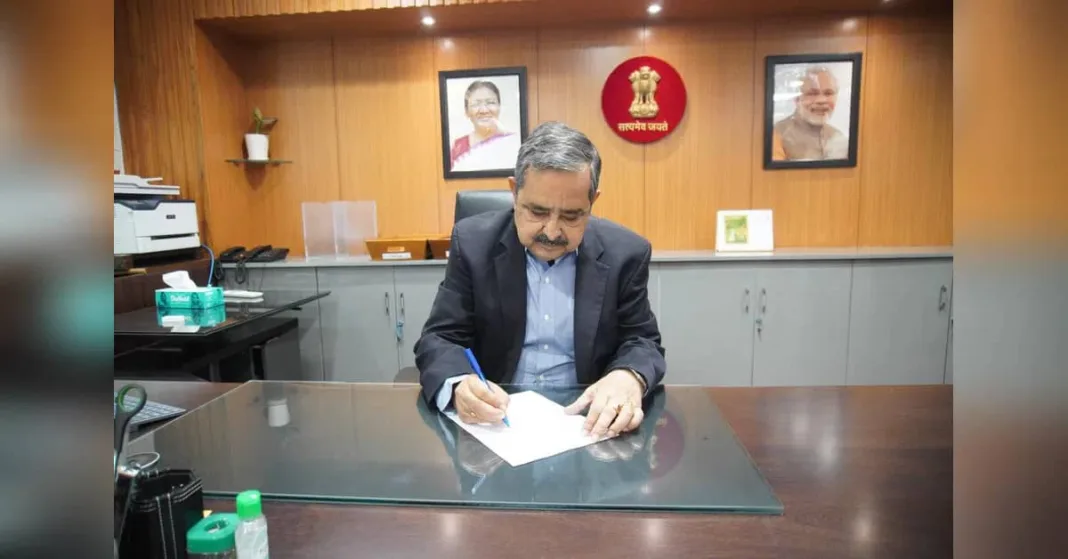

India needs to strengthen its credit depth by leveraging the rich transaction data generated through UPI to bring the informal sector, particularly micro, small and medium enterprises (MSMEs), into the formal credit system, said Ashok Lahiri, vice-chairman, NITI Aayog, on Wednesday.
Speaking at the Global Fintech Fest (GFF), Lahiri said transaction data could help banks improve credit assessment, price risk more accurately and extend loans to small businesses that have traditionally remained outside the formal lending system.
“India needs to incorporate the informal sector in the financial sphere and find ways to use rich data which UPI is throwing, for credit appraisal and better pricing of risk and including the informal sector particularly MSMEs in the formal credit system,” Lahiri said.
Credit appraisal remains one of the key functions of a bank manager, but greater availability of financial data can make the process more efficient, he said. Better visibility into a borrower’s financial behaviour could allow lenders to assess risks more accurately and price credit accordingly.
Lahiri said India would also need to raise its investment rate if it wants to become a developed economy. While the investment rate is around 30 per cent of gross domestic product (GDP), he said it had risen to about 34 per cent based on first-quarter data.
He pointed to China and Korea, where investment as a share of GDP is at least 10 percentage points higher than in India. At the same time, India’s current account deficit is now below 1 per cent of GDP and could soon turn into a surplus, he said.
While foreign investment can bring capital, technology, access to global value chains and knowledge of manufacturing at scale, the bulk of investment in India will have to be supported by domestic savings, Lahiri said.
However, foreign capital flows in the near term could remain affected by uncertainty in the global economy, including the weaponisation of tariffs, the breakdown of the World Trade Organization (WTO) system and disruptions caused by artificial intelligence and digital technologies.
In such an environment, investors are becoming more risk-averse, he said. Investment itself creates demand, while exports provide an additional source of demand.
Lahiri also called for greater collaboration between the government and industry in skill development. Industry should help identify the skills it requires and play a larger role in designing curricula and apprenticeships, he said.
The effectiveness of skill-development programmes should ultimately be measured by how many people trained under them are absorbed by industry, he added.
On infrastructure, Lahiri said there was considerable scope for public-private partnerships (PPPs), with the financial sector having an important role in mobilising long-term and risk capital.
“There are segments of infrastructure that can be built on a PPP model, I believe that the financial sector has a big role to play because it knows where the money is available, who is looking for an avenue for investment—long term, risk capital—but risk in a way can be contained by a well-worked out agreement between the government and the concession,” he said.
Asset monetisation could also help address India’s infrastructure requirements, although different projects would need different financing models, he said.
On manufacturing, Lahiri said investment was gaining momentum in renewable energy and infrastructure, while data centres, semiconductors and electronics manufacturing were attracting interest from both Indian and foreign companies.
NITI Aayog has identified 14 sectors with future potential, but policymakers should approach such exercises with some modesty rather than attempt to determine which industries will ultimately succeed, he said. He compared the approach to venture capital, where some investments fail while a few turn out to be highly successful.
Lahiri also touched upon India’s long-standing preference for gold, linking the accumulation of the precious metal over generations to the country’s historical trade surpluses.
At the same time, he questioned whether gold necessarily delivers superior long-term returns. Data he had seen suggested that over a 100-year period, gold could have delivered lower returns than bank deposits, let alone the stock market, he said.