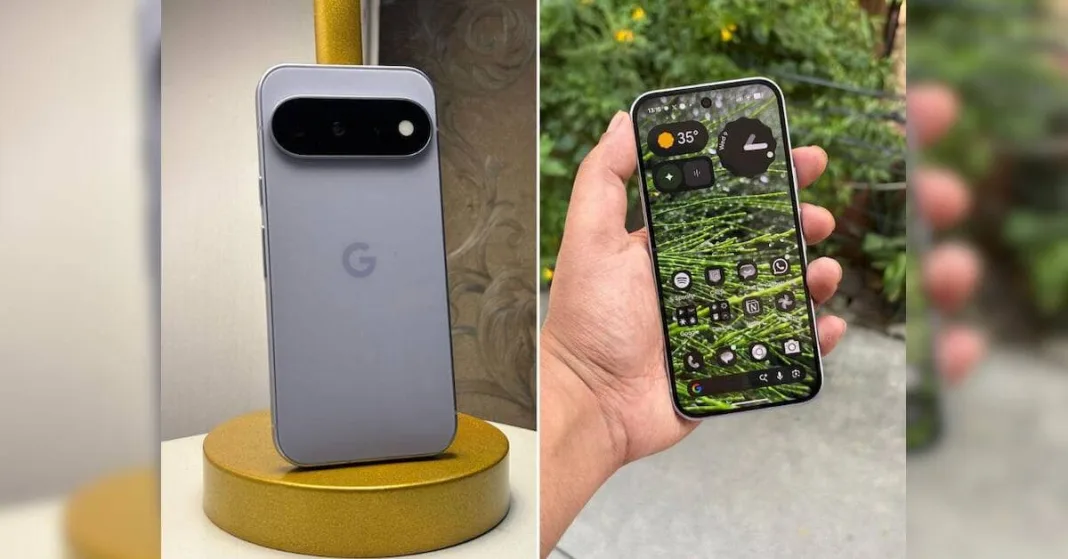

Google has a difficult task this year. It needs to convince you that a phone with a nearly unchanged display, a barely larger battery and a familiar camera setup is worth paying Rs 89,999 for. It is not like there are no changes at all, the Pixel 11 comes with a thinner camera bar, a more efficient Tensor G6 chip, faster wireless charging and a pile of new AI tricks.
I have been using the Pixel 11 as my primary device for a couple of weeks now and there are several things about it that I genuinely like. But after spending time with it, I kept coming back to the same question: how much of this year’s Pixel 11 is actually new, and how much of it is Google polishing a formula that already worked?
Familiar design, just more tidy
Google hasn’t touched the blueprint. You still get the glass front and back, flat aluminium sides, and the horizontal camera visor running across the back. What has changed is the depth of that visor, which is noticeably slimmer this time, so the phone sits flatter on a table and doesn’t dig into your palm the way earlier Pixels did. Slide it into a case and the camera bump barely registers anymore.
Build quality feels exactly as solid as you’d expect, with an IP68 rating and Gorilla Glass Victus 2 on both sides.
At 197g, the Pixel 11 is not particularly light, but the 6.3-inch size makes it relatively easy to handle. It’s genuinely usable one-handed.
The panel itself is a sharp, bright OLED that handles direct sunlight without complaints, though the refresh rate tops out at a fixed 120Hz rather than the smarter variable refresh you’d want for battery savings, and you have to dig into settings to even turn it on since the phone defaults to 60Hz out of the box.
Similar to the Pixel 10, the Pixel 11 gets a 3000 nits bright display, and it was never a problem to begin with. The display remains visible in the harshest sunlight and the colours remain punchy.
Camera is still the biggest reason to buy
The camera system carries over the same trio of sensors as before, a 48MP main, a 13MP ultrawide, and a 10.8MP 5x telephoto, so nothing here is dramatically new on paper. What has changed is processing speed and the size of the main sensor, which helps noticeably in low light.
Everyday shots come out detailed and well balanced without looking artificially punchy, and the telephoto lens continues to be the sleeper feature of Pixel cameras, holding up well even well past its native 5x range thanks to digital zoom that stays fairly clean up to around 30x.
The genuinely new addition this year is Camera Looks, which lets you pick a colour and processing style before you even take the shot, rather than applying a filter afterward. If you’ve ever felt Pixel photos looked a touch too clinical, this gives you a way to warm things up or add some grain, and the changes are baked directly into the image rather than sitting on top of it.
My favourite addition has to be the Magic Capture feature. We have all been in a spot where you are recording a video but the scene is so good that it deserves a good click. Magic Capture lets you do both using AI. The mode records video and pulls stills simultaneously when the AI system underneath thinks that what is in the frame is worth capturing. The pictures definitely do not look like a screenshot from a recorded video, and its hardly misses any moment.
Google is also going all in on content creation, with the creator suit that is built into the camera app offering tools like speech-enhancement, framing grids dedicated for clicking more social-media friendly pictures, and more importantly a teleprompter.
The teleprompter is also quite interesting as it gets dynamic speech tracking that adjusts the pace of the text on screen dynamically based on the pace of your natural speech. It works well with English, but dynamic tracking turns off automatically for Hindi. You can still use the Teleprompter function but only at a fixed pace.
AI is still where Google wins
If there’s one reason to pick a Pixel over anything else running Android, it’s this. Google’s AI features on Pixels do not feel like an afterthought, take dynamic speech tracking as an example or the Magic Capture feature.
But beyond cameras, the standout feature for me is rambler. Built, into the keyboard and available almost everywhere where you can type, the voice-typing tool cleans up your speech patterns as you dictate, stripping out the ums and false starts to produce something closer to a properly written sentence rather than a stream-of-consciousness transcript. It takes some getting used to since the text only appears after you finish speaking rather than live as you talk, but once that clicks, it’s a genuinely handy way to draft a message on the move.
Then there are the more contextual features. Google can surface information from a conversation, such as a restaurant suggestion or a meeting request, and provide shortcuts into Maps or Calendar. Gemini can also pull information such as hotel details from Gmail when given the necessary permissions.
Performance and battery: quietly competent
The Tensor G6 chip isn’t trying to win any benchmark wars, and it doesn’t. However, in everyday use, the Pixel 11 feels quick. Apps open promptly, scrolling is smooth and the camera launches and processes photos faster than before.
Start playing demanding games, and it will likely run at lower frame rates than any other flagship smartphone. Simpler games are fine, but this is not the phone to buy if gaming performance is high on your priority list.
The biggest improvement from Pixel 10 for me has to be the updated modem. Call drops are way less frequent than before, and it keeps up with the iPhone 17 in terms of 5G signal retention.
Coming to the battery, on-paper upgrade is modest but real-life use is way better than the Pixel 10 or Pixel 10a. Battery life comfortably gets through a full day, even a busy one, though I wouldn’t call it a two-day phone by any stretch.
Charging is one area with a mixed picture. Wired speeds top out at 30W, which is unremarkable, but the phone now supports 25W wireless charging over Qi2.2, and the magnetic Pixelsnap system on the back means you can just drop it onto a compatible charger without fumbling for a cable.
So, should you buy the Pixel 11?
The Pixel 11 is an easy phone to like, but a slightly harder phone to get excited about.
Google has not made dramatic changes to the hardware. The display is familiar, the design is familiar, the battery capacity has barely changed and the Tensor G6 still trails the fastest smartphone chips when it comes to raw performance.
Yet the phone works because the pieces fit together well.
The camera is excellent and easy to use. Battery life is good enough for a full day of heavy use. The screen is bright and smooth. The software is clean and new AI features have some practical applications.
If you are coming from a phone that’s a few years old, the Pixel 11 is an easy recommendation. If you already own a Pixel 10 or a Pixel 9, there’s very little urgency to upgrade. The improvements here are real but incremental, a slightly faster chip, a better modem, slightly improved cameras, and a handful of new AI features that will likely trickle down to older Pixels over time anyway.