



September 7, 2026 1:20 PM

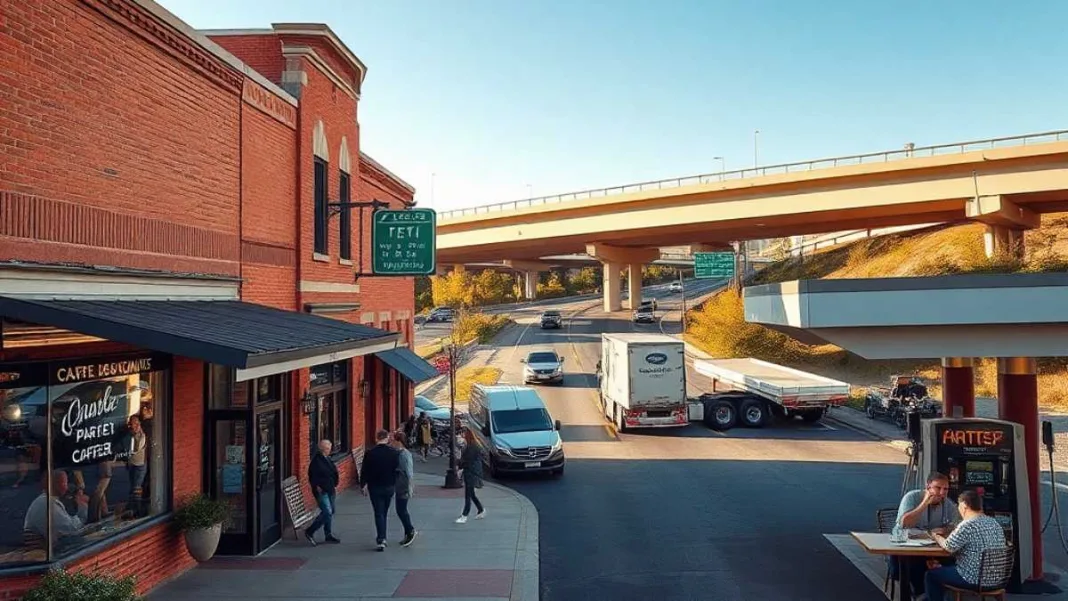
Image generated with Ai
For many years, the rapid growth of the Interstate Highway System largely ignored traditional regional communities within America, channeling motorist activity away from such areas and leaving downtowns stuck in economic decline. Nonetheless, a progressive regional trend has altered the rural transit map of the country, utilizing bypassed arterial highways to create cultural destinations. By creating thriving economies in their respective interstates bypasses, the rural communities which have been placed off of traditional thoroughfares are now turning passing motorists into actual visitors. With the aid of government-funded incentives, preservation laws, and increasing spending on outdoor recreation, these ignored communities are escaping economic isolation through historical bypasses.
Historical Precedents: The Division of Freight Logistics and Regional Towns
The contemporary spatial configuration of American surface transportation originated with the passage of the Federal-Aid Highway Act of 1956. This legislative milestone committed the resources of the federal government to the construction of the Dwight D. Eisenhower National System of Interstate and Defense Highways. Conceived primarily as an instrument of national defence, intercity passenger speed, and heavy freight mobility, this vast 49,000-mile motorway network transformed the economic topography of the continent.
Before limited-access, grade-separated highways reshaped the American landscape, intercity vehicular traffic moved along primary two-lane arterial roads that cut straight through the municipal squares of regional towns. Established thoroughfares including the Lincoln Highway (US Route 30), the National Road (US Route 40), and the multi-state route of Historic Route 66 served simultaneously as long-distance transit corridors and primary retail streets. Along these arterial routes, business districts evolved to service motorists directly, giving rise to mid-century motor courts, service stations, roadhouses, diners, and local retail outlets.
The progressive opening of high-speed interstates—most notably Interstate 80 across the central plains, Interstate 70 through the Midwest and Mountain West, and Interstate 95 down the eastern seaboard—fundamentally altered these traffic flows. Motorists were systematically redirected onto controlled-access motorways designed to circumvent population centres. By diverting long-distance travellers away from municipal street grids by distances ranging from five to thirty miles, the interstate system severed regional towns from their primary economic lifeblood.
Advertisement
Advertisement
Transportation planning literature documented the severe commercial disinvestment that followed, as business activity migrated from historic Main Streets out toward motorway junctions. At these interchange nodes, a standardised, franchise-dominated roadside commercial architecture emerged, catering to drivers prioritising refuelling speed and fast food over local engagement.
Yet, this spatial diversion had an unforeseen structural consequence: it insulated bypassed town centres from twentieth-century commercial road widening and demolition. While interchange clusters developed an anonymous corporate uniformity, the historic arterial corridors preserved their traditional urban street patterns, pedestrian storefronts, and vintage roadside architecture. This preserved built environment now forms the architectural backbone for communities reclaiming their economic autonomy.
The Architecture of Deceleration: Engineering Intentional Destination Corridors
Rather than attempting to compete with the logistical velocity of adjacent interstate freeways, forward-looking rural communities are cultivating sustainable interstate bypass economies. This operational model shifts transportation and economic planning from throughput maximization to dwell-time optimisation. A vehicle travelling at seventy miles per hour along an interstate generates minimal economic value for the surrounding region, with financial transactions restricted to off-ramp chain franchises. By contrast, a motorist travelling along a designated historic byway moves at a deliberate pace, converting transient passage into meaningful regional commerce.
The federal framework enabling this economic evolution is codified under Title 23 United States Code Section 162, which governs the National Scenic Byways Program. Managed by the Federal Highway Administration, this programme provides formal recognition and dedicated capital assistance to roads displaying exceptional archaeological, cultural, historic, natural, recreational, or scenic qualities. Bypassed regional towns capitalise on these designations by transforming what was once dismissed as a geographical impediment—being bypassed by the interstate—into an intentional visitor asset.
Advertisement
Advertisement
The fiscal dynamics of heritage byway corridors differ sharply from interchange economies. Interstate exits suffer from high rates of economic leakage, as franchise royalties, wholesale purchasing, and corporate profits flow directly out of the local community. In contrast, byway destination hubs retain capital locally through independent heritage motels, regional farm-to-table restaurants, artisan workshops, and cultural attractions. This architecture of deceleration encourages regional travellers to treat rural communities as destination stops rather than drive-by thoroughfares.
| Economic Dimension | Interstate Interchange Corridor | Historic Byway Destination Hub |
| Primary Transport Objective | Maximum vehicular throughput and logistical speed | Deliberate deceleration, landscape immersion, and dwell time |
| Prevailing Roadside Architecture | High-rise illuminated signs, franchise strips, asphalt aprons | Restored Main Street facades, vintage motor courts, historic depots |
| Capital Flow Dynamics | High corporate leakage to multi-state franchisors | High local retention across independent micro-enterprises |
| Target Consumer Profile | Long-haul logistics drivers and transit travellers | Cultural tourists, weekend leisure drivers, recreational travellers |
| Statutory Funding Mechanism | National Highway Performance Program (NHPP) | National Scenic Byways Program (23 U.S.C. § 162), ATIIP, TAP |

Image generated with Ai
Federal Policy and Statutory Frameworks: Reauthorising America’s Byways
The resurgence of historic corridors across the United States is supported by federal legislative mechanisms and targeted capital appropriations administered by the Federal Highway Administration. First established under the Intermodal Surface Transportation Efficiency Act of 1991 (ISTEA) and reauthorised across successive surface transport acts, the scenic byways program experienced a major revitalization following legislative mandates under the Infrastructure Investment and Jobs Act (IIJA) and targeted annual Consolidated Appropriations.
A major milestone occurred when the Federal Highway Administration officially announced 49 additions to the America’s Byways collection, comprising 15 All-American Roads and 34 National Scenic Byways across 28 states. This round of designations expanded the national roster of America’s Byways to 184 distinct corridors across 48 states. These federal designations grant regional corridors enhanced national marketing visibility, statutory protections, and priority access to federal discretionary grant competitions.
Demonstrating direct federal investment, the Federal Highway Administration announced $21.8 million in discretionary grants for 33 National Scenic Byways Program projects spanning 29 states, including five dedicated grants awarded to Native American tribal nations. These allocations fund capital construction, pedestrian infrastructure, and heritage interpretation:
In California, the Department of Transportation secured $96,000 to complete essential preservation and structural repairs at Sierra County’s Kentucky Mine Historical Park along the Yuba River State Scenic Byway. The facility houses the only operational full-scale gold mine stamp mill remaining on the West Coast, preserving regional mining heritage while protecting local bat habitats.
In Iowa, the Department of Transportation was awarded $714,000 to construct and install 51 thematic architectural kiosks across the state’s network of 14 designated scenic byways. These physical installations provide navigational orientation, cultural mapping, and historical context to encourage motorists to explore bypassed agricultural settlements.
In Wisconsin, the Forest County Potawatomi Community Tribe received $302,000 to enhance pedestrian and cycling routes along a path paralleling the Nicolet-Wolf River Scenic Byway. The project funds four culturally interpretive rest areas featuring tribal artwork and historical markers.
In Oklahoma, the Department of Transportation secured $1,000,000 in federal grant funding to implement safety improvements along a 1.3-mile segment of the Historic Route 66 corridor in Oklahoma County. The undertaking involves the addition of a dedicated turning lane and continuous eight-foot paved shoulders designed to accommodate long-distance cyclists traversing US Bicycle Route 66, generating commercial footfall for adjacent small businesses.
In Rhode Island, the Department of Transportation was allocated $750,000 to reconstruct a damaged sea wall, improve municipal stormwater drainage, and restore historic sidewalk curbing along Hope Street on the Revolutionary Heritage National Scenic Byway in Bristol.
| Recipient Public Agency | Designated Corridor | Grant Award | Core Infrastructure Scope |
| Oklahoma Department of Transportation | Historic Route 66 | $1,000,000 | Safety turn lanes, 8-foot cycling shoulders, and commercial access upgrades |
| Rhode Island Department of Transportation | Revolutionary Heritage Byway | $750,000 | Sea wall restoration, sidewalk curbing, and climate resiliency upgrades |
| Iowa Department of Transportation | 14 State Scenic Byways | $714,000 | Fabrication and deployment of 51 thematic wayfinding and interpretive kiosks |
| Forest County Potawatomi Community Tribe | Nicolet-Wolf River Byway | $302,000 | Cultural rest sites, pedestrian paths, and tribal art installation |
| California Department of Transportation | Yuba River Scenic Byway | $96,000 | Stamp mill restoration and habitat preservation at Kentucky Mine Historical Park |
Public statements underscore the strategic intent of these allocations. Federal Highway Administrator Shailen Bhatt stated: “FHWA is proud to award these grants that will help make travel safer, provide more enjoyable access, and support local businesses along scenic byways across the country. Scenic routes provide myriad ways to explore the United States, and it is no wonder that since its inception in 1992, the National Scenic Byways Program has received broad support from Members of Congress, State and local officials, and the public”.
Macroeconomic Dividends: Quantifying the Value of Heritage Travel and Recreation
The commercial rationale for establishing interstate bypass economies is supported by macroeconomic data tracking the leisure travel sector. Official statistics published by the U.S. Bureau of Economic Analysis (BEA) in its Outdoor Recreation Satellite Account demonstrate that outdoor recreation and heritage touring drive significant economic activity across non-metropolitan regions.
The outdoor recreation economy accounted for $696.7 billion in current-dollar value added, representing 2.4 percent of total United States Gross Domestic Product. Real, inflation-adjusted GDP generated by outdoor recreation expanded by 2.7 percent, outpacing several conventional industrial sectors. Furthermore, real gross output for the outdoor recreation sector expanded by 2.0 percent, reflecting sustained consumer demand for experiential regional travel.
Crucially, the BEA data reveals that core outdoor recreation activities stimulate broad demand across the service economy. Supporting activities—encompassing travel, accommodation, food services, retail trade, and local transport—accounted for 51.5 percent of all outdoor recreation economic value. Arts, entertainment, recreation, accommodation, and food services constituted the largest single industrial contributor to outdoor recreation GDP, generating $174.4 billion in current-dollar value added. Retail trade represented the second-largest sector, delivering $169.1 billion in value added. Conventional travel activities, including recreational vehicle (RV) travel ($27.5 billion value added) and boating and fishing ($38.4 billion value added), provide direct financial inflows to bypassed rural regions equipped to accommodate travelling motorists.
Employment indicators compiled by the BEA illustrate this geographic dispersion of capital. Nationwide employment supported by outdoor recreation grew by 1.1 percent, recording job gains across 36 states and the District of Columbia, while employee compensation across the sector increased by 5.2 percent. Bypassed communities that position themselves along scenic corridors directly absorb this consumer spending, converting automotive mobility into local service jobs.
| Economic Indicator (BEA / NPS Official Statistics) | Quantified Economic Value | Sectoral Impact and Multiplier Significance |
| National Outdoor Recreation Value Added | $696.7 billion (2.4% of U.S. GDP) | Core driver of non-metropolitan tourism and service spending |
| Arts, Accommodation, and Food Services Output | $174.4 billion (25.0% of outdoor recreation GDP) | Direct revenue stream for independent restaurants, cafes, and hotels |
| Retail Trade Value Added in Recreational Travel | $169.1 billion (24.3% of outdoor recreation GDP) | Supports regional craft, gear outfitting, and Main Street retail |
| Blue Ridge Parkway Direct Gateway Spending | $1.5 billion directly spent in local economies | Primary economic engine for bypassed Appalachian communities |
| Total Gateway Economic Output (Blue Ridge Parkway) | $1.9 billion economic output supporting 15,700 jobs | Generates $582 million in labour income and $1.1 billion in value added |
At the regional level, visitor expenditure analyses conducted by the National Park Service (NPS) confirm the economic impact of linear roadway corridors. Along the 469-mile Blue Ridge Parkway corridor traversing Virginia and North Carolina, 16.7 million visitors generated an estimated $1.5 billion in direct spending within surrounding gateway communities.
These visitor expenditures supported 15,700 regional jobs, $582 million in local labour income, $1.1 billion in value added, and $1.9 billion in total economic output. Because the Blue Ridge Parkway maintains minimal commercial lodging or dining along its scenic alignment, visitor spending flows directly into bypassed feeder settlements, demonstrating that linear scenic infrastructure can sustain vibrant municipal economies across adjacent rural corridors.
Built Environment and Regulatory Modernisation: Complete Streets and Section 4(f)
Transforming a bypassed thoroughfare into an intentional travel destination requires targeted physical adaptations of the built environment. The architectural appeal of historic byway corridor architecture relies on its human scale and historic character, featuring two-lane brick or concrete pavements, vintage road signs, motor courts, and pedestrian downtown storefronts. In standard highway widening projects, these cultural features were often cleared to create wide asphalt lanes and high-speed clear zones.
Federal regulatory protections serve as an institutional shield against this destruction. Under Section 4(f) of the Department of Transportation Act of 1966, codified at 23 U.S.C. § 138 and 49 U.S.C. § 303, the Federal Highway Administration cannot approve transportation programmes that use publicly owned parks, recreational lands, wildlife refuges, or historic sites unless no prudent and feasible alternative exists. This statutory mandate protects historic byways from intrusive road expansions, preserving the vernacular streetscapes that underpin rural tourism.
Simultaneously, federal transport guidance has embraced modern street design principles. In March 2022, the Federal Highway Administration published a landmark report to Congress titled “Moving to a Complete Streets Design Model: A Report to Congress on Opportunities and Challenges”. This policy establishes the Complete Streets framework as the agency’s default approach for funding and designing federally aided roadways, prioritising vulnerable road users, pedestrians, and cyclists over vehicular velocity.
Municipalities in bypassed corridors use this federal guidance to calm traffic along former state highways. Drawing on the Transportation Alternatives Set-Aside—funded at approximately $1.4 billion under the Surface Transportation Block Grant (STBG) programme—small towns are reallocating excess street capacity toward wide sidewalks, tree-lined medians, protected bike lanes, and mid-block crossings.
These design improvements are reinforced by the 11th Edition of the Manual on Uniform Traffic Control Devices (MUTCD), adopted in December 2023. The revised MUTCD introduces updated standards for National Scenic Byways signage—specifically the M10-1 sign and M10-1aP auxiliary plaque—along with clarified rules for trailblazer and junction assemblies. These visual indicators direct motorists travelling on high-speed interstates onto secondary historic corridors, turning what was once a visual blind spot into an accessible destination.
Transcontinental Case Studies: Regional Rebirth Across Classic Corridors
The implementation of bypass revitalization strategies is visible across several historic travel corridors in the United States. Bypassed communities along these routes have developed distinct heritage tourism models tailored to their geographic setting, cultural assets, and built environment.
The Lincoln Highway: Restoring US Route 30 Across the Heartland
Dedicated in 1913 as the first transcontinental motor route connecting New York to San Francisco, the Lincoln Highway established automobile tourism across twelve American states. However, the construction of Interstate 80—which broadly parallelled the historic route across the Midwest and High Plains—diverted long-distance traffic away from US Route 30, stranding dozens of agricultural and industrial settlements.
To revive local commerce, regional coalitions across Illinois, Iowa, Nebraska, and Wyoming established Corridor Management Plans (CMPs) that position US Route 30 as a celebrated heritage corridor. In Greene County, Iowa, civic leaders restored original brick-paved sections of the highway, preserved historic bridges, and erected interpretive markers to celebrate the highway’s pioneering role in transcontinental motoring.
In Nebraska, communities along the Platte River Valley leveraged the route’s intersection with historic westward migration routes, including the Oregon Trail and Mormon Pioneer Trail, to market US Route 30 as an immersive open-air history trail.
In Wyoming, the State Historic Preservation Office (SHPO) conducted an extensive thematic survey of roadside architecture, enabling bypassed communities along the former transcontinental artery to document, preserve, and restore historic motor courts, early service stations, and neon-lit municipal hotels. By highlighting their architectural authenticity, these communities draw cultural travellers seeking an authentic alternative to the monotonous freight traffic of Interstate 80.

Image generated with Ai
Route 66 and the 2026 Centennial: Strategic Infrastructure Along the Mother Road
Commissioned in 1926 across 2,448 miles from Chicago to Santa Monica, Historic Route 66 represents a world-renowned example of highway bypass and preservation. The corridor was replaced by five separate interstate highways—Interstates 55, 44, 40, 15, and 10—leading to its formal decommissioning as a federal highway in 1985. In response, local preservation movements joined forces with federal initiatives, leading to the enactment of the National Route 66 Preservation Bill of 1999, which provided $10 million in matching grants through the National Park Service to preserve historic features along the highway.
The corridor’s revitalization gained significant momentum leading up to the 2026 Route 66 Centennial. Across eight states, bypassed communities have integrated transportation modernization with cultural heritage tourism. In Oklahoma, a $1,000,000 grant from the Federal Highway Administration funded pavement resurfacing, safety turn lanes, and eight-foot shoulders along 1.3 miles of the highway in Oklahoma County, expanding safety for cyclists riding US Bicycle Route 66 while improving commercial access for local shops and diners.
Furthermore, the National Park Service’s cost-share grant programmes have funded oral history collections, neon restoration projects, and tribal interpretive exhibits, recognising the complex history of sovereign Native American nations traversed by the route. Centennial events have drawn sustained domestic and international tourism, turning bypassed roadside towns like Clinton, Oklahoma, and Kingman, Arizona, into active cultural destinations.
Blue Ridge Parkway Gateway Hubs: Channelling Scenic Traffic into Mountain Municipalities
Constructed through the Appalachian Mountains of Virginia and North Carolina, the Blue Ridge Parkway was designed from its inception as a dedicated scenic byway. The route intentionally prohibits heavy commercial trucking, maintains low speed limits, and avoids roadside billboard advertising, preserving an undisturbed mountain viewshed.
Because the parkway does not offer commercial lodging, petrol stations, or private restaurants along its corridor, it relies on regional feeder roads to supply these services. Bypassed Appalachian towns situated along intersecting state roads—such as Galax and Floyd in Virginia, and Blowing Rock and Little Switzerland in North Carolina—have aligned their economies with parkway visitors.
By developing traditional Appalachian music venues, regional craft cooperatives, farm-to-table restaurants, and boutique inns, these mountain towns capture significant spending from the 16.7 million annual parkway visitors. This integrated gateway approach channels $1.5 billion in direct visitor spending into surrounding rural municipalities, proving that scenic roadway design can stimulate regional commerce without compromising the natural environment.
Strategic Challenges and Future Horizons: Clean Energy and Rural Mobility
Despite the economic opportunities offered by historic byways, rural municipalities face operational challenges when developing interstate bypass economies. Developing and maintaining a formal Corridor Management Plan (CMP)—a statutory requirement under 23 U.S.C. § 162—demands continuous administrative coordination across multiple local, county, tribal, and state jurisdictions. Many small rural governments lack dedicated grant-writing personnel, making it difficult to compete against metropolitan transit authorities for competitive federal grants under programmes like the Active Transportation Infrastructure Investment Program (ATIIP) or the Surface Transportation Block Grant.
Furthermore, communities must balance tourism promotion with historic authenticity. Overdevelopment and generic attractions can erode the intrinsic scenic and historic qualities that justified federal designation in the first place. Preserving local architectural character requires enforceable local planning policies, strict regulations on billboard advertising in accordance with federal byway rules, and protection for essential local services—such as grocery stores and pharmacies—to ensure downtowns remain functional for permanent residents rather than exclusively catering to visitors.
Looking ahead, the long-term success of historic corridors is linked to modern clean energy and active transportation infrastructure. Under the National Electric Vehicle Infrastructure (NEVI) formula and discretionary grant programmes, federal and state agencies are deploying capital to build out national alternative fuel corridors. While initial fast-charging investments concentrated on interstate motorway exits, state departments of transportation are increasingly installing fast-charging stations within historic downtown districts along designated scenic byways.
Because fast-charging an electric vehicle typically requires a dwell time of twenty to forty-five minutes, EV infrastructure naturally complements byway tourism models. Travellers charging their vehicles in a historic downtown square are drawn into local restaurants, coffee shops, galleries, and museums, turning charging dwell time into direct local economic impact.
By coordinating federal transportation grants, statutory preservation protections, and modern mobility initiatives, bypassed communities are demonstrating that separation from the interstate highway network can become a powerful economic advantage. Rather than languishing as forgotten transit points, small towns along America’s historic byways are building resilient, place-based economies where travellers intentionally choose to slow down and experience the enduring character of the historic American road.
The revitalisation of America’s historic transportation corridors demonstrates that isolation from modern interstate highways does not dictate economic obsolescence. By establishing resilient interstate bypass economies, rural municipalities are leveraging authentic built heritage, federal infrastructure investments, and scenic designations to attract conscious travellers. These initiatives convert rapid transit thoroughfares into destinations that celebrate vernacular architecture, cultural identity, and outdoor recreation. As national surface transport programmes place renewed emphasis on active mobility and rural connectivity, bypassed communities are rewriting the economic geography of the American heartland. Strategic heritage planning proves that authentic places of deceleration remain essential economic engines for lasting regional commercial prosperity.
Conclusion
American communities that have been overlooked can now be transformed through the development of interstate bypasses, which will help to change their economic fates for the better. Through better connectivity, the attraction of travelers and investments on the side of the road, such bypasses can contribute to the revitalization of local business and tourism demands.
Advertisement
Advertisement