
As political outreach evolves, Congress leader Rahul Gandhi’s communication team is experimenting, tracking virality and recasting him as a quintessential Gen Z politician.
“The idea is to come across as organic as possible. This means putting him out not only as a politician, but also as a traveller, a sportsperson, and somebody who is naturally relatable,” says a source close to his team.
Gandhi’s core communication team has 8-10 people, at least four women. For campaigns such as Chatron ki Goonj, it expands to about 40, combining party workers and professionals.
“It is a young team. Not only does it make the communication better, but Gandhi also holds frequent workshops with them to understand the GenZ perspective,” the source says.
The strategy appears to be gaining traction. Gandhi has added more than 3 million Instagram followers in six months, taking his total to 15.5 million. His follower growth over the past 180 days is about 22 per cent, with an average engagement rate of 1.86 per cent.
Prime Minister Narendra Modi, the world’s most-followed political leader, recorded 5.9 per cent growth over the same period, with 1.09 per cent engagement. His Instagram follower tally is currently at 106 million.
For Gandhi’s team, polished set pieces and scripted speeches have underperformed.
“Interactions have done really well. The focus is on finding relevant people and then putting them into a frame with Rahul for a short conversation or an interview. That connects with the people,” the source says.
Recent examples include sessions with All India Students Association president Neha Bora and Mumbai Gen Z protest face Rhiya Ahir, a visit to daily-wage worker Mohammad Irfan’s home, and a conversation with Sarthak Sidhant, the teenager who flagged tender irregularities in CBSE examinations.
“The conventional IT cell system doesn’t work for us because those who are watching are also creating content. On official accounts, we avoid overdoing things. Those little gaps between reality and exaggeration are caught, especially by the youth,” the source explains.
The team also pushes issue-based content without chasing immediate gains. During the Monsoon Session, Gandhi’s repeated demand that Home Minister Amit Shah either accept he ordered the police crackdown on students on July 20 or say he was unaware of it dominated his social media accounts.
Virality is often identified after a post-hoc analysis. A “Girl Power” badge on Gandhi’s shirt at the Pune Chatron ki Goonj event, for instance, was not planned: A volunteer had picked it from venue merchandise.
“It gained traction on its own and then the team decided to play it up,” the source says. The same applies to Gandhi’s colourful shirts. “During the Bharat Jodo Yatra, wearing a white t-shirt throughout was a conscious choice. But here, these
shirts, they just took a journey of their own and the team followed.”
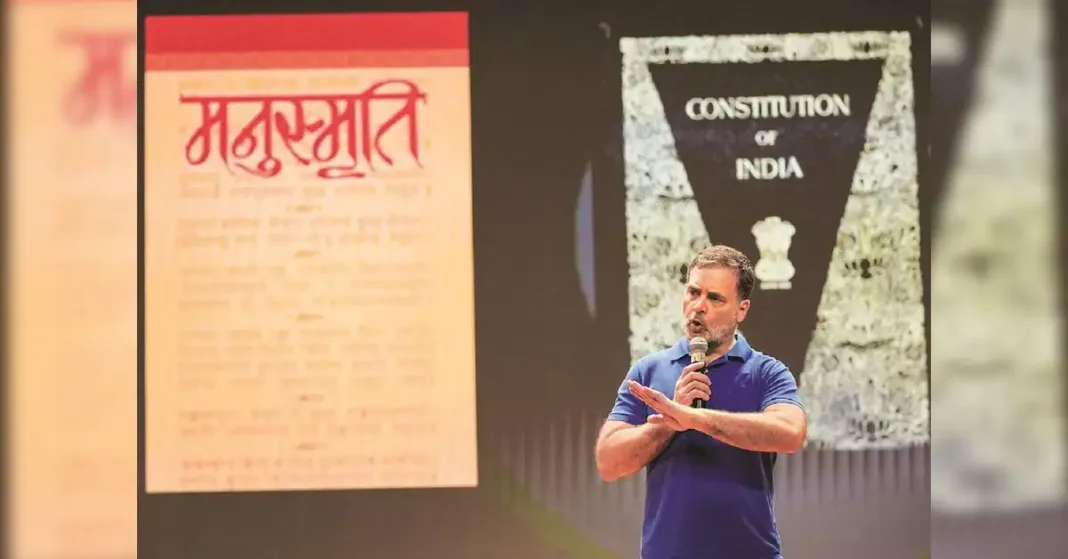
What happens on stage is less scripted. Asked who decides whether Gandhi will “smash the patriarchy” and attack Manusmriti, the source says: “There’s no script writer but yes, there are points of discussions. It was a conscious decision to criticise Manusmriti while talking against patriarchy.”
The conversation itself, however, is improvised. “Details like who joins him on the stage and when, could be pre-planned, but the conversations follow; he is an extempore guy,” the source says.
“The urge to bring more live faces in the picture also removes the need for artificial intelligence-generated content for us.”
Brainstorming typically starts with a topic, leaving the young brigade to determine how to package it.
The juxtaposition of Gandhi with Batman, for example, came from Youth Congress leaders.
“From the Bharat Jodo Yatra, there was a Rahul picture in the rain. Somebody from the youth team put a Batman poster with it,” the source says.
The intent, according to the team, is not to portray Gandhi as someone who can fight every battle for young people, but as someone willing to stand with them.
“This very well reflected in the fact that he supported the Jantar Mantar movement from outside.”
The Congress’ official handles follow a similarplaybook: Experiment, reinvent and translate for mass audiences. “Our digital push came very early, even slightly before Bharat Jodo Yatra. The switch was largely triggered by the narrative being set by the mainstream media,” says Ruchira Chaturvedi, national convenor of social media and digital communications at the Congress.
The party has strengthened state units to amplify local issues, translated Gandhi’s speeches into regional languages, made humour a key component and cut response times on fake news, Chaturvedi says.
The team monitors content across platforms to see what works.
“On Instagram, we realised that edits were doing really well. Video format and then mixing Rahul’s speeches with his interactions with people to create short reels,” she says.
AI is largely confined to backend work such as graphics, translation and amplification, rather than front-end content.
Gandhi’s and the Congress’s communication teams meet frequently to keep the narrative aligned.
“Our canvas is bigger. Content is the same, it is just that he remains there in more first-person form,” Chaturvedi adds.