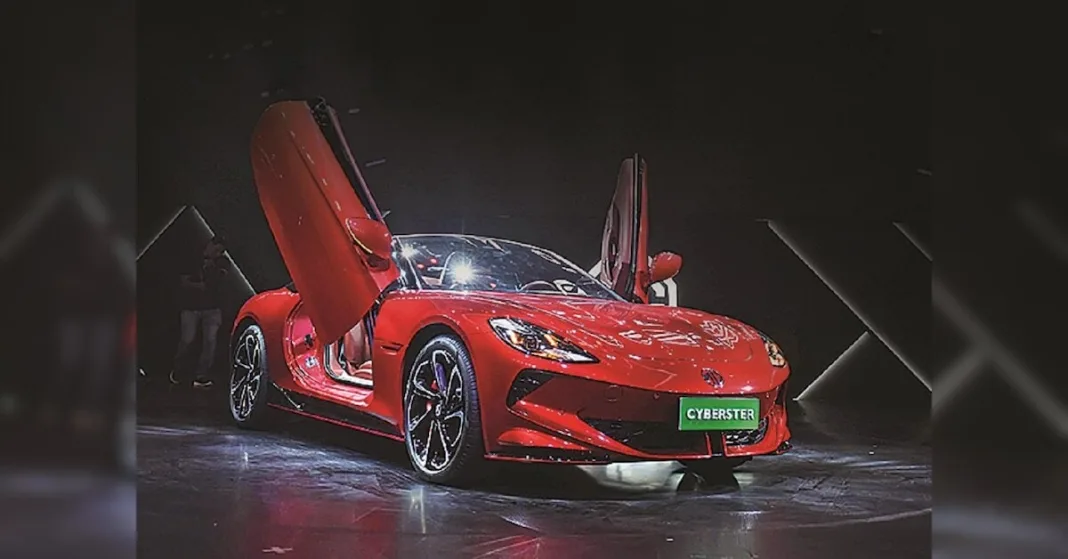

JSW Group and China’s SAIC Motor are discussing the next round of capital support for JSW MG Motor India as the automaker looks to expand manufacturing beyond the annual capacity of 220,000 units already planned at its Halol facility and widen its new-energy vehicle (NEV) portfolio.
The company, which is investing around ₹3,500 crore in capacity, localisation and new products, ultimately sees scope to expand the Halol facility to around 400,000 vehicles annually. Beyond that, JSW MG has an ambition to scale to 1 million vehicles, Parth Jindal, managing director, JSW Group, said on Wednesday.
“We really want to go beyond 220,000. Two hundred and twenty thousand is not enough for MG with the way the market has received us,” Jindal said. “We are very excited and we want to scale to 400,000 and then get to a million cars. And for that you will need capital.”
JSW currently owns 35 per cent of JSW MG Motor India, while SAIC holds 49 per cent. The remaining equity is held by Indian financial institutions, dealers and employees.
The existing ₹3,500 crore investment programme is being funded through a mix of debt and equity, including funds remaining from JSW’s original investment in MG. However, expansion beyond the currently approved programme will require the shareholders to decide on the next round of funding.
“The discussions between both shareholders are well underway,” Jindal said, while declining to comment on whether the talks could result in a change in their respective shareholdings.
He added that the recent easing of restrictions under Press Note 3 could open more avenues for SAIC to invest in the Indian venture. Both shareholders remained keen to support the business, he said. Under Press Note 3, investments in Indian companies by entities based in countries sharing a land border with India, including China, require prior government approval.
According to Jindal, SAIC sees India as its next major growth market as growth matures in China and Europe, while its partnership with JSW gives it an advantage in localisation and navigating the Indian market.
The expansion comes as MG targets another sharp increase in volumes. Jindal expects the company to cross 95,000 vehicles in calendar year 2026 and is targeting the 100,000-unit mark, compared with around 70,500 vehicles in 2025.
“Our aim is to continue to grow our volumes between 35 and 40 per cent,” he said, adding that increased localisation would also be critical to improving profitability.
Capacity at Halol is currently around 110,000 units annually. Jindal said this would increase to 160,000 units by March 2027 and 220,000 units by January 2028. The company has completed master planning that would allow the same site to eventually produce around 400,000 vehicles annually.
Jindal said the company did not see the need for another manufacturing location for at least the next three to four years. A decision on another plant could be considered when volumes move beyond roughly 250,000 units, he added.
MG is already running Halol on three shifts as it seeks to increase output. Production has risen from around 8,000 vehicles a month a few months ago to 9,000 last month, with the company targeting 9,500 this month before progressively moving towards 10,000-12,000 units a month.
The company’s own ₹3,500 crore investment is being supplemented by about ₹2,500 crore of investment by its vendors, taking the overall investment associated with the expansion to around ₹6,000 crore, Jindal said.
Localisation will be a key part of this expansion. The company is targeting around 70 per cent localisation for both the Windsor and the newly introduced Hector Tomahawk by the end of calendar year 2027. Battery cells, rare-earth magnets and some electronics remain among the key components that cannot currently be sourced locally at the required level.
ADAPT to drive next phase of growth
MG’s next phase of growth will also be anchored by ADAPT — Advance Drive Architecture Platform Technology — its modular multi-new-energy-vehicle architecture. The platform can support battery electric vehicles (BEVs), hybrid electric vehicles (HEVs), plug-in hybrid electric vehicles (PHEVs) and extended-range electric vehicles (EREVs).
Anurag Mehrotra, managing director, JSW MG Motor India, said the multi-powertrain strategy was aimed at addressing different consumer needs, particularly those of buyers who want the running-cost benefits of an EV but also undertake longer journeys.
MG plans to use ADAPT for EVs and PHEVs and is also evaluating EREVs. In an EREV, the wheels are driven only by the electric motor, while a smaller internal-combustion engine acts as a generator to recharge the battery, reducing range anxiety.
“EREV is definitely something that we would like to bring. We can bring it, and we want to bring it,” Jindal said.
Jindal also called for differential taxation for such new-energy technologies. While pure EVs attract 5 per cent goods and services tax (GST), PHEVs are taxed at 18 per cent or 40 per cent, depending on vehicle size and engine specifications. He said the government’s approach appeared to distinguish between vehicles in which the engine can directly drive the wheels and EREVs, in which it only generates electricity.
Jindal said lower taxation could accelerate the adoption of PHEVs and EREVs, while acknowledging that they need not necessarily receive the same 5 per cent rate as pure EVs.
“Then don’t make it 5 per cent, make it 18 per cent, no problem… But the consumer should get it cheaper,” he said.
While MG will continue selling internal-combustion-engine vehicles, new-energy vehicles will remain at the centre of its growth strategy.
Mehrotra has previously said the company expects NEVs to account for around 70-80 per cent of its sales, with multiple powertrain technologies required to expand the addressable market.