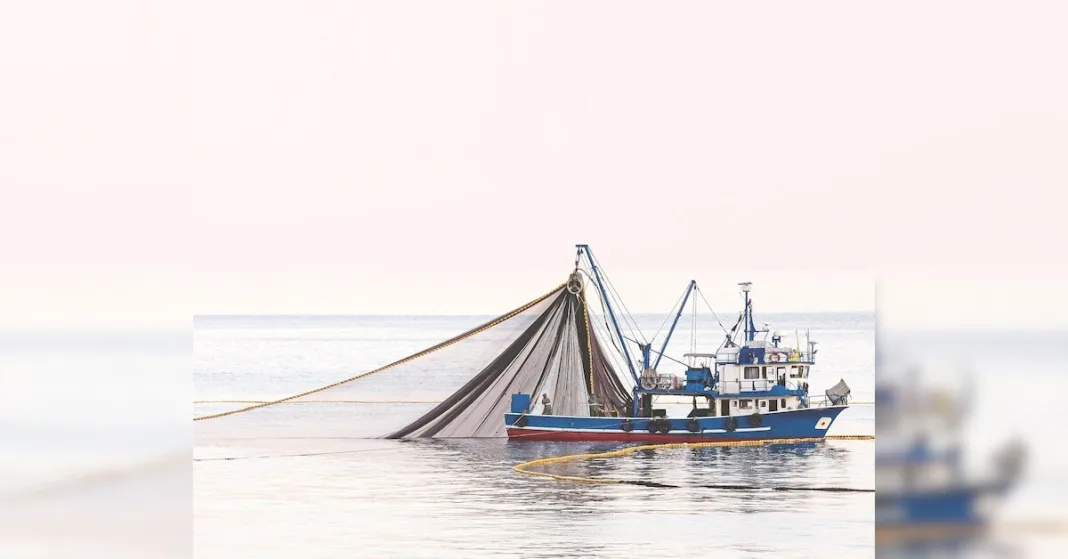

With the launch of the letter of authorisation (LoA) for sustainable harnessing of fisheries in the high seas, India has taken a decisive step towards unlocking one of its least exploited marine resources — the vast expanse
of the deep ocean. The LoA allows Indian-flagged vessels to venture into deeper waters beyond the country’s Exclusive Economic Zone (EEZ) — which is defined as 200 nautical miles from the coast. The new permit is a transparent and internationally compliant framework.
So far, Indian fishermen have been confined to waters within 40 to 50 nautical miles of its coastline, partly because of the absence of authorisation and partly due to the absence of suitable boats. This means India has now to catch up with countries such as Japan, Taiwan, South Korea, Spain and China, which have sophisticated distant-water fishing fleets.
Ironically, India’s 11,099-km coastline and an EEZ covering around 2.4 million square km make it one of the world’s most resource-rich maritime nations.
The country’s fisheries story has been a striking paradox. With around 20 million tonnes of total fish production (both inland and marine), India has emerged as the world’s second-largest fish-producing country and one of the leading seafood exporters. Yet, a significant portion of deep-sea and oceanic resources remained untapped.
While coastal fish stocks have come under pressure from decades of intensive fishing, vast stretches of deeper waters within and beyond India’s EEZ have remained largely unexplored by Indian fishing vessels, allowing other distant-water fishing nations to dominate the global trade in high-value species.
This scenario could now change with deep-sea vessels receiving authorisation to sustainably harness fisheries in the high seas. The authorisation encourages fishermen to confidently venture into deeper waters for the sustainable harvesting of high-value species, generating employment across the entire value chain, including fish processing, cold-chain infrastructure, transportation, packaging, logistics and export services.
Rajiv Ranjan Singh, Union Minister for Fisheries, Animal Husbandry and Dairying, said the LoA is a historic milestone.
“Since the global appetite for sustainably sourced seafood continues to rise, the framework could create new avenues for fisherfolk, strengthen seafood exports and reinforce India’s ambitions of becoming a major Blue Economy power by allowing fishermen to sustainably tap the vast premium marine resources, particularly tuna and tuna-like species,” he said during the national launch of LoA in Bhubaneswar last month.
Passport to the faraway waters
The LoA is a mandatory vessel-specific permit introduced under the Guidelines for Sustainable Harnessing of Fisheries in the High Seas by Indian-Flagged Fishing Vessels, 2025. In short, it is India’s “passport” to the high seas. Until now, Indian fishing vessels could legally fish within India’s EEZ, extending up to 200 nautical miles (370 km) from the coastline, subject to various state and central regulations.
Fishing beyond the EEZ in the high seas, which are international waters governed by international law and Regional Fisheries Management Organisations (RFMOs), required a formal legal framework that India did not have. Under the new guidelines, introduced in December last year, an Indian vessel can only fish in the high seas if it has an LoA. Unlike an ordinary fishing licence, the LoA is a vessel-specific, non-transferable digital authorisation, enabling authorities to monitor fishing operations, maintain catch records and ensure compliance with international rules.
B K Mishra, former managing director of the National Federation of Fishermen’s Cooperatives Ltd, said, “Unlike conventional fishing licences issued by coastal states, the LoA specifically authorises Indian-flagged vessels to undertake fishing and fishing-related activities in international waters beyond India’s EEZ.”
The framework has been deliberately designed to minimise compliance costs while strengthening accountability. Every authorised vessel must maintain voyage records, report catches and comply with conservation measures prescribed by RFMOs, the international bodies responsible for managing shared fish stocks across oceans. The entire application process is online, allowing vessel owners to submit applications, monitor approvals and renew authorisations without
Officials said the new initiative will also improve India’s credibility in international seafood markets where traceability and legal sourcing have become critical requirements.
Abhilaksh Likhi, secretary (fisheries), Union Ministry of Fisheries, emphasising the fisheries sector’s role in supporting the livelihoods of nearly 30 million fishers and fish farmers, called for a whole-of-government approach and strengthened collaboration among state governments and fisheries stakeholders. “Fisheries cooperatives and fish farmer producer organisations (FFPOs) will play a pivotal role in strengthening the fisheries value chain and ensuring inclusive growth of the sector,” Likhi said.
India has about 224,985 registered fishing vessels, comprising 64,727 mechanised vessels, 121,005 motorised vessels, 39,111 non-motorised vessels and 142 deep-sea vessels in 13 coastal states and UTs. So far, 9,650 access passes and 14 LoAs, of which 10 recipients are members of cooperative societies, have been issued.
Among all deep-sea resources, tuna represents the biggest economic opportunity. Globally, tuna is one of the most valuable commercial fishes, with annual production of over seven million tonnes and an international market valued at around $47 billion. Species such as yellowfin tuna, skipjack tuna, bigeye tuna and albacore command premium prices across Japan, Europe, the United States, South Korea and Southeast Asia. Fresh sashimi-grade yellowfin fetches exceptionally high prices in export markets, while frozen and processed tuna continues to witness robust demand from retail chains and food-service industries worldwide.
Countries such as Sri Lanka, Maldives, Indonesia, Thailand, Iran, China, Taiwan and European nations are already active in high-seas fishing in the Indian Ocean region and beyond. Japan’s long-line tuna fleet fishes across the Pacific, Atlantic and Indian Oceans, supplying premium sashimi markets. Similarly, Spain, Taiwan and South Korea have also built globally competitive industries supported by modern fleets, onboard freezing technology and strong export networks.
These countries recognised early on that high-value fishes like tuna, swordfish and billfish are among the most profitable marine resources. Consequently, they invested in specialised vessels, satellite navigation, cold-chain logistics and compliance systems that enabled them to fish legally in international waters.
India, despite its strategic location, remained largely absent from this segment. According to government estimates, the country has an oceanic resource potential of 270,000 tonnes, yet the actual harvest remains well below this level, largely because most fishing fleets stayed close to shore, lacking specialised ships.
However, the government has invested more than ₹39,000 crore in fisheries in the past decade, resulting in over 100 per cent growth in fish production and record seafood exports of ₹73,890.46 crore in 2025-26.
With international demand for sustainably harvested tuna continuing to grow, policymakers said the LoA framework could become a game-changer — Mishra said India has an estimated marine fisheries potential of 5.86 million tonnes. Plans are also afoot to develop Andaman and Nicobar Islands and Lakshadweep, which together account for nearly 49 per cent of India’s EEZ area, as key nodes for deep-sea fisheries, processing and exports.
Choosy markets Internationally, consumers continue to prefer certified seafood sourced from fisheries complying with international conservation standards. Pawan Kumar G, national president of the Seafood Exporters Association of India (SEAI), said the new digital LoA framework directly addresses such market expectations.
“Apart from raw frozen tuna, there is growing global demand for canned tuna, vacuum-packed loins, ready-to-cook portions and value-added seafood products. If we can expand domestic processing capacity, it will multiply export earnings beyond simple increases in fish catch,” he said.
Despite the promises, successful implementation will require substantial investment. Deep-sea fishing demands larger, technologically advanced vessels equipped with satellite communication, navigation systems, onboard freezing facilities and fuel-efficient engines. Cold-chain expansion will be critical as export-quality fish species require immediate chilling and uninterrupted temperature control during transit. The prices of these vessels range from ₹80 lakh to ₹1.80 crore.
Inadequate harbour, landing, insurance and risk-management issues remain other major constraints. Financing such vessels may also pose another challenge for many. Industry experts believe government-backed credit support, interest subsidies and capacity-building programmes will be necessary to ensure a smooth transition.
J Vincent Jain, president and CEO of the Federation of Indian Fisher Organisations (FIFO), said though LoA is expected to strengthen the regulatory framework for high-seas fishing and improve traceability of fish, the success of the initiative would depend on how effectively the system is implemented on the ground.
“Implementation may face several challenges, including the high investment required for deep-sea fishing vessels and equipment. The LoA could become an important instrument for unlocking India’s under-utilised deep-sea fisheries potential, provided that regulatory access is complemented by financing, infrastructure, skilled manpower and
institutional support,” Jain said.