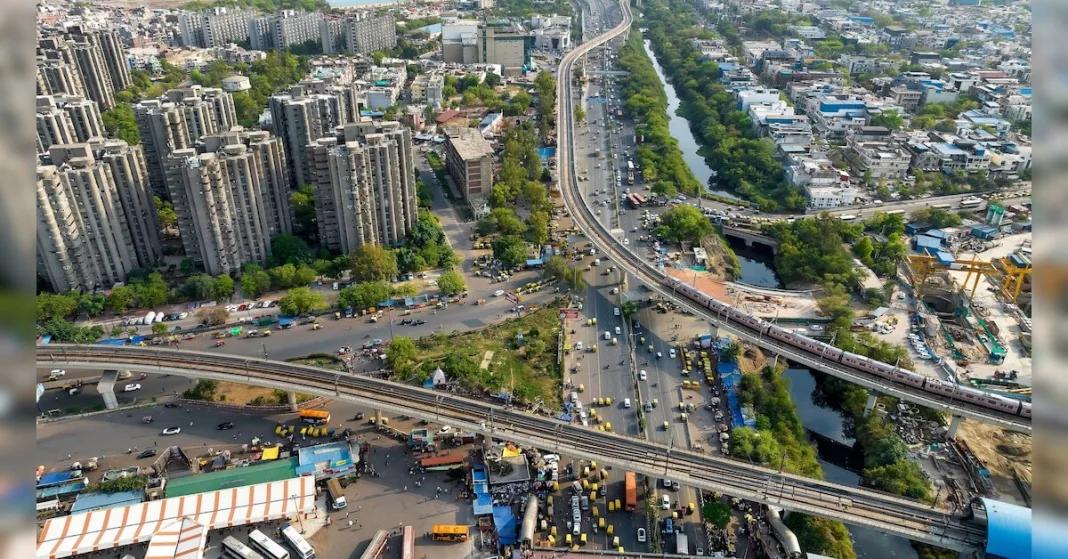

The plan comes as Delhi’s population is projected to reach 32 million by 2047 from the current 23 million, creating demand for nearly four million additional homes. It was approved by Lieutenant Governor Taranjit Singh Sandhu on August 12 and will now be sent to the Ministry of Housing and Urban Affairs for final approval and notification.
More housing through higher-density development
A major focus of MPD-2047 is to increase housing supply, including affordable housing, by allowing higher-density development around major public transport corridors.
One key approach is Transit-Oriented Development (TOD), which encourages denser housing and other development around public transport to make better use of land and improve access to mass transit.
Under MPD-2047, around 207 sq km along Metro, Regional Rapid Transit System (RRTS) and railway corridors has been identified for higher-density development. The TOD influence zone generally covers land within 500 metres of Metro corridors and 500 metres of RRTS and railway stations.
According to PTI, these areas could accommodate around 1.7 million dwelling units over the next 10 years. The plan also allows for the possibility of high-rise residential development within 250 metres on either side of Urban Extension Road II, subject to applicable rules.
The plan also seeks to unlock stalled or underused land through land pooling, under which landowners combine their plots for planned development and receive a share of the developed land in return.
For slum rehabilitation, the DDA proposed a higher floor area ratio (FAR), allowing developers to build more floor space on a given plot. This could make redevelopment within existing slum areas more financially viable while creating additional housing.
Old DDA colonies could get a new lease of life
MPD 2047 also addresses Delhi’s ageing housing stock. A uniform redevelopment framework has been approved for old two-storey DDA housing units built on individual plots.
Many such homes date back more than 50 years and were developed under MPD 1962. Under the new approach, built-up plots can receive redevelopment rights similar to vacant residential plots, subject to applicable norms covering FAR, ground coverage, height, fire safety and structural safety.
This could allow older colonies to accommodate more housing without requiring the city to expand outwards.
Faster building approvals
The plan also seeks to reduce one of the biggest hurdles in urban construction: the number of separate clearances required before a project can begin.
Changes to the Unified Building Bye-Laws 2016 will remove the requirement for prior NOCs from several departments, including the Delhi Pollution Control Committee, Delhi Jal Board, Forest Department and Chief Inspector of Factories for building permits. The objective is to reduce procedural delays and make project approvals faster.
New growth corridors
The DDA approved a change in land use for 19.63 hectares in Narela for a Metro depot linked to the proposed Rithala-Kundli corridor.
The corridor is expected to improve connectivity between north-west Delhi, Rohini and Narela and adjoining areas of Haryana, which could also encourage residential and commercial development along the route.
The plan also allows greater development potential in 70 peripheral villages under the Green Development Area framework, including regulated commercial and institutional activity in areas where development was previously restricted.
Yamuna floodplain gets stricter protection
While the plan opens up new areas for development, it also draws a harder line around environmentally sensitive land.
No concrete structures will be permitted in the core area of the Yamuna floodplain, or O-Zone. In the remaining part, only recreational uses such as parks will be permitted. The move is intended to protect the floodplain from further construction while preserving its ecological role.
The DDA also plans to expand green areas across 174 villages, while a proposed Waste-to-Energy plant in Gazipur is part of the wider effort to improve waste management and reduce pollution.