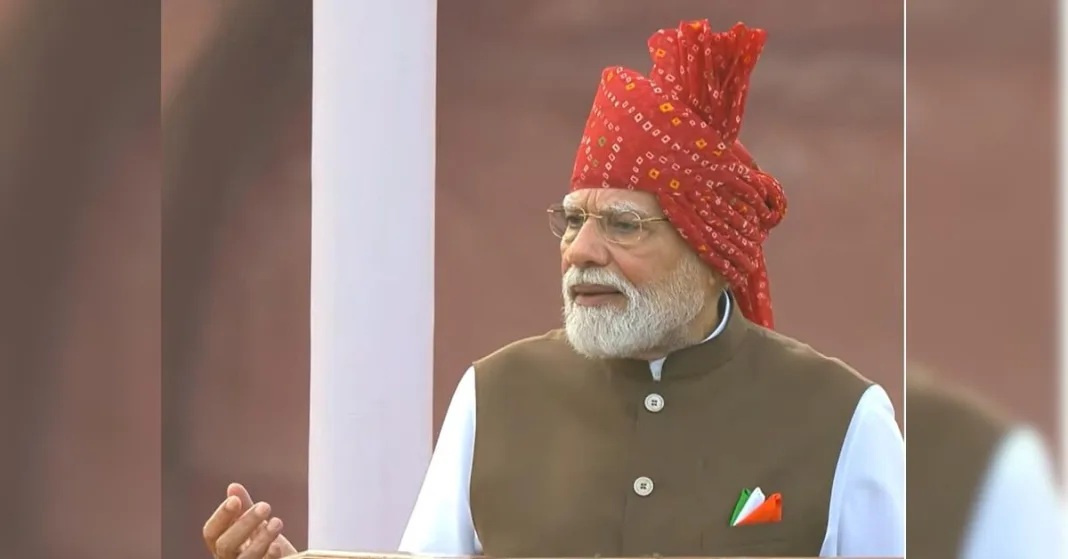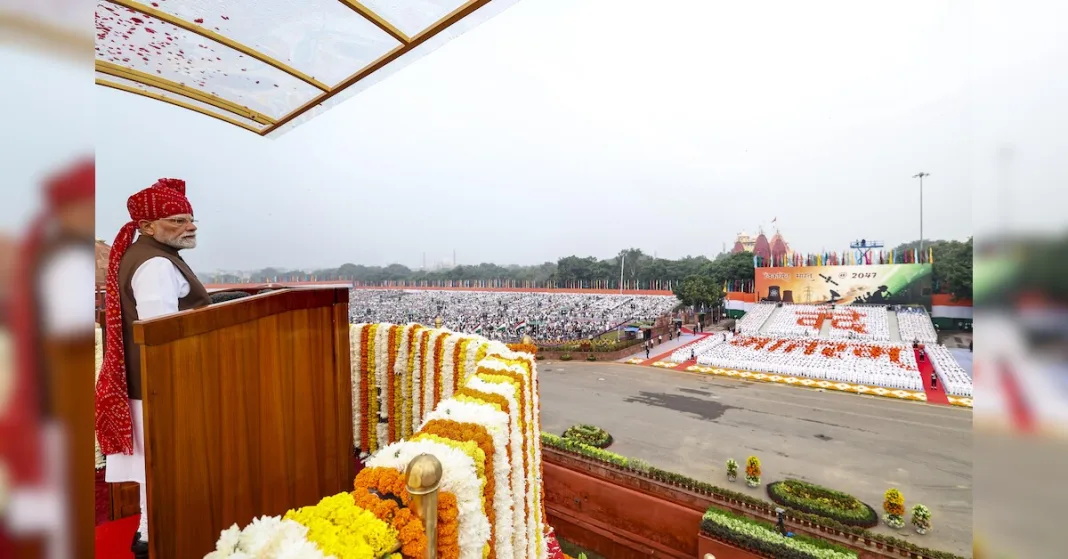

Prime Minister Narendra Modi on Saturday outlined a seven-pillar development framework, or “Sapta Dhara”, to guide India’s journey towards becoming a developed economy by 2047, placing manufacturing, food processing and technology at the heart of the next phase of economic growth.
In his 80th Independence Day address, Modi said India needed a new growth framework to achieve the goal of Viksit Bharat, identifying seven “streams of strength” that would drive the country’s economic transformation.
“The first shakti of the Sapta Dhara is the manufacturing sector. For this, we need to focus on three things—cost, quality, and scale. There should be no compromise with quality. This will be our brand value,” Modi said.
The emphasis on manufacturing comes as India seeks to raise the sector’s share in gross domestic product (GDP) to 25 per cent by 2035 from around 17 per cent currently. The government aims to position India as a key alternative production base in global supply chains. Modi’s focus on cost, quality and scale echoes broader efforts to improve export competitiveness and attract investment into manufacturing.
The second pillar that the Prime Minister identified for Viksit Bharat was agriculture and food processing. Modi urged industry to leverage the market-access opportunities created by India’s expanding network of free trade agreements (FTAs).
“With the new FTAs, we have access to greater global markets now,” he said, advocating a renewed push towards value addition in agriculture and processed food exports.
In the current financial year so far, New Delhi has put into effect two trade deals — FTAs with Oman and the United Kingdom (UK). The next on the cards is India’s agreement with the European Union (EU), likely to be signed by December and made effective in the first half of next year.
The third pillar highlighted by Modi was technology and innovation, with an emphasis on semiconductors, artificial intelligence (AI), digital infrastructure and emerging technologies as key drivers of future growth.
Beyond these three areas, Modi outlined four additional pillars under the Sapta Dhara framework: Gati Shakti, aimed at strengthening infrastructure and logistics; defence power, centred on self-reliance in arms manufacturing; the green and blue economy, focused on sustainable growth and marine resources; and India’s soft power, encompassing its cultural, diplomatic and global influence.
Modi said these seven streams would collectively shape India’s development trajectory as it works towards becoming a developed nation by 2047.
The seven-pronged framework reinforces several themes that have featured prominently in recent government policy initiatives, including infrastructure creation, export-led manufacturing, energy transition, technological self-reliance and defence indigenisation.
The emphasis on food processing and manufacturing is particularly significant as India seeks to expand its share in global trade while creating large-scale employment opportunities.
While the Prime Minister did not announce specific policy measures under the “Sapta Dhara” framework, he said the seven-pillar roadmap would offer a broad blueprint for the government’s economic and development priorities in the coming years.
The “Sapta Dhara” can help India achieve in five to seven years what it could not achieve in the past five to seven decades, Modi said.
“Through the power of Sapta Dhara, we will give the nation new heights, new momentum, and the ability to outdo new goals,” he said.