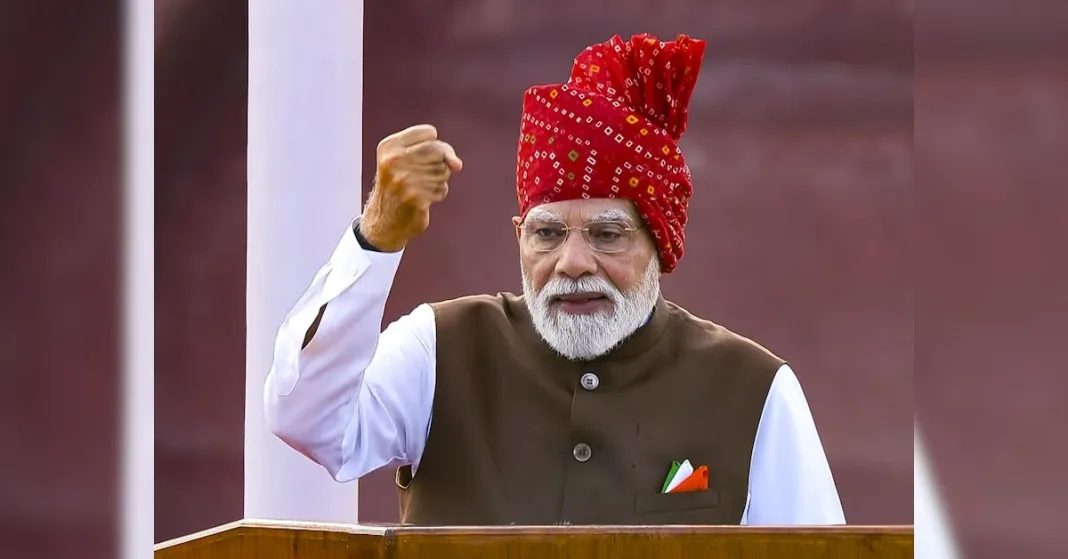

Prime Minister Narendra Modi on Saturday highlighted the government’s focus on two key areas to address future energy- and technology-related challenges — energy security and critical minerals.
Addressing the nation from the ramparts of the Red Fort on Independence Day, Modi said it was difficult to run the modern world without energy.
“Therefore, we will need vast amounts of electricity to power chips, Artificial Intelligence (AI) and data centres. Energy security is the need of the hour. That is why we have already taken a series of strong steps in this direction,” he said.
His comments come at a time when the West Asia war and the resulting energy shock have tested the energy-security strategies of countries such as India, which rely heavily on imported supplies of crude oil, natural gas and liquefied petroleum gas (LPG).
Modi said some people had raised concerns regarding supplies of petrol, diesel and LPG during the West Asia crisis, but the government proved them wrong by ensuring sufficient energy supplies.
The Prime Minister also said technology development depended heavily on critical minerals and that the country was working to secure itself in this area as well.
“We have launched the National Critical Minerals Mission and announced the Critical Mineral Corridor. Agreements are being signed with several countries, and nations around the world are increasingly placing their trust in India when it comes to Critical Minerals,” he said.
The mission was launched by the government in 2025 to achieve self-reliance and secure reliable supply chains for critical minerals, including lithium, nickel, cobalt and rare earth elements, which are vital for clean energy, electric vehicles and high-tech defence manufacturing.
Praising the government’s efforts to boost manufacturing, Modi said that over the past 12 years, modern railway coach production had increased 21-fold, defence production had risen fourfold and electronics manufacturing had increased sevenfold.
Modi also highlighted the pace of railway electrification, saying 70 per cent of the network was electrified in the past 10 years, compared with 30 per cent in the previous 90 years.
“We completed 100 percent electrification in just one decade. Thirty per cent in 90 years and 70 percent in 10 years. This is the pace of work,” he said, adding that electrification had helped save imported diesel and benefited the environment.
The Prime Minister also said India had launched its first hydrogen-powered train, marking its place among global leaders in hydrogen train technology. The train, named “NaMo Green Rail”, was launched on July 17, 2026. It is a 10-car train set that runs on the 89-kilometre Jind-Sonipat section of Northern Railway.
“India has a big dream to build a Viksit Bharat by 2047, powered by the strength and resolve of 140 crore Indians. When the world’s most populous nation sets its sights on becoming a developed country, it reflects our confidence and ambition and compels the world to see India differently,” Modi said.