

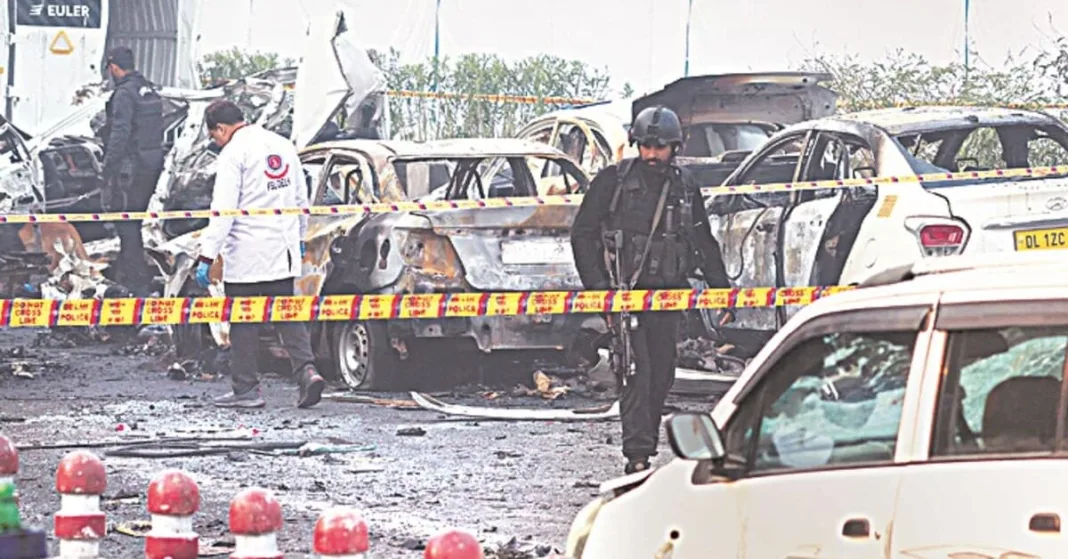

The Red Fort terror attack in New Delhi in November last year has been “officially attributed” to Al-Qaeda in the Indian Subcontinent (AQIS), according to a new report from a UN Security Council body monitoring counter-terrorism sanctions.
A deadly and high-intensity explosion had rocked the Red Fort area in New Delhi, killing about 15 people and injuring many more. The explosion had ripped through a slow-moving car at a traffic signal near the Red Fort metro station.
The report, published on Monday, said that “AQIS continued to evolve from a fragmented group into a regional terrorist entity.
“AQIS established logistics and financial networks, working in decentralised small, scattered cells instead of large units. The attack in November 2025 on the Red Fort in Delhi was officially attributed to AQIS,” the 38th report of the Analytical Support and Sanctions Monitoring Team submitted to the Security Council 1267 Sanctions Committee concerning ISIL and Al-Qaeda said.
The report added that there was some concern about “AQIS trying to exploit Bangladesh to establish cells there.”
The report further said that Al-Qaeda and ISIL (Da’esh) have shown a sustained interest over many years in developing chemical and biological weapons, but so far have failed to overcome the associated technical challenges. Instructions on how to develop such weapons have been shared widely within online terrorist communities.
“For example, in February, ISIL (Da’esh)’s English-language Invade magazine included instructions on how to develop botulinum toxin and cyanide,” it said.
ISIL-K has shown a “particular interest, and over the past 12 months circulated instructions on developing the toxin ricin. At the end of 2025, Indian authorities arrested three people, including a doctor, who had been tasked by an ISIL (Da’esh) cell abroad to develop ricin.”
The report further said that regional tensions in South Asia remained “high” as cross-border attacks between Pakistan and Afghanistan continued.
The Taliban continued publicly to deny harbouring any terrorist groups. Member States expressed concern that the conflict could create opportunities for terrorist groups, generating additional security challenges for the region.
“The terrorist threat emanating from Afghanistan remained largely unchanged. The ability of numerous terrorist groups to operate in Afghanistan constituted an enduring threat to neighbouring countries and the Central Asian region. Despite efforts by the de facto authorities to combat Islamic State in Iraq and the Levant-Khorasan and contain other terrorist groups, the authorities were unable to suppress the terrorist problem,” it said.
The report also pointed out that on December 25 last year, following its annual rahbari shura (leadership council), Tehrik-e Taliban Pakistan (TTP) “announced a revised structure with two new divisions covering: (a) Balochistan and the central region; and (b) Kashmir and the division of Gilgit. The restructuring included a new division described as the TTP Air Force.