

At a glance
- MindTopo is a new benchmark for testing topological reasoning in AI, evaluating whether multimodal models can understand concepts such as connectivity, enclosure, order, separation, and knots.
- The benchmark measures both reasoning and planning, testing not only whether models can recognize topological relationships in static images but also whether they can preserve and manipulate those relationships through a sequence of actions.
- Current multimodal models perform much better on static recognition than interactive tasks, suggesting they struggle to maintain a consistent understanding of topology over time.
- Failures often emerge during planning rather than perception, with models losing track of structural relationships as scenes change or proposing actions that violate physical constraints.
- The findings highlight an important opportunity to advance AI systems for robotics and interactive environments, where understanding what stays connected, enclosed, ordered, or knotted is essential for reliable decision-making.
Can AI determine whether two rooms remain connected after a wall is added? Can it recognize whether an animal is inside a fence, distinguish a true knot from a tangled loop, or rearrange several ropes without allowing them to pass through one another?
These questions concern 3D topology, a form of spatial understanding based not on exact distances, angles, or shapes, but on structural relationships that persist as objects bend, stretch, or deform. Connectivity, enclosure, ordering, and knottedness are examples of topological properties. These properties are a foundational layer of human spatial understanding in Cognitive Science, yet they remain largely absent from how multimodal AI systems are evaluated.
In a new research study, we introduce MindTopo (opens in new tab), a benchmark designed to evaluate whether multimodal large language models possess this kind of topological intuition. Our findings reveal a substantial gap between recognizing topology in a static image and maintaining an innate understanding of that topology while planning and acting. Current models can sometimes identify a connected path, enclosed region, or knot in a single scene, but that understanding often breaks down once the model must manipulate the scene through a sequence of actions.
How MindTopo defines topological space
Most spatial evaluations for multimodal models focus on Euclidean properties such as distance, direction, size, and relative position. Inspired by Piaget and other cognitive literature’s classification of topological ability, MindTopo organizes its tasks around the following five categories:
- Continuity asks whether a path or object remains unbroken.
- Separation asks whether nearby elements form one structure or distinct parts.
- Order tracks how elements are arranged along a path or through a transformation.
- Enclosure tests whether a boundary creates an inside and an outside.
- Knots tests whether ropes are truly knotted or linked rather than merely tangled in appearance.
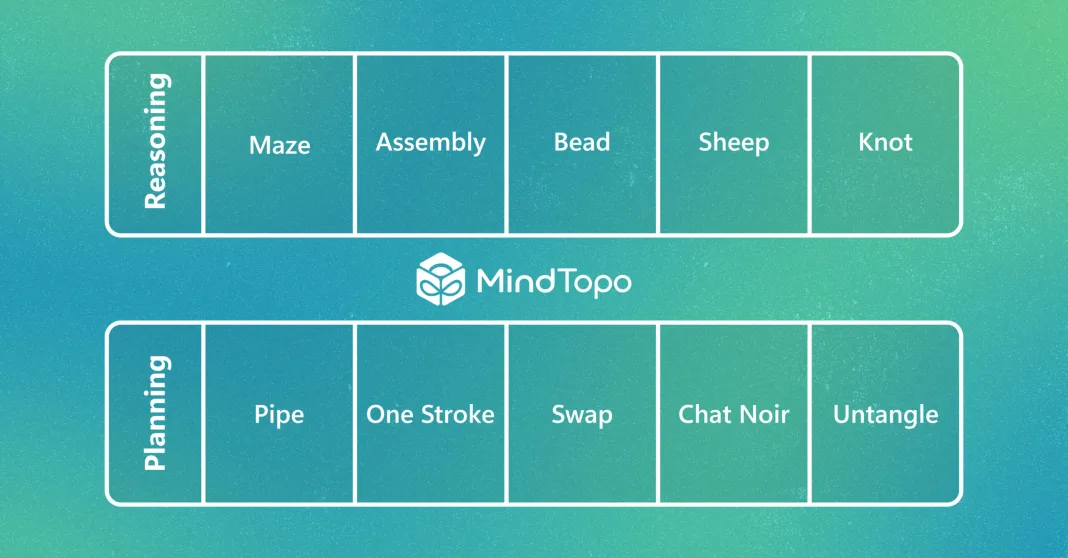
Each category is evaluated at two cognitive levels. In reasoning tasks, a model examines one or more rendered scenes and answers a question about their topological structure: whether two points in a maze are connected, whether the sheep are inside the fence, whether a rope is truly knotted. In planning tasks, the model interacts with a simulated environment and selects actions that must create, preserve, or remove a particular relation, such as rotating pipe segments, drawing a separating path, rearranging blocks, trapping a moving agent, or untangling ropes. The environments enforce legal actions, so a model cannot solve a rope puzzle by passing one strand through another.

All scenes are generated from controlled simulators, which provide exact ground truth and adjustable difficulty. That control makes it possible to separate two failure modes that otherwise look alike: a model that fails because a scene is visually complex, and a model that fails because it cannot maintain the underlying relationship as objects move.

Seeing topology is not the same as acting on it
Across a broad set of proprietary and open-weight models, performance was consistently stronger on static reasoning than on interactive planning, and both remained well below human performance. The contrast was especially clear when success depended on preserving a relationship across many actions.
The error patterns help locate the problem. Static mistakes usually began with perception, such as missing a wall, opening, or crossing. Planning mistakes appeared after the scene had been understood. Models followed a locally plausible move without tracking its later consequences, lost the task over multiple turns, or proposed an action that violated the environment’s dynamics.
Spotlight: Microsoft research newsletter
Microsoft Research Newsletter
We also tested whether image and video generation could help models maintain an understanding of topological relationships. Image generation sometimes helped when the relevant relation was visible in a single frame, but it remained unreliable across a sequence of crossings or moves. Video rollouts frequently altered topology or violated task dynamics. Visual simulation appeared useful only to the extent that it preserved structural constraints over time.
Building agents that preserve structure
MindTopo is intended as a controlled diagnostic for this gap. Robots, accessibility tools, and interactive assistants must understand not only where objects are, but also what remains connected, enclosed, ordered, or knotted as actions unfold. Closing that gap may require models that carry an explicit topological state, or world models whose predictions preserve topology by construction.