
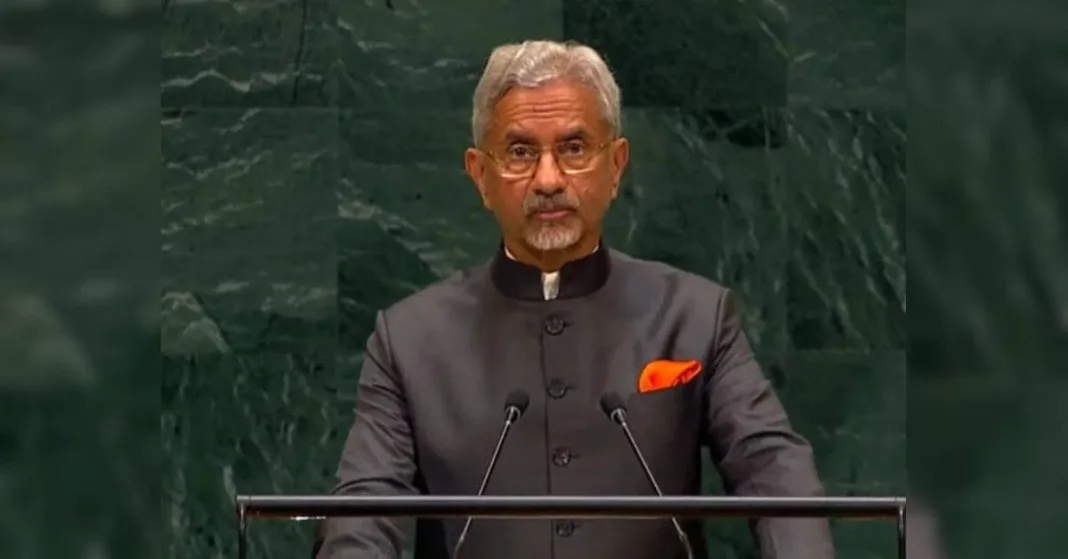

External Affairs Minister S Jaishankar on Saturday said India would not dilute its zero-tolerance policy towards terrorism and would exercise its right to defend itself against such threats.
Addressing the United Nations General Assembly (UNGA), Jaishankar said, “A serial practitioner of terrorism has misrepresented facts before this Assembly, seeking to normalise terrorism and claim immunity from its consequences. That will not stand.”
“We will exercise our right to defend ourselves against terrorism. Friendship and goodwill cannot coexist with terrorism. Understandings based on them will naturally be called into question. It is for the perpetrator of terrorism to change its ways,” he said.
Jaishankar said terrorism continues to pose a threat to peace and security. “Terrorism remains a persistent threat to peace. When a state sponsors it to carry out attacks across borders, it becomes a direct affront to the global order,” he said.
“Governments that engage in cross-border terrorism must be called out,” Jaishankar said.
He added that India would maintain its existing approach towards terrorism.
“There must be no dilution in our zero-tolerance approach towards terrorism,” he said.
Commercial shipping, seafarers
Jaishankar also spoke about the impact of conflicts on commercial shipping and the safety of seafarers.
“This year, we are witnessing conflict in the Gulf. Attacks on commercial shipping are simply unacceptable. All sides must exercise restraint and ensure the safety of civilians and seafarers,” he said.
“Targeting of commercial shipping and seafarers transiting international waterways is unacceptable,” Jaishankar said.
Calling for an end to prolonged conflicts, he said, “As Prime Minister Narendra Modi stated, endless war must give way now to an end to war.”
“Peace is not just the absence of war. If the world is subjected to continuous threats and pressures, then we are really living on the edge of an abyss. All it takes is one more step to push us over. Therefore, it is imperative to strengthen stability, security, and predictability. These are crucial elements of the enabling environment for peace,” Jaishankar said.
Global South faces multiple pressures
Jaishankar also spoke about the challenges facing the Global South, including pressure on food, fuel, fertiliser and finance.
“Nations are increasingly focused on reducing risks and diversifying their sources of supply. These steps may protect their individual interests, but the wider atmosphere is no longer one of trust and goodwill. The Global South faces a particularly acute challenge: a crisis involving four essentials: food, fuel, fertiliser and finance,” he said.
He also raised concerns over food security, development goals and access to markets.
“The combined impact of a super El Nino, fertiliser shortages and barriers to the movement of grain is cause for alarm. Progress towards the Sustainable Development Goals is under growing pressure. The Global South’s right to industrialise is being undermined by non-market practices and restricted access to markets,” Jaishankar said.
On artificial intelligence, he said technology was increasingly creating concerns over its misuse.
India responded to Pakistan at UNGA
India exercised its Right of Reply on Friday night after Pakistan Prime Minister Shehbaz Sharif addressed the UNGA. Sharif credited US President Donald Trump for his “timely intervention” in the 2025 conflict with India and again raised the Kashmir issue during his address.
Responding on behalf of India, First Secretary in India’s Permanent Mission to the UN Petal Gahlot questioned Pakistan’s statements on democratic rights and human values.
“We heard some hypocritical homilies about democratic rights and human values from a regime whose capital at this very moment is being fortified against its own people,” Gahlot said.
“And that is happening because this is a regime of the army, by the army, and for the army. Their puppets may come and go but let us have no illusion who calls the shots. The reality of Pakistan is expressed in its 27th Amendment and the lifelong immunity granted to its real ruler,” she said.
Gahlot was referring to Pakistan’s 27th Constitutional Amendment, passed in November last year, which grants Field Marshal Asim Munir lifelong immunity from legal prosecution in his roles as Chief of Defence Forces and Chief of Army Staff.