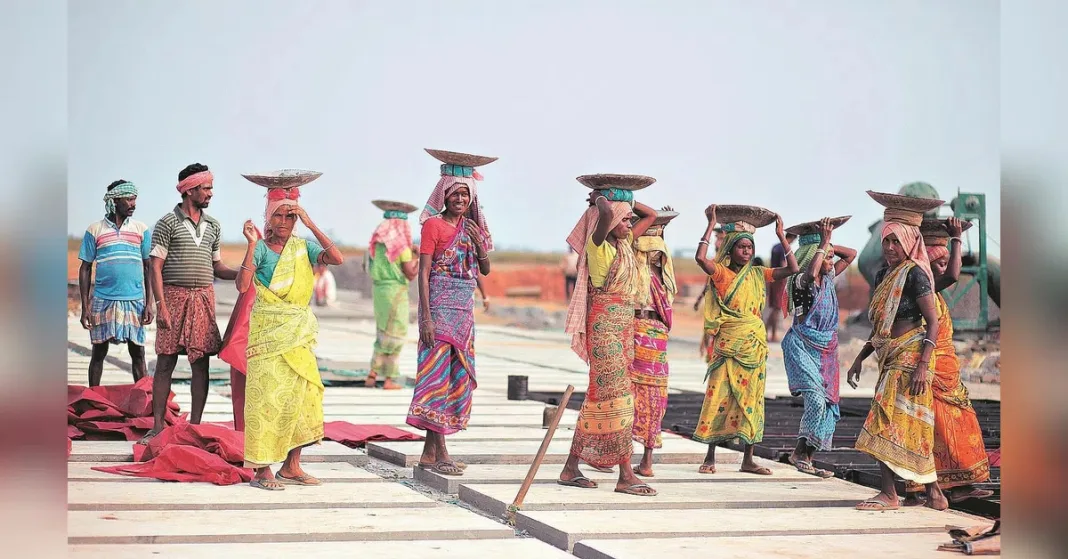

Employment generated under the government’s new rural job guarantee programme fell by nearly half in July, its first month of operation.
According to data on the government’s rural employment dashboard, the Viksit Bharat–Guarantee for Rozgar and Ajeevika Mission (Gramin), or VB-G RAM G, generated 77.6 million person-days in July 2026. In comparison, 153.3 million person-days were generated under MGNREGA in July 2025. This represents a year-on-year decline of 49.3 per cent.
A person-day refers to the amount of work done by one person in one working day.
Number of households seeking work also falls
Women accounted for about 62.13 per cent of the total person-days generated under the new programme so far. This is well above the one-third participation requirement for women under the rural employment guarantee law.
According to government officials, the fall in employment generation is due to the “Agriculture Pause Period” provided under VB-G RAM G. The new programme allows a pause in employment activities during certain periods when agricultural work is at its peak. Officials said this affected the number of person-days generated in July.
What changed under VB-G RAM G?
VB-G RAM G replaced the nearly two-decade-old MGNREGA framework from July 1, 2026.
The new law provides a higher annual employment guarantee for rural households. Under the VB-G RAM G Act, every rural household whose adult members volunteer to undertake unskilled manual work is entitled to up to 125 days of guaranteed wage employment in a financial year.
This is higher than the 100 days of employment guaranteed under MGNREGA.
The programme also requires employment to be provided within the specified timeframe. If the government fails to provide work within that period, eligible workers can claim unemployment allowance under the provisions of the Act.
The government has said that wages under VB-G RAM G will continue to be paid directly into workers’ bank or post office accounts through the Direct Benefit Transfer (DBT) system.
The law provides for wage payments on a weekly basis or within 15 days of the closure of the muster roll. If payments are delayed beyond the prescribed period, workers will be eligible for compensation for the delay.
The Centre has allocated ₹95,692.31 crore for the rural employment programme for 2026-27. The government has described this as the highest-ever Budget Estimate allocation for a rural employment programme.