

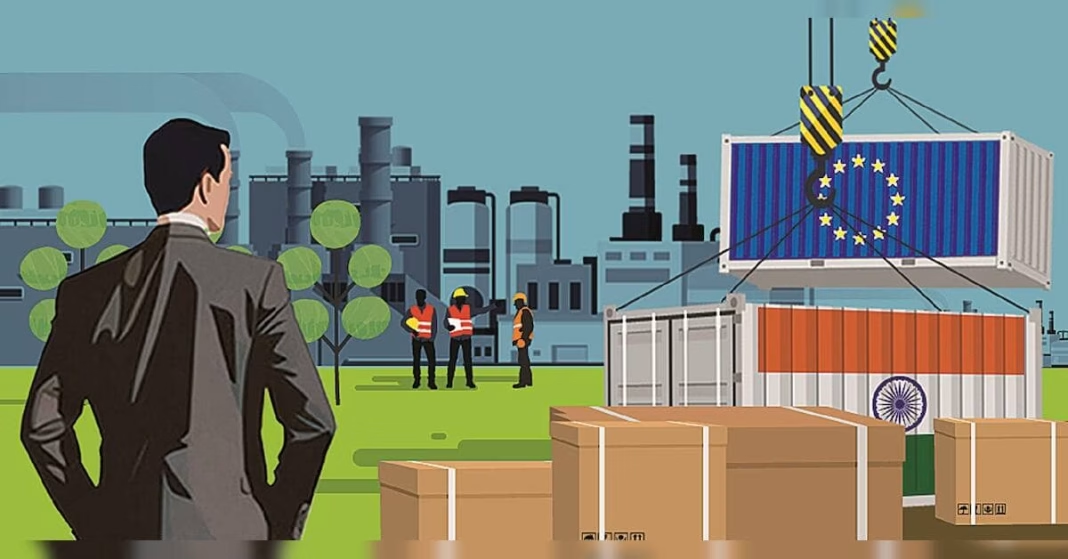

A growing web of EU rules on sustainability, traceability and human rights will require exporters to gather more data from suppliers and document how their goods are made. The cost of doing so could squeeze margins across industries. For smaller Indian factories, it could determine whether they can afford to sell in Europe at all.
We examine eight important EU regulations that will affect India’s exports.
The Deforestation Regulation: It aims to slow global forest loss and protect wildlife by restricting imports of cocoa, coffee, palm oil, rubber, soya, and wood, as well as products like furniture, chocolate, and tyres. These goods can enter the EU only if produced on land not deforested after December 31, 2020. The rules apply from December 30, 2026 for larger firms and June 30, 2027 for small businesses. Compliance is costly. Indian exporters must map farm boundaries, provide GPS coordinates for online declarations through the EU’s TRACES (Trade Control and Expert System), keep verified crops separate, and show that suppliers follow local land and labour laws. Farmers without formal land titles can forget exporting to the EU.
The Carbon Border Adjustment Mechanism (CBAM): It is designed to stop European factories from moving to countries with weaker climate laws by charging a carbon fee on imports equal to what EU producers pay. CBAM currently covers iron and steel, aluminium, cement, fertilisers, electricity, hydrogen, and some related goods, and this list will gradually expand to cover all industrial goods over the next few years.
Emissions reporting started in October 2023, and carbon payment rules began on January 1, 2026. Indian exporters share verified emissions data with their EU buyers, who will submit carbon certificates by the first annual deadline of September 30, 2027. While large Indian steel and aluminium suppliers are tracking and sharing plant emission data, smaller businesses that cannot track emissions risk being hit with higher carbon taxes. Once CBAM is fully phased in within a few years, most Indian industrial products will pay an average carbon tax of 20-35 per cent of the value of the goods.
The EU Green Claims Rules: They took effect on September 27, 2026, to curb misleading marketing and protect businesses that can back up their environmental claims. The rules cover consumer goods and services, including claims on packaging and in online marketing. Vague terms such as “eco-friendly” or “sustainable” need recognised backing, sustainability labels must be independently verified, and “carbon neutral” claims based solely on offsets are banned. EU buyers may ask Indian brands and suppliers to review labels, remove unverified logos, and get certification or provide data on a product’s environmental impact over its lifetime.
The Digital Product Passport: This aims to track material origins and verify eco-claims. Covered goods will need an EU-registered product ID and a scannable label linking to data on materials, carbon footprint, lifespan, repair, and recycling, with all this data uploaded to EU servers before export. Passports become mandatory for electric vehicle and industrial batteries from February 18, 2027. The EU plans to adopt rules for iron and steel in late 2026, clothing, textiles, aluminium, and tyres in 2027, furniture in 2028, and mattresses in 2029, with electronics also a priority. Compliance becomes mandatory 18 months after rules are published, meaning Indian clothing suppliers could need passports by 2029.
The EU Forced Labour Regulation: Set to take effect on December 14, 2027, it bans all goods made with exploited workers to stop unfair price competition. EU buyers may ask Indian firms to check their supply chains, including imports. If investigated, companies must prove within 30 working days that forced labour risks were prevented across every stage, or face sales bans, recalls, and the destruction of goods.
Extended Producer Responsibility: It shifts waste-management costs from taxpayers to manufacturers to encourage recycling and eco-design. It covers electronics, single-use plastics, batteries, packaging, and clothing and footwear. Mandatory rules began for batteries in August 2025 and packaging in August 2026, while the date for textiles is April 2028. Companies must register in EU countries’ national databases, report product and packaging weights, and pay waste-management fees with higher penalties for hard-to-recycle items. Indian brands selling directly to EU consumers must hire local representatives and register in individual EU member states.
The Corporate Sustainability Reporting Directive: It sets common environmental, social, and governance reporting rules to curb misleading claims and help investors assess sustainability. Reporting for qualifying non-EU parent companies will begin in 2029. Although EU rules limit data requests to suppliers with 1,000 employees, European buyers may still ask Indian textile, farm, electronics, and manufacturing suppliers for data on greenhouse gas emissions, energy and water use, and working conditions.
Corporate Sustainability Due Diligence Directive: It holds large companies accountable for human rights abuses and environmental harm across their global operations, with enforcement starting July 2029. It applies across industries to EU firms with more than 5,000 employees and over €1.5 billion in global turnover, as well as non-EU firms with over €1.5 billion in EU turnover. Companies must check for risks, handle complaints, review progress every five years, and report annually, with fines reaching up to 3 per cent of global turnover. Indian suppliers can expect audits and requests from large European buyers on worker safety and environmental practices. Buyers may suspend orders if gaps persist.
By positioning themselves as “compliance-ready, low-risk preferred partners” for major European buyers, mid-size and large Indian exporters can capture higher-value buyer contracts, and convert regulatory compliance into a sustained competitive advantage across the European single market.
But the compliance costs will hit the small Indian exporters hard. To help them, the Indian government, export councils, manufacturing associations, and exporters must work together.
For the most unreasonable requirements, New Delhi could even consider countermeasures targeting European imports.
The writer is the founder of Global Trade Research Initiative